25 Video Content Ideas for Creators to Try in 2026
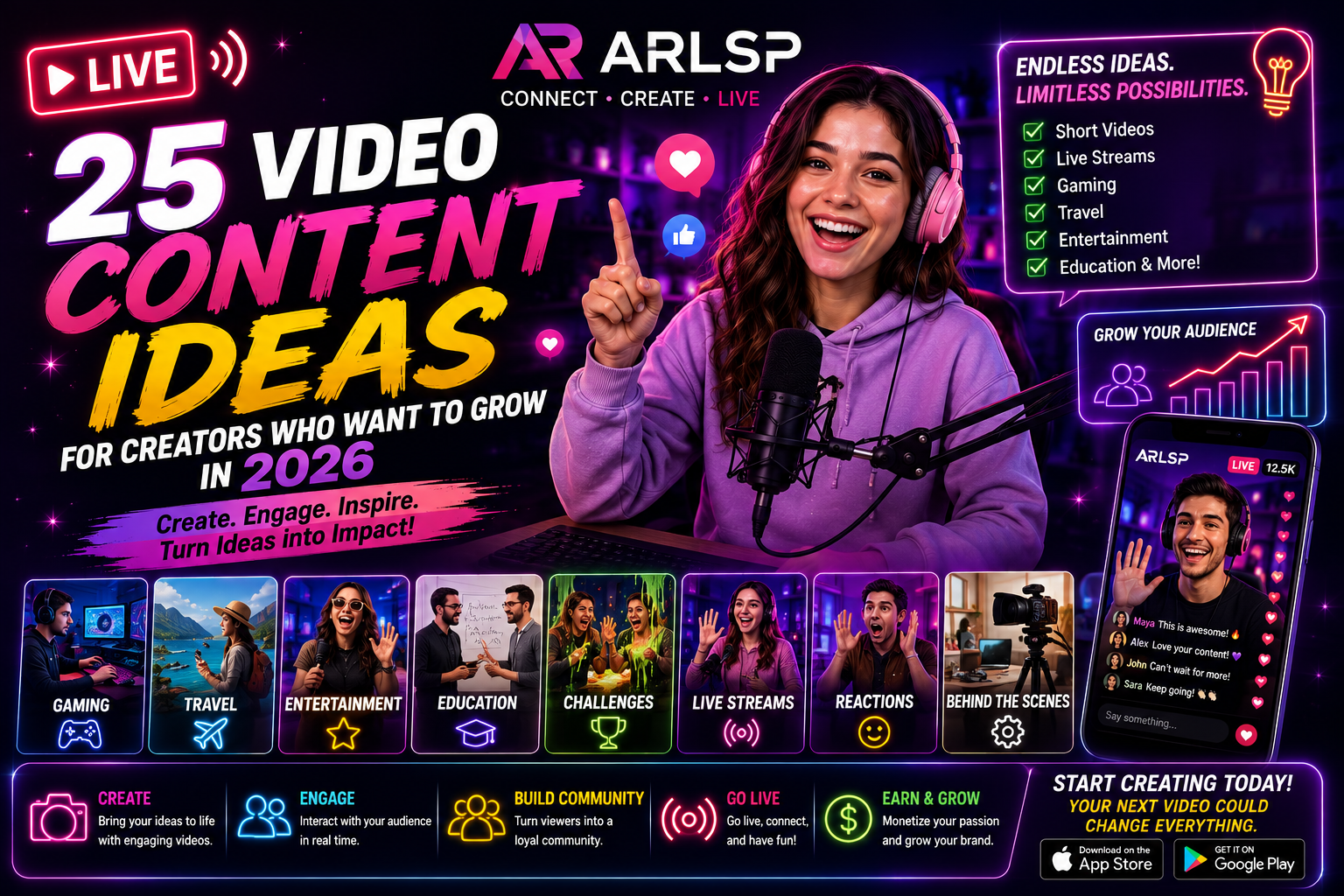
25 Video Content Ideas for Creators Who Want to Grow in 2026
Introduction
Coming up with a good video idea can sometimes be harder than creating the video itself.
You may have the equipment.
You may have the platform.
You may even have an audience.
But eventually, every creator reaches the same question:
"What should I create next?"
That is why having a collection of reliable video content ideas matters.
You don't need every video to be completely original.
You need formats that give you room to add your own personality, experience, humor, knowledge, and creativity.
In 2026, creators have more ways than ever to produce video content.
You can create short videos, livestreams, gaming content, travel videos, community discussions, challenges, educational content, reactions, interviews, and interactive experiences.
The smartest approach is not to choose only one.
Instead, build a content system where different video formats support each other.
Why Video Content Still Matters for Creators
Video gives creators something that many other formats struggle to reproduce.
It combines:
Visuals + Voice + Personality + Story + Emotion
A creator can explain something.
Demonstrate something.
React to something.
Take viewers somewhere.
Play a game.
Tell a story.
Or simply have a conversation.
This flexibility makes video suitable for almost every type of creator.
1. "A Day in My Life" Video
People are naturally curious about how other people live and work.
A creator can show:
Morning routine
Work routine
Travel day
Gaming setup
Content creation process
Behind-the-scenes activities
The key isn't simply documenting everything.
Choose the interesting parts.
2. Behind-the-Scenes Content
Show viewers what normally happens before the final content appears online.
For example:
Camera setup
→
Lighting
→
Preparation
→
Recording
→
Final result
This type of content can make audiences feel closer to the creator.
It also works particularly well for creators who want to show their personality rather than only their finished work.
3. "How I Do It" Videos
Teach your audience something you already know.
It could be:
Gaming techniques
Editing
Photography
Cooking
Travel planning
Fitness routines
Creative skills
Technology
Study techniques
You don't have to be the world's leading expert.
You simply need to provide useful information from your own experience.
4. Challenge Videos
Challenges naturally create a beginning, middle, and outcome.
For example:
Can I complete this game challenge?
Can I visit three locations in one day?
Can I learn this skill in 24 hours?
Can my audience choose every decision?
The audience wants to know what happens.
That creates natural curiosity.
5. Audience-Controlled Videos
Let your viewers influence the content.
Ask them to choose:
The topic
The game
The destination
The challenge
The question
The next activity
This transforms content from something you create for your audience into something you create with your audience.
6. Gaming Videos
Gaming remains one of the most flexible categories for video creators.
You don't have to upload ordinary gameplay every time.
Try:
Challenges
Strategy videos
Funny moments
Game reviews
Reactions
Tutorials
Competitions
Multiplayer sessions
Community challenges
Live gameplay
Gaming becomes more interesting when there is a clear idea behind the video.
7. Travel Exploration Videos
Travel content doesn't require luxury destinations.
You can explore:
Local neighborhoods
Markets
Restaurants
Cultural locations
Hidden places
Tourist attractions
Events
Streets
Nature
The creator's perspective can be as important as the destination.
8. "Things You Didn't Know" Videos
Curiosity is powerful.
Create videos around surprising facts, unusual information, hidden details, or interesting stories related to your niche.
For example:
Things you didn't know about this game
Things tourists don't know about this city
Things new creators get wrong
The format works across many categories.
9. Reaction Videos
Reaction content allows you to add your perspective to something interesting.
You might react to:
Gaming moments
Trends
Newsworthy entertainment
Creator moments
Community submissions
Interesting events
The creator's commentary should provide the value rather than simply replaying someone else's material.
Always respect copyright and applicable platform rules when using third-party content.
10. Storytelling Videos
You don't always need a complicated production.
Sometimes a good story is enough.
Tell your audience about:
An unexpected experience
A travel story
A funny mistake
A lesson you learned
A difficult challenge
An interesting encounter
Your creator journey
Stories help audiences understand the person behind the account.
11. "This or That" Videos
Create two choices.
Ask your audience to choose.
Examples:
Gaming setup A or B?
Beach or mountains?
Game A or Game B?
Morning stream or night stream?
This simple format can encourage comments and interaction.
12. Comparison Videos
Comparison content gives viewers a clear reason to watch.
You can compare:
Products
Games
Destinations
Apps
Experiences
Strategies
Creator tools
The most useful comparisons don't simply declare a winner.
Explain why one option might be better for a particular type of person.
13. Beginner Guide Videos
If you have experience in something, create a beginner-friendly explanation.
Examples:
How to start gaming content
How to prepare for your first livestream
How to create better travel videos
How to talk confidently on camera
These videos can attract people searching for solutions.
14. FAQ Videos
Look at the questions people repeatedly ask you.
Turn those questions into videos.
One question can become one piece of content.
For example:
"How do I start livestreaming?"
becomes:
"How to Start Your First Livestream: Beginner Guide."
This is one of the easiest ways to create useful content without constantly inventing new subjects.
15. Live Q&A Content
Livestreaming can turn ordinary questions into real-time conversations.
Tell your audience:
"Join me live and ask anything about X."
Then answer questions while interacting with viewers.
Afterward, interesting answers can potentially become shorter videos.
16. Live Competition Videos
Competition creates a natural storyline.
Two creators.
One challenge.
One audience.
One outcome.
ARLSP's Live Battle feature provides a creator-versus-creator format that can fit naturally into this type of content.
The competition itself becomes the video idea.
The audience can follow the interaction and experience the event in real time.
17. Funny Moments
Not every video needs to educate.
Entertainment is a legitimate reason to watch.
Funny moments can come from:
Gaming
Travel
Creator collaborations
Live streams
Challenges
Audience interactions
Unexpected situations
The best funny content often comes naturally rather than being forced.
18. "Try It With Me" Videos
Invite viewers into an experience.
For example:
Try this challenge with me.
Explore this place with me.
Test this game with me.
Let's learn this together.
The language makes the audience feel included.
19. Community Videos
Your audience itself can become a source of content.
You can feature:
Viewer questions
Community stories
Viewer challenges
Fan submissions
Community achievements
Audience opinions
This can strengthen the relationship between creator and audience.
People become more invested when they have opportunities to participate.
20. Creator Collaboration Videos
Two creators can combine audiences and ideas.
Possible formats include:
Interviews
Challenges
Gaming
Travel
Reactions
Discussions
Competitions
Live Battles
The important thing is to create a reason for the collaboration.
Don't collaborate simply because two creators are available.
Build an actual concept.
21. "Before and After" Videos
Transformation creates curiosity.
It could be:
Before → After
for:
A room
A gaming setup
A video
A skill
A travel experience
A creative project
A creator profile
Viewers naturally want to see the final result.
22. Trend-Based Videos
Trends can create discovery opportunities.
But don't copy a trend blindly.
Instead, connect it to your niche.
For example:
Gaming creator + current trend
Travel creator + current trend
Comedy creator + current trend
Live creator + current trend
This allows you to participate in broader conversations while maintaining your identity.
23. "What Would You Do?" Videos
Present a situation.
Then ask the audience what they would do.
This works particularly well for:
Travel
Gaming
Social situations
Entertainment
Challenges
Storytelling
The question creates an easy reason to comment.
24. Turn Your Livestream Into Video Content
A livestream shouldn't necessarily disappear after it ends.
Look for:
Funny moments
Surprising moments
Strong opinions
Interesting conversations
Competition highlights
Viewer interactions
Unexpected events
Then turn those moments into shorter pieces of content.
This creates a powerful relationship between live and recorded video.
25. "Join Me Live" Videos
Sometimes the video itself can promote your livestream.
Create a short piece of content around what you're going to do live.
For example:
"Tonight we're letting viewers choose our challenges."
or:
"Tonight I'm going live with another creator for a Live Battle."
The short video becomes the invitation.
The livestream becomes the main event.
The Best Content Strategy Isn't One Format
Creators often ask:
"Should I make short videos or livestream?"
There doesn't have to be a single answer.
A stronger content ecosystem can combine multiple formats.
For example:
Short Video
↓
Discovery
↓
Creator Profile
↓
Interest
↓
Livestream
↓
Interaction
↓
Community
↓
Return
This creates a complete journey.
Short Video Can Attract Attention
Short-form video is useful for discovery.
Someone may see a 20-second clip without knowing who you are.
If they enjoy it, they may investigate further.
That's your opportunity.
Livestreaming Can Deepen the Relationship
A livestream provides something short-form content usually cannot:
real-time interaction.
You can talk to people.
Answer questions.
React.
Compete.
Play games.
Tell stories.
And build a community.
Community Can Create Retention
The ultimate goal isn't to make someone watch one video.
You want them to think:
"I'll come back."
That is when content starts becoming a relationship rather than a one-time interaction.
Build a Video Content System
Instead of creating random videos, organize your content into categories.
Discovery Content
Short videos designed to reach new people.
Authority Content
Educational or informative videos.
Entertainment Content
Fun, challenges, reactions, and stories.
Community Content
Audience-focused videos.
Live Content
Real-time interaction and livestreams.
Conversion Content
Content that encourages viewers to follow, join, participate, or explore your creator profile.
This gives every piece of content a purpose.
The 70/20/10 Experiment
Creators can experiment with a simple distribution:
70% — Core Content
The content your audience already understands and enjoys.
20% — Related Content
Topics connected to your niche.
10% — Experiments
New formats, trends, and unusual ideas.
This isn't a universal rule.
It's simply a useful framework for balancing consistency with experimentation.
How ARLSP Fits Into a Video Creator Strategy
ARLSP can be part of a broader creator journey built around live video and social interaction.
A creator can use different types of content to attract and engage audiences, including:
Video Content
↓
Live Streaming
↓
Audience Interaction
↓
Community
The platform's creator ecosystem includes features such as live streaming, Live Battles, virtual gifts, creator coins, messaging, notifications, communities, and live shopping.
That means creators can think beyond simply uploading a video.
They can build an interactive experience around their content.
Video Can Lead Into Live Streaming
Imagine a creator publishes a short gaming clip.
Someone discovers it.
They visit the creator's profile.
The creator has a livestream scheduled.
The viewer joins.
During the stream, they interact.
Eventually, they become a regular viewer.
The journey becomes:
Video → Discovery → Live → Interaction → Community
This is much more powerful than treating every video as an isolated post.
Video Content and Creator Monetization
Creators can eventually explore different monetization opportunities depending on their platform, audience, eligibility, and content.
These may include:
Virtual gifts
Live commerce
Sponsorships
Affiliate opportunities
Premium content
Creator programs
Brand collaborations
On ARLSP, virtual gifts and coin-based interactions form part of the platform's creator ecosystem.
But monetization should support the content experience rather than replace it.
Create value first. Monetize the relationship responsibly afterward.
What Should You Post When You Have No Ideas?
Go back to your audience.
Ask them.
Use questions such as:
"What should I make next?"
"Which topic do you want me to cover?"
"Which game should we play?"
"Where should I travel next?"
"What should I test?"
Your audience can become your content research team.
A Simple Weekly Video Plan
You could structure a week like this:
Monday
Short discovery video.
Tuesday
Educational or useful video.
Wednesday
Community-focused content.
Thursday
Short entertaining video.
Friday
Livestream.
Saturday
Livestream highlight.
Sunday
Audience question or discussion.
The exact schedule doesn't matter.
The important thing is having a repeatable system.
Measure More Than Views
Views are useful.
But they aren't the entire picture.
Also consider:
Watch time
Completion rate
Comments
Shares
Follows
Returning viewers
Live participation
Community activity
A video with fewer views but significantly stronger engagement can sometimes be more valuable than a large but passive audience.
Don't Be Afraid to Repeat Successful Formats
Creators sometimes think every video needs to be completely different.
It doesn't.
If one format works, make another version.
For example:
Challenge #1
works well.
Create:
Challenge #2
Then:
Challenge #3
The topic changes.
The successful structure remains.
This is how creators turn individual successes into repeatable content systems.
The Video Content Flywheel
A strong creator strategy can eventually look like this:
Create
↓
Publish
↓
Discover What Works
↓
Go Live
↓
Interact
↓
Find Memorable Moments
↓
Create More Videos
↓
Reach New Viewers
↓
Build Community
↓
Repeat
The objective isn't endless content.
It is a sustainable content loop.
Final Thoughts
There is no single perfect video content idea.
The best idea depends on:
Your personality
Your niche
Your audience
Your platform
Your strengths
Your goals
A gamer may thrive on challenges.
A traveler may thrive on exploration.
An entertainer may thrive on audience interaction.
An educator may thrive on tutorials.
A social creator may thrive on conversations.
The important thing is to stop thinking:
"I need a viral video."
Start thinking:
"I need a repeatable content format that my audience enjoys."
Once you find that format, you can experiment with it, improve it, turn livestream moments into shorter videos, bring new viewers into your live sessions, and gradually build a stronger creator community.
And that's where platforms such as ARLSP can become interesting for creators: not simply as a place to broadcast, but as an environment where video, live streaming, interaction, community, entertainment, and creator monetization can connect.
Your next video doesn't need to be perfect.
It needs to give someone a reason to watch, interact, and come back.