Best Monetization Methods for Small Creators
Best Monetization Methods for Small Creators
Introduction
One of the biggest misconceptions in the creator economy is that you need a huge following before you can make money.
You don't.
A creator with 100,000 followers may have a large audience but relatively little engagement. Meanwhile, a creator with 2,000 highly relevant followers can have a community that watches regularly, trusts their recommendations, participates in livestreams, buys products, and supports their work.
The difference isn't always audience size.
It's audience relationship.
For small creators, monetization is often less about maximizing reach and more about turning existing attention into meaningful interactions and multiple revenue streams.
That can include:
Live streaming
Virtual gifts
Premium content
Paid livestreams
Affiliate marketing
Sponsorships
Digital products
Physical products
Live shopping
Memberships
Coaching or consulting
Creator communities
The most sustainable approach is usually not choosing one method.
It is building a creator monetization system where several income streams support each other.
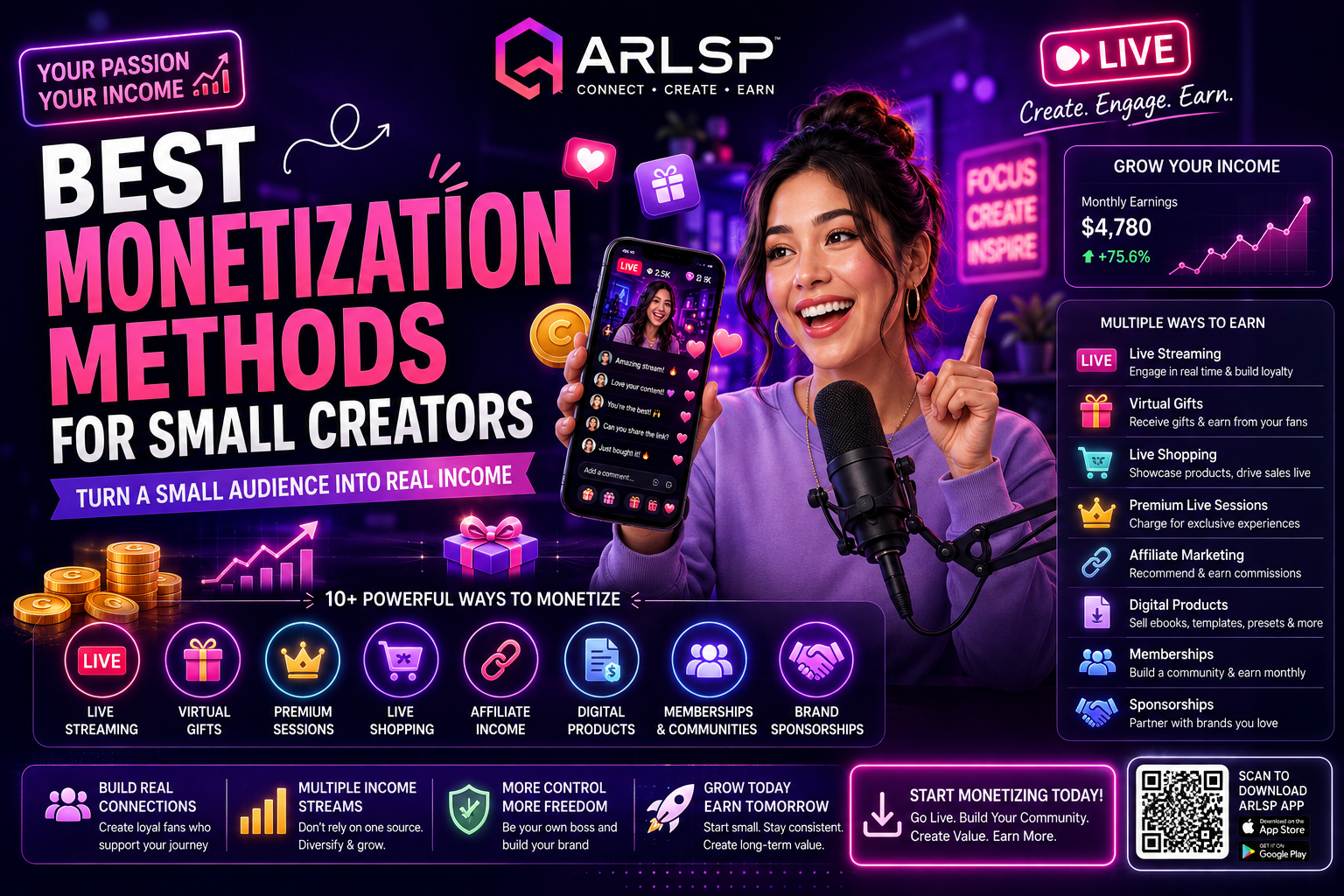
This guide explores the best monetization methods for small creators in 2026 and explains how platforms such as ARLSP can fit into that strategy.
Can Small Creators Really Make Money?
Yes—but expectations matter.
A small creator shouldn't approach monetization with the assumption:
"I have 500 followers, so I should immediately make thousands of dollars."
Instead, think about the value of your audience.
A small audience can be commercially valuable when it is:
Relevant
Engaged
Trusting
Active
Interested in a specific niche
Willing to interact
Willing to purchase appropriate products or experiences
For example, a creator with 1,500 followers focused exclusively on professional photography may have a more commercially relevant audience for camera equipment than a general entertainment account with 20,000 passive followers.
This is why audience quality can matter more than follower count.
The Creator Monetization Funnel
Before choosing monetization methods, understand the journey.
A useful creator funnel is:
Discovery → Follow → Engagement → Community → Trust → Monetization → Retention
A viewer may initially discover a creator through a short video.
Then they follow.
Eventually they watch a livestream.
Then they participate in the chat.
Later they send a virtual gift.
Eventually they may purchase a product or premium experience.
The goal isn't to monetize a stranger immediately.
The goal is to gradually turn attention into trust and participation.
1. Live Streaming
Best for:
Creators who are comfortable communicating in real time.
Live streaming is one of the strongest monetization opportunities for smaller creators because it allows creators to build relationships rather than simply publish content.
A livestream can include:
Q&A sessions
Tutorials
Gaming
Entertainment
Music
Product demonstrations
Interviews
Coaching
Community events
Behind-the-scenes content
The important advantage is interaction.
A small creator may not compete with major influencers on reach, but they can compete on accessibility and community connection.
A viewer may never get a response from a celebrity creator.
A small creator can potentially respond to every question.
That creates value.
2. Virtual Gifts
Virtual gifting is another monetization model particularly suited to livestreaming.
Viewers can use supported platform currencies or virtual items to show appreciation for creators during live experiences.
The model can look like:
Viewer → Virtual Gift → Creator → Eligible Platform Earnings
Virtual gifts can be especially effective when the creator has a highly engaged community.
The key is that gifting should be connected to genuine audience interaction rather than constant pressure to spend.
3. Premium Live Streams
Not every livestream needs to be free.
Creators can potentially create premium experiences around specialized knowledge or exclusive access.
Examples include:
Private workshops
Advanced tutorials
Small-group Q&A sessions
Exclusive events
Specialized training
Expert discussions
Members-only sessions
The important distinction is value.
People aren't paying simply because a stream is private.
They're paying because the experience provides something worth accessing.
4. Affiliate Marketing
Affiliate marketing can be one of the easiest monetization methods for creators who don't have their own products.
The basic model is:
Recommend → Viewer Clicks → Viewer Purchases → Creator Earns Commission
A creator might recommend:
Software
Books
Cameras
Gaming equipment
Beauty products
Fitness equipment
Courses
Productivity tools
Clothing
Technology
The strongest affiliate content usually comes from genuine experience.
If a creator recommends something they have never used, trust can disappear quickly.
5. Live Shopping
Live shopping combines content, interaction, and commerce.
A creator demonstrates a product during a livestream while viewers can ask questions and explore purchasing options.
This is particularly useful for:
Fashion creators
Beauty creators
Gaming creators
Fitness creators
Food creators
Product reviewers
Small business owners
Entrepreneurs
Instead of creating a separate sales page and hoping customers discover it, the creator can introduce the product directly to an engaged audience.
The funnel becomes:
Audience → Demonstration → Questions → Trust → Purchase
6. Selling Your Own Products
Small creators don't have to depend entirely on other companies.
They can create and sell their own products.
These can include:
Physical Products
Clothing
Merchandise
Accessories
Handmade products
Beauty products
Fitness products
Digital Products
Guides
Templates
Ebooks
Presets
Courses
Tutorials
Downloadable resources
The advantage is control.
Instead of earning only a percentage of someone else's product sale, the creator controls more of the customer experience and economics.
7. Digital Products
Digital products are particularly interesting for niche creators.
Why?
Because they can create something once and potentially sell it repeatedly.
For example:
A photographer could create a photography preset pack.
A designer could create templates.
A fitness creator could create a workout guide.
A language teacher could create study materials.
A marketer could create a campaign template.
The key question is:
What problem does your audience repeatedly ask you to solve?
That question can reveal potential digital products.
8. Memberships and Communities
Some followers want more than occasional content.
They want access.
A creator can potentially build a paid community around:
Exclusive content
Private discussions
Member events
Direct interaction
Tutorials
Behind-the-scenes content
Group coaching
Special livestreams
This changes the relationship from:
Creator → Audience
to:
Creator → Community
For small creators, community-based monetization can be particularly powerful because the business becomes less dependent on viral reach.
9. Sponsorships
You don't necessarily need millions of followers to attract a brand.
Brands often care about:
Audience relevance
Engagement
Content quality
Trust
Geographic audience
Niche expertise
Conversion potential
A creator with 3,000 highly relevant followers can sometimes be more useful to a niche brand than a creator with 300,000 unrelated followers.
Potential sponsorship formats include:
Sponsored livestreams
Product demonstrations
Sponsored videos
Product reviews
Brand integrations
Event appearances
Sponsored community events
Always disclose sponsored relationships appropriately and follow applicable advertising requirements.
10. Coaching and Consulting
If your expertise solves a valuable problem, your knowledge itself can become a product.
Examples:
Fitness Creator
→ Personalized coaching
Marketing Creator
→ Marketing consultation
Language Creator
→ Private lessons
Business Creator
→ Strategy consulting
Gaming Creator
→ Coaching sessions
Design Creator
→ Portfolio reviews
This model can work with a relatively small audience because the transaction value can be higher than advertising revenue.
You don't necessarily need thousands of customers.
You may need a small number of customers who genuinely value your expertise.
11. Creator Coins and Interactive Monetization
Coin-based ecosystems introduce another way for viewers to participate in creator experiences.
On platforms that support creator coins, viewers may use platform currency for eligible interactions such as virtual gifts or premium experiences.
ARLSP incorporates coins into its broader creator ecosystem.
Depending on the applicable platform features and eligibility requirements, creators can use coin-based experiences alongside:
Live Streaming
Virtual Gifts
Premium Live Sessions
Live Battles
Creator Communities
Live Shopping
This matters because monetization becomes integrated into the livestream rather than being treated as an entirely separate business activity.
12. Live Battles
Interactive competition can create another monetization opportunity for livestream creators.
On ARLSP, Live Battles allow creators to compete in real time while audiences participate.
The format can encourage:
Audience interaction
Community rivalry
Cross-audience discovery
Repeated livestream participation
Virtual gifting
Entertainment
For small creators, collaborations and competitive livestream formats can also help expose them to audiences beyond their existing followers.
Why ARLSP Can Be Useful for Small Creators
A small creator often faces a common problem:
They need an audience before they can monetize.
But they also need monetization opportunities to justify investing more time into content.
A creator-focused platform can help connect these activities.
ARLSP combines:
Live Streaming
↓
Audience Engagement
↓
Creator Community
↓
Virtual Gifts
↓
Coin-Based Experiences
↓
Live Battles
↓
Live Shopping
↓
Creator Monetization
This doesn't guarantee earnings.
No platform can guarantee that.
But it gives creators multiple mechanisms through which audience participation can potentially become monetizable activity.
The Best Monetization Strategy Isn't One Revenue Stream
Consider two creators.
Creator A
Relies entirely on sponsorships.
If brands stop sponsoring them, their income drops significantly.
Creator B
Uses:
Livestreaming
Virtual gifts
Affiliate marketing
Digital products
Live shopping
Premium sessions
If one source slows down, the others can continue generating opportunities.
This is why diversification matters.
A creator business should ideally avoid depending entirely on one platform, one sponsor, or one income source.
A Practical Monetization Stack for Small Creators
Here's a realistic progression.
Stage 1: Build Attention
Focus on:
Consistent content
Short-form discovery
Search-friendly content
Community interaction
Don't obsess over monetization yet.
Stage 2: Introduce Live Content
Start regular livestreams.
Focus on:
Q&A
Tutorials
Entertainment
Community discussions
Audience participation
Stage 3: Introduce Low-Friction Monetization
Consider:
Virtual gifts
Affiliate links
Sponsored content
These can monetize existing engagement without requiring a major product operation.
Stage 4: Introduce Higher-Value Offers
Once you understand your audience, consider:
Premium livestreams
Coaching
Digital products
Courses
Memberships
Stage 5: Add Commerce
If your audience responds well to products, introduce:
Live shopping
Product demonstrations
Affiliate commerce
Your own products
How to Choose the Right Monetization Method
Ask yourself five questions.
1. What does my audience want?
Look at comments, questions, messages, and livestream discussions.
2. What problem can I solve?
The stronger the problem, the easier it can be to build an offer around it.
3. What format suits me?
Are you better at:
Speaking?
Teaching?
Demonstrating?
Entertaining?
Reviewing?
Selling?
4. How much time can I invest?
A digital product and weekly livestream have very different operational requirements.
5. Does the monetization method fit my brand?
Don't promote products that make your audience question your credibility.
Small Audience Doesn't Mean Small Business
This is perhaps the most important lesson.
Creators often look at follower counts and assume:
More followers = more money.
A better equation is:
Relevant Audience × Trust × Engagement × Offer = Monetization Potential
Imagine two creators.
Creator A
50,000 followers
1% regularly engaged
Low niche relevance
Creator B
3,000 followers
40% highly engaged
Strong niche relevance
Creator B may have a much smaller audience but a stronger foundation for selling a specialized product or service.
The goal isn't simply to become famous.
The goal is to become valuable to a specific audience.
How Small Creators Can Increase Monetization Without Increasing Followers
You don't always need more followers.
You can improve:
Engagement
Give people reasons to participate.
Retention
Give them reasons to return.
Trust
Be consistent and transparent.
Offer Quality
Solve a real problem.
Conversion
Make the next step clear.
Customer Value
Create experiences worth paying for.
This is why a creator with 5,000 followers shouldn't automatically assume they need 50,000 before starting monetization.
They may already have enough audience to test an offer.
A Simple Creator Monetization Funnel
For a small creator, the following funnel can work:
Content
↓
Follower
↓
Livestream Viewer
↓
Community Member
↓
Engaged Fan
↓
Customer / Supporter
↓
Repeat Customer
The important transition is from follower to participant.
A follower who never interacts may have limited commercial value.
A viewer who regularly joins livestreams, participates in the community, purchases relevant products, or supports the creator can become much more valuable.
Common Monetization Mistakes
Monetizing Too Early
Don't turn every piece of content into a sales pitch.
Build trust first.
Chasing Every Revenue Opportunity
You don't need 10 income streams immediately.
Start with one or two that naturally fit your audience.
Promoting Irrelevant Products
Short-term money isn't worth long-term audience distrust.
Ignoring Live Content
Small creators often have an advantage in livestreaming because they can provide more personal interaction.
Focusing Only on Followers
Track engagement, returning viewers, conversions, and community activity.
Making Unrealistic Income Claims
Creator income varies dramatically.
Never present hypothetical revenue as guaranteed earnings.
90-Day Monetization Strategy for a Small Creator
Month 1 — Audience & Content
Focus on:
Consistent publishing
Finding your strongest content topics
Talking directly with your audience
Starting regular livestreams
Goal:
Understand what your audience actually wants.
Month 2 — Engagement & Testing
Introduce:
Interactive livestreams
Virtual gifting where available
Affiliate recommendations
Community events
Audience surveys
Goal:
Identify what your audience responds to.
Month 3 — Monetization
Test one higher-value offer:
Premium livestream
Digital product
Live shopping
Coaching
Membership
Product collaboration
Goal:
Turn engagement into a repeatable revenue model.
Which Monetization Methods Are Best?
Monetization MethodBest ForAudience Size RequiredDifficultyRepeat PotentialVirtual GiftsLivestream creatorsSmall–MediumLowHighAffiliate MarketingReview / niche creatorsSmall–MediumLowMediumSponsorshipsEstablished niche creatorsSmall–LargeMediumMediumDigital ProductsExpertsSmall–MediumMediumHighPremium LivestreamsEducators / expertsSmall–MediumMediumHighLive ShoppingProduct-focused creatorsSmall–LargeMediumHighCoachingExpertsSmallMediumHighMembershipsCommunity creatorsSmall–LargeMediumHighOwn ProductsEntrepreneursSmall–LargeHighHigh
The "audience size required" column is not a guarantee or industry threshold. It simply indicates the relative audience requirement for testing the model.
Best Monetization Combination for a Small Creator
There is no universal answer.
But a strong starting combination can be:
Content
Build discovery.
Livestreaming
Build relationships.
Virtual Gifts
Monetize active supporters.
Affiliate Marketing
Monetize product recommendations.
Premium Experiences
Monetize expertise.
Live Shopping
Monetize product interest.
Community
Increase retention.
This creates a much stronger business than relying entirely on advertising.
Why Community Is the Real Asset
A creator can lose a viral video overnight.
Algorithms change.
Trends disappear.
Platforms change policies.
But a loyal community can continue returning.
That makes community one of the most important assets a creator can build.
ARLSP's creator-focused approach places community alongside livestreaming and monetization rather than treating it as an afterthought.
For a small creator, that can be particularly relevant.
The objective shouldn't simply be:
"How many people watched me?"
It should become:
"How many people want to come back?"
Frequently Asked Questions
What is the best way for a small creator to make money?
There is no single best method. Livestreaming, virtual gifts, affiliate marketing, digital products, coaching, sponsorships, memberships, and live shopping can all work depending on the creator's niche and audience.
Can I monetize with fewer than 1,000 followers?
Potentially, yes. Audience quality and engagement can matter more than a specific follower threshold.
How can small creators make money from live streaming?
Depending on the platform, creators can potentially monetize through virtual gifts, subscriptions, premium livestreams, sponsorships, affiliate products, live shopping, and other supported features.
Is live shopping good for small creators?
It can be, particularly when the creator has a niche audience that trusts their product recommendations.
Can creators make money without selling products?
Yes. Creators can explore virtual gifts, memberships, sponsorships, affiliate commissions, coaching, premium content, digital products, and other models.
Is ARLSP suitable for small creators?
ARLSP is designed around a creator ecosystem that includes live streaming, communities, virtual gifts, Live Battles, coin-based experiences, and live shopping, giving smaller creators multiple potential ways to engage and monetize their audiences.
Should creators use multiple monetization methods?
Generally, diversification can reduce dependence on a single revenue source. However, creators should introduce new monetization methods gradually and focus on the ones that genuinely fit their audience.
ARLSP
You don't need a million followers to start building a creator business.
You need an audience that cares.
Then you need to give that audience valuable reasons to:
Watch.
Interact.
Return.
Support.
Buy.
The strongest creator businesses don't treat monetization as something that happens after success.
They build monetization naturally into the audience journey.
For small creators, that means starting with authentic content and community, developing regular livestreams, understanding what the audience values, and then introducing monetization methods that fit naturally into the relationship.
Platforms such as ARLSP can support this approach by bringing together live streaming, creator communities, virtual gifts, Live Battles, creator coins, premium live experiences, and live shopping within one creator-focused ecosystem.
The goal isn't to monetize every viewer.
It's to build a community where the people who genuinely value your work have meaningful ways to support it.
A small audience can become a real business when the relationship behind that audience is strong enough.