How to Sell Products on Live Stream Without Being Pushy
How to Sell Products on Live Stream Without Sounding Pushy
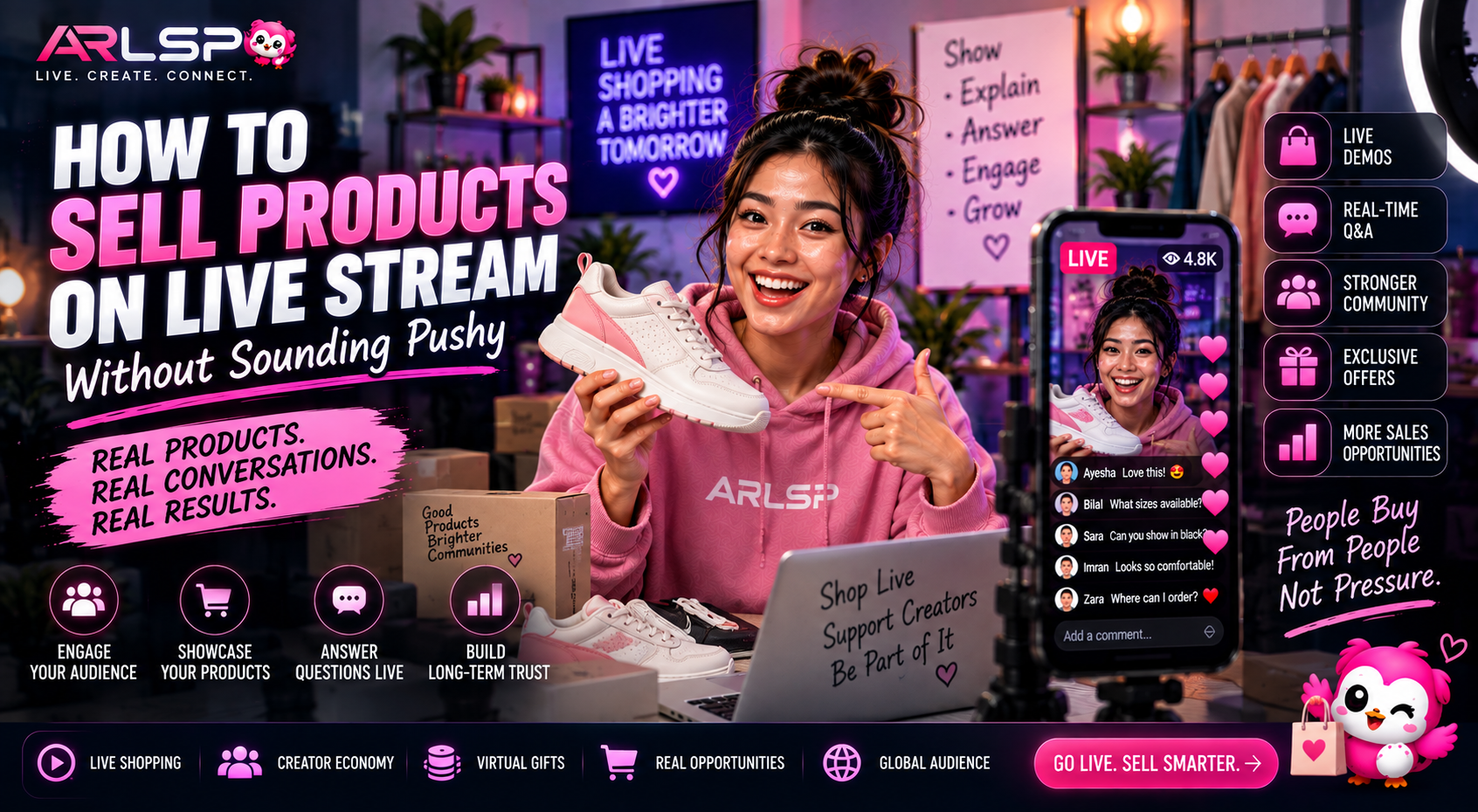
The Best Live Selling Often Does Not Feel Like Selling
Imagine opening a live stream and immediately hearing:
Buy this now.
Limited offer.
Order today.
Don't miss out.
You probably would not stay very long.
People may join a live shopping session because they are interested in products, but that does not mean they want to watch a nonstop advertisement.
They still want something useful.
They want to see the product properly.
They want questions answered.
They may want entertainment.
They may want to understand whether the product actually fits their needs.
That is why strong live selling is usually less about pushing people toward a purchase and more about making the buying decision easier.
A good live seller does not simply say:
“Buy this.”
They show:
“Here is what this is, how it works, who it is useful for and what you should know before deciding.”
That difference can turn a sales broadcast into a useful live experience.
What Is Live Selling?
Live selling is the practice of presenting, demonstrating or discussing products through a live video stream while viewers can interact with the host in real time.
A live selling session might include:
Product demonstrations
Questions and answers
Comparisons
Tutorials
Unboxings
Product testing
Customer-use scenarios
Creator recommendations
Audience voting
Several products shown during one stream
It combines the convenience of online shopping with something traditional ecommerce often lacks:
a real person who can respond immediately.
Live Selling Is Different From Simply Advertising Live
Putting an advertisement inside a livestream does not automatically create good live commerce.
There is an important distinction.
An advertisement says:
Here is why you should buy our product.
A strong live-selling session says:
Let me show you the product properly so you can decide whether it makes sense for you.
That second approach is more useful.
And usefulness builds trust.
Why People Watch Live Product Demonstrations
A product page can contain excellent photos and descriptions.
But some questions are easier to answer visually.
A viewer might want to know:
How big is it in someone's hand?
How does the material move?
What does the interface actually look like?
Is this difficult to set up?
Can you compare these two versions?
What happens when you use this feature?
During a live product demonstration, the host can respond immediately.
That reduces uncertainty.
And reducing uncertainty is one of the most useful things a seller can do.
Start With the Viewer’s Problem, Not the Product
Weak opening:
Today we're selling our new microphone.
Stronger opening:
If your livestream audio sounds unclear but you don't want a complicated studio setup, I'm testing three beginner microphones live today.
The second version starts with something the viewer cares about.
The product becomes part of the solution.
This principle applies to almost every category.
Instead of:
Here is our skincare product.
Try:
If your morning skincare routine takes too long, let me show you how I would simplify it.
Instead of:
Here are our travel bags.
Try:
I'm packing for a three-day trip live, and we're testing which of these bags actually fits everything.
The content becomes more interesting because the viewer understands why the product matters.
Give Every Live Sale a Clear Theme
A random collection of products can quickly become boring.
A theme gives the session structure.
Examples:
Five Products Every Beginner Streamer Actually Needs
Summer Travel Essentials Tested Live
Budget Gaming Setup Under One Theme
Which Product Is Better? Live Comparison
New Arrivals: What Is Actually Worth Trying?
Audience Chooses What I Test Next
Now the livestream has a reason to exist beyond:
We have products for sale.
Demonstrate Instead of Describing
This may be the most important rule in live selling.
If viewers can read the information themselves, do not spend the entire stream reading it aloud.
Instead of saying:
This bottle is leak-resistant.
Turn it upside down.
Instead of:
These headphones have easy controls.
Show the controls.
Instead of:
This bag has plenty of storage.
Pack it.
Instead of:
This product is easy to assemble.
Assemble it live.
Live video is powerful because you can show proof through use.
Use that advantage.
Show Products in Real Situations
A product often makes more sense when viewers can imagine using it themselves.
Suppose you are selling a travel backpack.
Do not simply rotate it in front of the camera.
Show:
What fits inside
How it sits on your shoulders
Where a laptop goes
How accessible the pockets are
How it looks when full
The viewer should be able to picture the product in their own life.
That is much more persuasive than repeating specifications.
Answer the Questions People Are Already Thinking
Before a live session, write down the most likely questions.
For example:
Fashion
How does it fit?
What material is it?
Is it true to size?
What does the color look like in normal lighting?
Technology
Is setup difficult?
Does it work with my device?
What is the difference between the models?
Who actually needs the expensive version?
Beauty
How does it look when applied?
Which skin type is it for?
How much do you need?
How does one shade compare with another?
Home products
How large is it?
Is it difficult to clean?
How is it assembled?
How much space does it require?
Answering these naturally makes the stream more useful.
Invite Questions Before You Finish the Demonstration
Do not wait until the end to say:
Any questions?
Interaction should happen throughout the session.
Try:
Which part should I test first?
Want to see the smaller or larger version?
Should I compare these side by side?
What would you actually use this for?
This turns viewers from observers into participants.
Make Questions Easy to Answer
People interact more when participation requires little effort.
Instead of:
Tell me your detailed opinion about these products.
Ask:
Black or white?
Or:
Product A or Product B?
Or:
Would you use this at home or while traveling?
Simple interactions can start larger conversations.
Let the Audience Influence the Stream
One of the biggest advantages of live commerce is that the content can change in response to viewers.
Suppose you planned to demonstrate four features.
But viewers keep asking about one particular feature.
Spend more time on it.
Your audience is telling you what matters.
A prerecorded advertisement cannot adapt.
A live seller can.
Use Product Comparisons Carefully
Comparison content works because people often struggle to choose between similar products.
A useful comparison explains:
Who Product A suits
Who Product B suits
Main differences
Advantages
Limitations
Value differences
Avoid automatically declaring the more expensive product superior.
Sometimes the cheaper option may genuinely make more sense for a particular customer.
Saying that can actually increase trust.
Be Willing to Say Who Should Not Buy the Product
This sounds strange for a sales strategy, but it can make the session far more credible.
For example:
If you only stream once a month from your phone, you probably don't need this advanced setup.
Or:
If you need a large travel bag, this particular model is probably too small.
Now the audience understands that you are not trying to sell everything to everyone.
That makes your recommendations more believable.
Do Not Pretend Every Product Is Perfect
No product is perfect for everyone.
A trustworthy live seller can say:
This one is easier to use, but it does not have the advanced controls of the other model.
That is much stronger than:
This is amazing. Everything about it is perfect.
Viewers are capable of recognizing exaggerated selling.
Credibility lasts longer than hype.
Tell a Story Around the Product
People often remember stories better than specifications.
Instead of:
This has a 500 ml capacity.
You might say:
I used this during a full day out because I wanted something small enough to carry but large enough that I wasn't refilling it constantly.
The specification now has context.
Stories help viewers understand why features matter.
Use Before-and-After Demonstrations When Appropriate
Some products are easier to understand when viewers can see the difference.
Examples:
Lighting equipment
Cleaning products
Beauty products
Creator equipment
Editing tools
Organizational products
Show:
Before
↓
Product being used
↓
After
This gives the viewer a complete story.
Do not manipulate demonstrations or exaggerate results.
The goal is clarity, not deception.
Create Mini Challenges Around Products
Live selling can also be entertaining.
Examples:
Can this bag actually hold everything I need for a weekend trip?
Can I set this device up in under five minutes?
Which microphone sounds best without editing?
Can viewers guess which product costs more?
A challenge gives the stream an outcome people want to see.
Now viewers have a reason to continue watching even if they are not immediately shopping.
Let Viewers Choose What Happens Next
Audience control works extremely well in live content.
Try:
Which one should we unbox next?
Should we test durability or ease of use first?
Which color should I try?
Product A won the first round. Should we put it against Product C?
The product session becomes interactive entertainment.
Repeat Context for People Who Join Late
Live audiences are constantly changing.
Someone may join halfway through.
Occasionally say something like:
If you've just joined, we're comparing three beginner streaming microphones. We've tested the first two and we're about to try the last one.
Now the new viewer understands what is happening immediately.
Without context, they may simply leave.
Do Not Spend Too Long on One Product
A live seller may love a product and spend 25 minutes explaining every detail.
The audience may not.
Watch the energy of the session.
If viewers understand the product, move forward.
You can always answer detailed questions later.
Good live content feels active.
Use a Simple Live Selling Structure
A practical session might look like this:
Opening
Explain the problem or theme.
Today we're testing three products that promise to make mobile streaming easier.
Product One
Show:
What it is
Who it is for
Main benefit
Demonstration
Viewer Questions
Answer the strongest questions.
Product Two
Repeat the process without repeating the exact same explanation.
Comparison
Show the products side by side.
Audience Vote
Which one would you choose?
Recommendation
Explain which product fits which type of person.
Closing
Recap the main differences and tell viewers what happens in your next stream.
That is structured enough to stay focused without feeling scripted.
Live Selling for Creators
Creators have an advantage over traditional salespeople.
Their audience often watches because of their:
Personality
Expertise
Entertainment
Perspective
Community
Protect that relationship.
If every stream suddenly becomes a product pitch, the audience may stop trusting the creator.
A healthier mix might include:
Entertainment
Community discussions
Tutorials
Live Battles
Product-focused sessions
Creator Q&As
Commerce should fit into the creator identity rather than replace it.
Live Selling for Small Businesses
Small businesses can use live content differently from large brands.
A founder or team member can personally explain:
Why a product exists
How it was developed
How customers use it
What makes different versions different
This can make the business feel more human.
A polished advertisement may look impressive.
A knowledgeable founder answering real customer questions can build a different kind of trust.
Live Selling for Fashion
Fashion is naturally suited to demonstrations.
Instead of only showing photos, a host can demonstrate:
Fit
Movement
Styling
Color
Fabric
Different sizes
Outfit combinations
Viewers can ask:
Can you show the jacket with the other trousers?
That turns a product catalogue into an interactive styling session.
Live Selling for Beauty
Beauty products often create questions that are difficult to answer with static images.
Creators can demonstrate:
Application
Shades
Texture
Different techniques
Product combinations
The session can feel more like a tutorial than an advertisement.
That is often exactly why people keep watching.
Live Selling for Technology
Technology products often overwhelm customers with specifications.
A live stream can translate specifications into real use.
Instead of:
This microphone has these technical specifications.
show:
Here is how it sounds from one metre away.
Practical demonstrations often answer questions faster than technical descriptions.
Live Selling for Gaming and Creator Equipment
Creators can test products in the exact environment their audience cares about.
For example:
Microphones
Headsets
Cameras
Lighting
Controllers
Keyboards
Streaming accessories
A creator can use the product during the stream rather than simply talking about it.
That produces stronger content and better product understanding.
Turn One Live Sale Into Multiple Short Videos
Your live session should not disappear when it ends.
Find the best moments.
For example:
Clip 1: Best product comparison
Clip 2: Viewer question
Clip 3: Unexpected demonstration result
Clip 4: Quick buying advice
Clip 5: Funniest moment
Now one live stream becomes several pieces of short-form content.
This also connects our ARLSP short video and live commerce content clusters naturally.
Use Short Videos to Promote the Next Live Sale
Before going live, create a short teaser.
For example:
Tomorrow I'm testing three budget microphones live. One costs less than half the others. Let's see whether anyone can hear the difference.
That creates curiosity.
The short video attracts attention.
The live session delivers the full experience.
The creator journey becomes:
Short Video → Curiosity → Live Stream → Interaction → Product Discovery
Do Not Create Fake Urgency
Statements such as:
Only three seconds left!
when there is no real reason for urgency can damage trust.
The same applies to misleading scarcity.
If an offer genuinely ends at a particular time, explain it accurately.
If inventory is genuinely limited, say so accurately.
But do not manufacture pressure simply because the stream needs excitement.
Trust is part of the product experience.
Make Your Calls to Action Natural
You do not need to repeat:
Buy now.
every minute.
A natural CTA might be:
If this is the version that fits what you need, you can explore it from the product section.
Or:
If you're still deciding between the two, ask me your use case and I'll tell you which one I'd choose.
That keeps the focus on helping the viewer decide.
Selling Is Easier When the Viewer Understands the Product
A common mistake is trying to create urgency before creating understanding.
Think in this order:
Attention
↓
Interest
↓
Understanding
↓
Questions
↓
Confidence
↓
Decision
Trying to jump directly from attention to purchase can make the stream feel aggressive.
Use Viewer Questions as Market Research
Live selling can reveal valuable information.
If viewers repeatedly ask:
Does this come in another size?
that tells you something.
If everyone asks:
Why is Product B more expensive?
your positioning may not be clear enough.
If people ask:
Can you demonstrate this feature?
your product page may need better visual content.
The livestream gives businesses real-time customer language.
That can improve:
Future content
Product descriptions
FAQs
Short videos
Ads
Landing pages
Future livestreams
Do Not Measure Success Only by Immediate Sales
A person may watch today and buy later.
Another viewer may follow the creator.
Someone else may join the next stream.
Useful metrics can include:
Questions asked
Comments
Viewers staying
Returning viewers
Product interest
Audience participation
Community growth
Frequently discussed products
Live selling exists within a broader relationship.
Not every valuable interaction produces an immediate purchase.
How ARLSP Fits Into Live Selling
ARLSP includes live shopping and product showcasing/selling functionality, making live commerce one part of its wider creator-focused ecosystem.
Relevant confirmed features include:
Live streaming
Live shopping
Live Battles
Communities
Messaging
Notifications
Virtual gifts
Creator coins
Trending/discovery features
QR profile sharing
This creates opportunities for creators to build a journey that goes beyond a simple product listing.
A possible path looks like:
Creator Content
↓
Audience Discovery
↓
Live Session
↓
Product Demonstration
↓
Questions and Interaction
↓
Product Exploration
↓
Community Relationship
The product is part of the experience rather than the only reason the audience is there.
A Better ARLSP Live Shopping Session
Weak concept:
I'm live selling products.
Better concept:
We're testing three creator accessories tonight, and the audience decides which one wins.
Now you have:
A clear topic
Real products
Demonstrations
Audience interaction
Competition
Creator personality
The commerce becomes part of something entertaining.
Live Battles Can Also Inspire Commerce Content
ARLSP's Live Battles are primarily a creator-versus-creator interaction format, but the broader idea of competition can inspire product content too.
For example, creators can structure demonstrations around:
Budget vs Premium
Old vs New
Product A vs Product B
Audience Favorite vs Creator Favorite
You do not need to turn every product session into an official Live Battle.
The useful lesson is that competition creates structure.
A Practical Checklist Before Your Live Sale
Before going live, confirm:
Products:
Do I know exactly what I am showing?
Theme:
Why should someone watch?
Demonstration:
What will viewers actually see?
Questions:
What are customers likely to ask?
Comparisons:
Which options commonly confuse people?
Interaction:
How will viewers participate?
Truthfulness:
Are all claims accurate?
CTA:
What is the natural next step?
Follow-up:
Can the strongest moments become additional content?
If those are clear, you have much more than a product pitch.
You have a live show.
Common Live Selling Mistakes
Talking About Price Before Value
First help viewers understand the product.
Reading the Product Page
Show something the page cannot.
Ignoring Comments
Interaction is one of the main reasons to go live.
Pretending Every Product Is for Everyone
Explain who each option actually suits.
Overhyping Everything
If every feature is “revolutionary,” nothing feels credible.
No Stream Structure
A random product list becomes difficult to follow.
Selling Constantly
Give viewers entertainment, education or useful demonstrations too.
The Goal Is Confidence, Not Pressure
The strongest salesperson in a live stream is often not the person who talks the most.
It is the person who removes the most uncertainty.
The viewer understands:
What the product does
How it works
Whether it fits their needs
How it compares
What its limitations are
Then they can make their own decision.
That is a much healthier relationship between content and commerce.
Live Selling Works Best When People Would Watch Even Without Buying
This is a useful test.
Ask:
If the viewer had no intention of buying today, would this stream still be worth watching?
If the answer is yes, you probably have good content.
Maybe they learn something.
Maybe they are entertained.
Maybe they discover useful products.
Maybe they enjoy interacting with the creator.
That value gives them a reason to return.
And returning audiences are far more important than one aggressive sales session.
Sell Less. Demonstrate More.
Live commerce works because it combines two things that traditional ecommerce separates:
content
and
conversation.
Creators and businesses can show products, answer real questions and adapt the experience according to what viewers care about.
So instead of asking:
How do I convince people to buy during a livestream?
Ask:
How can I help people understand this product better than they could from a normal page?
That question leads to better content.
Better demonstrations.
Better conversations.
And potentially better commercial outcomes.
ARLSP gives creators a live-social environment where live streaming, live shopping, communities and creator interaction can work together.
The strongest approach is simple:
Don't pressure the audience. Help them make a better decision.
That is what good live selling should feel like.
Frequently Asked Questions
What is live selling?
Live selling is the use of live video to demonstrate, discuss or sell products while viewers can interact with the host in real time.
How do I sell products on a live stream?
Choose a clear theme, demonstrate products in real situations, answer viewer questions, compare relevant options and provide a natural way for interested viewers to explore the product.
What makes a good live product demonstration?
A strong demonstration shows how the product works instead of simply repeating features. It should answer practical questions viewers are likely to have.
How can I make live selling less pushy?
Focus on education, demonstrations, comparisons and questions rather than constantly asking viewers to purchase.
What products work well for live selling?
Products that benefit from visual demonstration, comparison or explanation can work particularly well, including fashion, beauty, technology, lifestyle and creator equipment.
Can creators use short videos with live selling?
Yes. Short videos can promote upcoming live sessions, while highlights from live selling sessions can later become short-form content.
Is live selling the same as live shopping?
The terms overlap. Live selling usually emphasizes the seller or host activity, while live shopping often refers more broadly to the viewer's interactive shopping experience.
Does ARLSP support live selling?
ARLSP includes live shopping and product showcasing/selling functionality alongside its live-streaming and creator-community features.