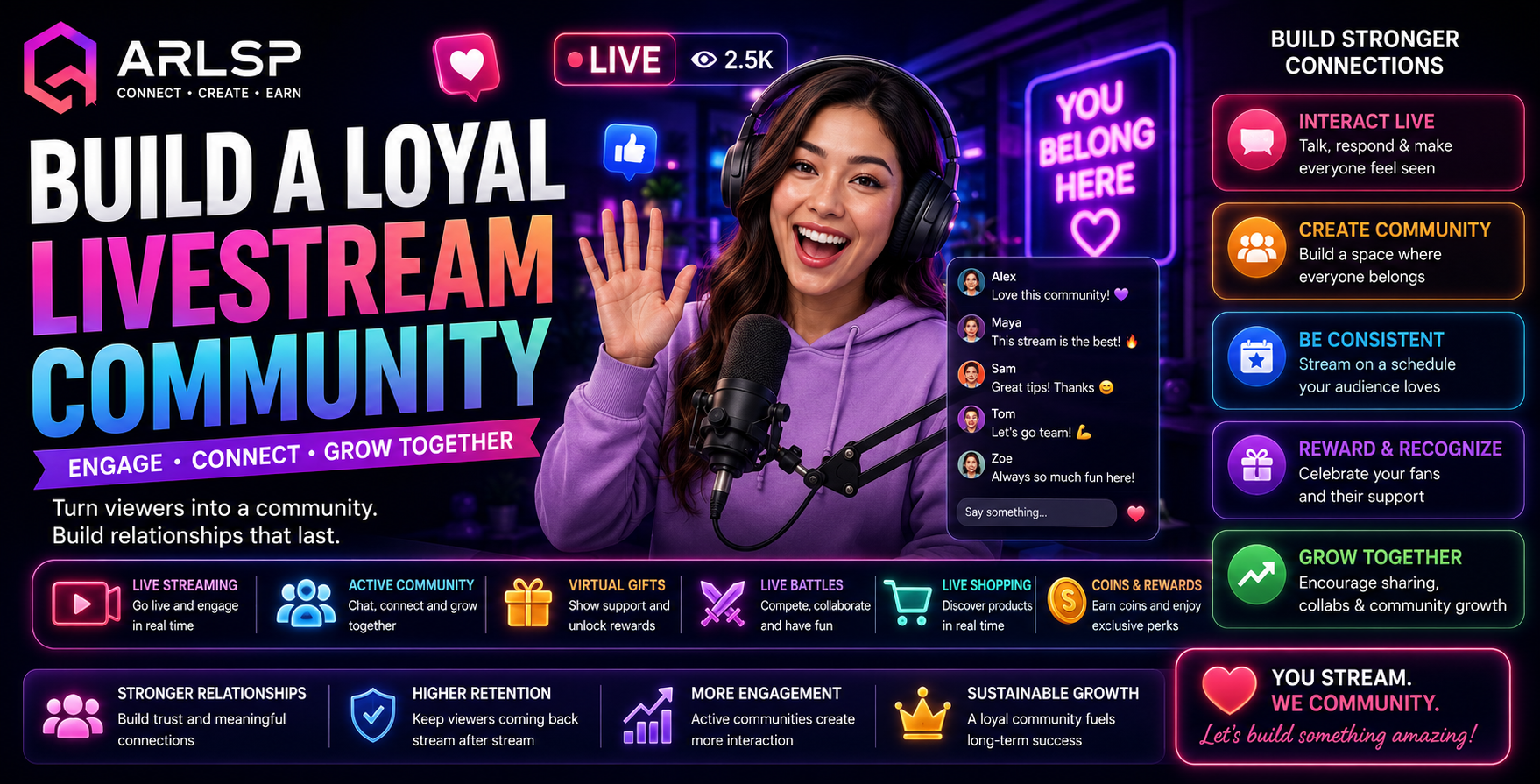
Build a Loyal Livestream Community
Build a Loyal Livestream Community : A Complete Guide for Streamers and Creators
Introduction
Getting viewers to click on a livestream is one thing.
Getting them to come back tomorrow is something completely different.
That difference is what separates a stream with occasional viewers from a genuine livestream community.
A viewer may discover a creator through a recommendation, search result, social media post, collaboration, or trending livestream. But discovery alone doesn't create a long-term audience.
A community develops when viewers begin to feel that they are part of something.
They know the creator.
They recognize other viewers.
They participate in conversations.
They look forward to recurring streams.
They celebrate milestones.
They share content.
They invite friends.
They support the creator.
Eventually, the relationship changes from:
Creator → Viewer
into:
Creator ↔ Community
That is one of the most valuable transitions a livestream creator can make.
In 2026, livestreaming is no longer simply about broadcasting video. It is increasingly about real-time interaction, social connection, creator identity, community participation, and audience retention.
This guide explains how creators can build a loyal livestream community from the ground up—and how features such as live interaction, virtual gifting, community spaces, Live Battles, and live commerce can contribute to that ecosystem.
What Is a Livestream Community?
A livestream community is a group of viewers who regularly interact around a creator, topic, niche, or streaming experience.
It is more than a follower count.
A follower may watch once.
A community member is more likely to:
Return regularly
Participate in chat
Recognize other members
Share the creator's content
Join community events
Participate in discussions
Support the creator
Invite friends
Recommend the creator
Feel connected to the group
The difference can be summarized simply:
Audience = people watching.
Community = people participating.
Why Community Matters More Than Follower Count
Follower count is an easy metric to understand.
But it doesn't tell the whole story.
Imagine two creators.
Creator A
100,000 followers
1,000 regular viewers
Very little interaction
Creator B
10,000 followers
2,500 regular viewers
Highly active chat
Strong returning audience
Frequent community interaction
Creator B has fewer followers but may have a much stronger community.
This matters because engaged viewers can contribute to:
Watch time
Returning traffic
Conversations
Shares
Virtual gifting
Purchases
Memberships
Live shopping
Collaborations
Organic growth
The objective should therefore not simply be:
"How do I get more followers?"
A better question is:
"How do I turn viewers into regular participants?"
The Livestream Community Funnel
A useful community-building funnel looks like this:
Discovery
↓
First View
↓
Follow
↓
Return Visit
↓
Interaction
↓
Regular Viewer
↓
Community Member
↓
Superfan
↓
Advocate
Each stage represents a deeper relationship.
A creator's job is not to force everyone to become a superfan.
It is to give interested viewers reasons to move naturally from one stage to the next.
Stage 1: Get Discovered
Before you can build a community, people need to find you.
Discovery can come from:
Short-form video
Search
Recommendations
Collaborations
Trending content
Social media
Creator profiles
Livestream discovery
Existing communities
Your discovery content should make one thing clear:
Why should someone care about this creator?
A gaming streamer might focus on:
Competitive gameplay
Challenges
Tutorials
Reactions
Strategy
An educator might focus on:
Practical lessons
Q&A
Tutorials
Demonstrations
An entertainment creator might focus on:
Conversations
Games
Challenges
Performances
Your niche gives people a reason to discover you.
Stage 2: Give New Viewers a Reason to Stay
The first few minutes matter.
A new viewer should quickly understand:
Who you are
What the stream is about
What is happening
Why they should participate
When you normally stream
Avoid making new viewers feel like outsiders.
Instead of saying:
"You should already know what we're doing."
Give them context.
A welcoming environment can turn a first-time visitor into a returning viewer.
Stage 3: Learn Your Viewers
One of the biggest mistakes creators make is treating the audience like a number.
People want recognition.
During livestreams, creators can:
Welcome new viewers
Respond to questions
Remember regular participants
Ask for opinions
Discuss viewer suggestions
Celebrate community milestones
Small interactions can have a surprisingly large effect.
A viewer who receives a genuine response may remember the experience.
Make Your Livestream Interactive
A livestream shouldn't feel like a prerecorded video with a chat box attached.
The audience should have opportunities to influence what happens.
Try:
Polls
Let viewers choose between options.
Questions
Ask the audience directly.
Challenges
Allow viewers to suggest challenges.
Predictions
Let viewers predict outcomes.
Q&A
Reserve dedicated time for questions.
Audience Decisions
Allow viewers to choose topics, games, products, or discussion points.
The more meaningful the interaction, the stronger the sense of participation.
Build Recurring Formats
Random livestreams can work.
But recurring formats can build habits.
For example:
Monday: Community Q&A
Wednesday: Tutorial
Friday: Live Battle or collaboration
Sunday: Weekly community event
The exact schedule depends on the creator.
The principle is what matters:
Give viewers something to look forward to.
A recurring format can turn livestreaming into a routine.
Consistency Beats Constant Streaming
More livestreams do not automatically create a stronger community.
A creator who streams for eight hours once every two weeks may have less predictable audience behavior than someone who streams for two hours on a consistent schedule.
Consistency helps viewers understand:
When should I come back?
The schedule doesn't need to be perfect.
It needs to be understandable.
Create Community Traditions
Communities develop identity through shared experiences.
Create recurring traditions such as:
Weekly challenges
Community competitions
Viewer spotlights
Milestone celebrations
Special greetings
Community goals
Themed livestreams
Monthly events
These small traditions can become part of the creator's identity.
Eventually, viewers may participate because:
"This is what our community does."
That is a much stronger relationship than simply:
"I watch this person's videos."
Give Your Community an Identity
A memorable community often has its own identity.
That could involve:
A community name
Inside jokes
Recurring phrases
Shared challenges
Community goals
Visual identity
Special events
The objective isn't to manufacture a fake culture.
It's to allow genuine community characteristics to develop.
Encourage Viewer-to-Viewer Interaction
A strong community isn't dependent entirely on the creator.
Eventually, viewers should begin interacting with one another.
They might:
Answer each other's questions
Welcome new members
Discuss the stream
Share recommendations
Support community events
Participate in challenges
This creates a powerful transition:
Creator-led community → Self-reinforcing community
The creator remains the center of the experience, but the relationships expand beyond the creator.
Collaborations Can Accelerate Community Growth
Creators don't always need to grow alone.
Collaborations can introduce audiences to new creators.
Examples include:
Joint livestreams
Interviews
Gaming competitions
Live Battles
Educational sessions
Creator challenges
Product demonstrations
The key is compatibility.
A collaboration should make sense to both audiences.
Live Battles and Community Competition
Competitive livestream formats can create strong participation.
For example, two creators can compete while their respective audiences participate.
This creates multiple layers:
Creator A
↓
Creator A's Community
versus
Creator B
↓
Creator B's Community
Viewers aren't simply watching.
They have a reason to participate.
On ARLSP, Live Battles are part of the platform's interactive creator ecosystem and can provide one format for turning livestreaming into a more participatory experience.
The objective isn't competition for its own sake.
It is creating an experience that gives the audience something to do.
Use Rewards Carefully
Rewards can increase participation, but they shouldn't replace genuine community value.
Depending on the platform, community incentives can include:
Virtual gifts
Points
Recognition
Milestones
Challenges
Community achievements
Exclusive experiences
On ARLSP, virtual gifts and points form part of the platform's internal engagement ecosystem.
However, creators should always communicate clearly about what rewards mean and avoid presenting platform points as cash when they are not.
Virtual Gifting and Community
Virtual gifts can be more than a monetization mechanism.
They can also become a form of audience participation.
A viewer may send a virtual gift because they want to:
Support a creator
Celebrate a moment
Participate in an event
Show appreciation
Encourage a creator during a competition
For creators, the important principle is:
Don't make your community feel like an ATM.
The relationship should come first.
Monetization should naturally follow genuine value.
Build a Two-Way Relationship
Weak creator communities often operate like this:
Creator speaks → Audience listens.
Strong communities look more like:
Creator speaks ↔ Audience responds ↔ Creator adapts
Your audience should influence your content.
Ask:
What do they want to see?
What questions keep appearing?
Which topics create the most discussion?
Which livestreams have the strongest retention?
What do viewers ask for next?
Your audience can effectively become part of your content strategy.
Use Viewer Feedback as a Content Engine
Suppose viewers repeatedly ask:
"Can you explain this?"
That's not just a question.
It could become:
A livestream topic
A tutorial
A short video
A guide
A community event
A premium session
One audience question can create an entire content cluster.
This is one of the easiest ways for creators to make content that is genuinely relevant.
Create Moments People Want to Share
Not every livestream needs to be viral.
But every livestream should ideally contain moments worth remembering.
These might be:
Funny reactions
Unexpected outcomes
Major achievements
Emotional moments
Expert insights
Community celebrations
Competitive moments
Viewer interactions
Turn those moments into short-form content.
Now your livestream becomes a source of discovery content.
The Content Flywheel
A strong livestream strategy can create:
Livestream
↓
Best Moments
↓
Short-Form Clips
↓
New Viewers
↓
New Followers
↓
Next Livestream
↓
Community Growth
This is much more efficient than treating every piece of content as an isolated activity.
Build a Recognizable Creator Personality
People don't always return only for the subject.
They return for the person.
Two creators can discuss exactly the same topic while developing completely different communities.
Your personality can include:
Communication style
Humor
Teaching style
Energy
Opinions
Visual identity
Recurring formats
Community traditions
Authenticity matters because communities are relationship-driven.
Don't Try to Please Everyone
A community becomes stronger when its identity is clear.
If you attempt to appeal to everyone, your content may become generic.
Instead, ask:
Who is this community actually for?
For example:
Competitive gamers
Beginner creators
Language learners
Fitness enthusiasts
Entrepreneurs
Music fans
Technology enthusiasts
Online shoppers
A focused audience can create stronger relationships than a completely generic audience.
Create a Safe and Welcoming Environment
Community growth isn't only about entertainment.
People need to feel comfortable participating.
Creators should establish clear expectations around:
Harassment
Spam
Hate
Personal attacks
Scams
Unwanted promotion
Disruptive behavior
Moderation becomes increasingly important as a community grows.
A small toxic minority can negatively affect a much larger group.
Moderation Is Part of Community Building
Good moderation doesn't mean deleting every disagreement.
It means protecting the environment where productive interaction can happen.
As your community grows, consider:
Community guidelines
Moderators
Reporting systems
Spam controls
Clear rules
Consistent enforcement
A creator's community culture is partly defined by what they allow.
Turn Regular Viewers Into Community Members
A viewer becomes more connected when they receive opportunities to participate.
Try:
Viewer Recognition
→ Welcome returning viewers.
Participation
→ Ask them questions.
Community Roles
→ Give regular members meaningful responsibilities where appropriate.
Events
→ Create recurring activities.
Recognition
→ Celebrate community achievements.
Access
→ Provide deeper experiences to genuinely engaged members.
The objective isn't to create artificial hierarchy.
It's to make participation meaningful.
Retention Is More Important Than One-Time Reach
A livestream with 10,000 viewers sounds impressive.
But if almost nobody returns, the long-term value may be limited.
Compare that with:
2,000 viewers today
↓
1,000 return tomorrow
↓
800 return next week
↓
600 become regular community members
That is the foundation of a durable creator business.
Track returning behavior—not just peak viewers.
Metrics That Matter for Livestream Communities
Creators should monitor more than follower count.
Important metrics can include:
Average Concurrent Viewers
How many people are watching at the same time?
Average Watch Time
How long are viewers staying?
Returning Viewers
How many people come back?
Chat Participation
How many viewers interact?
Engagement Rate
How much audience activity occurs?
Follows per Stream
How many viewers become followers?
Community Growth
Is your regular audience increasing?
Gift Activity
Where applicable, how much virtual gifting activity occurs?
Conversion
How many viewers take the desired next action?
A Simple Community Health Formula
You can think about community health as:
Reach × Engagement × Retention = Community Growth
Reach brings people in.
Engagement gives them a reason to participate.
Retention gives them a reason to return.
If one element is weak, community growth becomes harder.
Don't Chase Engagement for the Sake of Engagement
Not every interaction has equal value.
100 meaningless comments aren't necessarily better than 20 thoughtful conversations.
A healthy community creates:
Genuine discussion
Useful questions
Shared experiences
Repeat participation
Creator-viewer relationships
Focus on quality of interaction, not only quantity.
How ARLSP Can Support a Livestream Community
ARLSP is positioned around more than simply broadcasting video.
Its creator ecosystem includes features such as:
Live Streaming
Creator Communities
Live Battles
Virtual Gifts
Creator Coins
Premium Coin-Based Live Sessions
Live Shopping
Messaging
Audience Interaction
Creator Profiles
Notifications
Trending Content
This combination can support different stages of community development.
For example:
Live Streaming
creates the shared experience.
Messaging and interaction
help maintain relationships.
Live Battles
create participatory events.
Virtual Gifts
provide a mechanism for audience support.
Communities
help organize recurring engagement.
Live Shopping
can connect community attention with commerce.
The platform itself doesn't create a loyal community automatically.
The creator still has to provide the personality, consistency, value, and interaction that make people want to return.
Building a Community Around Live Shopping
Commerce doesn't have to destroy authenticity.
A creator can incorporate products naturally into content.
For example:
Product Discovery
↓
Live Demonstration
↓
Audience Questions
↓
Creator Recommendation
↓
Community Discussion
↓
Purchase
This is fundamentally different from simply posting an advertisement.
The audience gets an opportunity to see the product in context and ask questions.
Community Before Commerce
One of the biggest mistakes creators can make is monetizing before building trust.
Imagine a creator who joins a new audience and immediately says:
"Buy this."
Then:
"Send gifts."
Then:
"Purchase this product."
Then:
"Join my paid community."
Viewers may leave.
Instead:
Value → Relationship → Trust → Participation → Monetization
That sequence is much healthier.
How Small Creators Can Build Communities Faster
You don't need a huge audience.
Start with a specific niche.
For example:
Instead of:
Gaming
Try:
Competitive mobile gaming for beginners
Instead of:
Fitness
Try:
Home workouts for busy professionals
Instead of:
Education
Try:
English speaking practice for beginners
Specificity makes it easier to create relevant community experiences.
A 30-Day Livestream Community Plan
Week 1 — Establish Your Identity
Define:
Niche
Audience
Streaming schedule
Content themes
Community tone
Create a simple reason for people to return.
Week 2 — Increase Interaction
Add:
Q&A
Polls
Viewer questions
Audience challenges
Viewer recognition
Focus on conversations.
Week 3 — Create a Community Event
Run something special:
Challenge
Collaboration
Competition
Live Battle
Themed livestream
Community milestone
Give viewers something to participate in.
Week 4 — Analyze and Improve
Review:
Returning viewers
Watch time
Chat activity
Follower growth
Best-performing topics
Community participation
Then repeat what worked.
The 5-Part Community Framework
If you want a simple system to remember, use:
1. Attract
Create discoverable content.
2. Welcome
Make new viewers feel included.
3. Engage
Give viewers reasons to participate.
4. Connect
Build relationships between creator and community.
5. Retain
Create reasons to come back.
Then repeat.
Attract → Welcome → Engage → Connect → Retain
Common Livestream Community Mistakes
Only Talking to the Biggest Supporters
Everyone deserves a reasonable opportunity to participate.
Ignoring New Viewers
A new viewer today could become a regular viewer tomorrow.
Streaming Without Structure
Give viewers a reason to know what they are watching.
Changing Your Schedule Constantly
Predictability helps create habits.
Making Everything About Monetization
Community comes first.
Ignoring Viewer Feedback
Your audience can tell you what they want.
Focusing Only on Follower Growth
Returning viewers and engagement often provide deeper insight.
Allowing Toxic Behavior
Poor moderation can destroy community culture.
The Future of Livestream Communities
The future of live streaming is unlikely to be defined only by higher video quality.
The bigger opportunity is deeper interaction.
Viewers increasingly expect to do something rather than simply watch.
They can:
Chat
React
Send virtual gifts
Join communities
Participate in competitions
Influence content
Shop
Collaborate
Communicate directly with creators
This turns livestreaming into an interactive social environment.
And that is where creator communities become particularly valuable.
Frequently Asked Questions
What is a livestream community?
A livestream community is a group of viewers who regularly return, interact, communicate, and participate around a creator or streaming topic.
How do I build a livestream community?
Focus on a specific niche, stream consistently, interact with viewers, create recurring events, recognize regular participants, encourage viewer-to-viewer interaction, and give people reasons to return.
How do I increase viewer retention?
Create consistent schedules, interactive formats, recurring events, strong openings, audience participation, and content that gives viewers a reason to return.
How important is engagement in livestreaming?
Very important. Engagement turns passive viewers into participants and can help creators understand what their audience values.
Can small creators build strong livestream communities?
Absolutely. Smaller creators can have an advantage because they may be able to provide more direct interaction and recognition to individual viewers.
Are virtual gifts important for livestream communities?
They can be one form of audience participation and creator support, depending on the platform. They should complement genuine community value rather than replace it.
How can ARLSP help creators build communities?
ARLSP combines livestreaming with creator communities, Live Battles, virtual gifts, creator coins, premium live experiences, live shopping, messaging, and audience interaction, providing several tools that can support community-based creator activity.
Final Thoughts from ARLSP
A livestream community isn't built by collecting followers.
It is built by creating belonging.
People return when they know what to expect.
They participate when they feel heard.
They stay when they find value.
They become loyal when they feel connected.
The strongest livestream creators therefore think beyond:
"How many people are watching?"
They ask:
"Who is coming back?"
"Who is participating?"
"Who knows other members of the community?"
"Who would notice if I wasn't live?"
Those are the signs of a real community.
Platforms such as ARLSP can provide the infrastructure for live interaction through features including livestreaming, creator communities, Live Battles, virtual gifts, creator coins, premium experiences, and live shopping.
But technology is only the foundation.
The creator builds the relationship.
The community creates the culture.
The interaction creates the loyalty.
And ultimately, that is what turns a livestream from a broadcast into a place people want to return to.