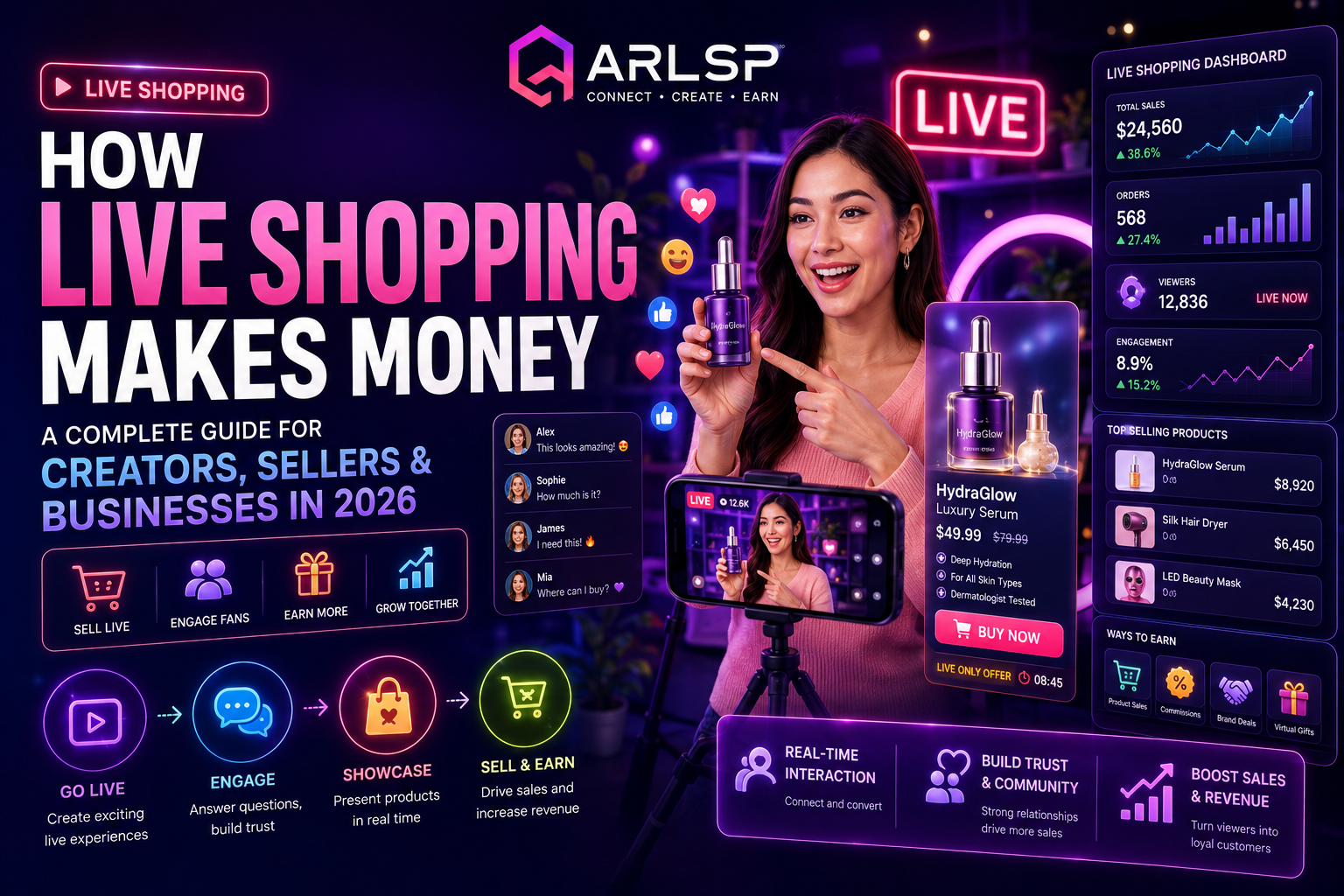
how live shopping makes money
How Live Shopping Makes Money: A Complete Guide for Creators, Sellers, and Businesses in 2026
Introduction
Imagine a customer watching a creator demonstrate a product live.
Instead of opening another website to research it, the viewer asks a question in the chat.
The creator answers immediately.
The product is demonstrated again.
Other viewers share their opinions.
The customer decides to buy while the conversation is still happening.
That is the basic idea behind live shopping.
Live shopping combines livestreaming, entertainment, community interaction, product discovery, and ecommerce into one experience.
And in 2026, it is becoming increasingly important to creators and businesses because it brings two activities that were traditionally separated much closer together:
content and commerce.
Recent industry research describes live commerce as a format that compresses product discovery, evaluation, and purchasing into a real-time experience. One 2026 industry analysis estimates the global live-commerce market could grow from $25.63 billion in 2025 to $31.79 billion in 2026, although market estimates vary by methodology.
But how does live shopping actually make money?
Who gets paid?
Can small creators use it?
Can businesses sell through livestreams?
And what does a platform such as ARLSP bring to the model?
This guide breaks down the entire live-shopping business model.
What Is Live Shopping?
Live shopping, also called livestream commerce or live commerce, combines a live video broadcast with the ability to discover, evaluate, and purchase products during the experience.
A traditional ecommerce journey might look like:
Search → Product Page → Read Reviews → Compare → Add to Cart → Purchase
A social commerce journey can be:
Content → Interest → Interaction → Product Discovery → Demonstration → Purchase
Live shopping compresses even more of that journey into a single event:
Watch → Ask → See → Trust → Buy
That difference is important.
The customer isn't simply looking at a product photograph.
They're seeing it being demonstrated by a real person while having the opportunity to ask questions.
How Does Live Shopping Make Money?
There isn't just one way live shopping generates revenue.
A successful live-commerce ecosystem can make money through several connected channels.
1. Product Sales
The most obvious revenue source is the sale of products.
A creator or seller demonstrates a product during a livestream and directs interested viewers toward the purchase.
For example:
100 viewers × 5% buyers × $40 average order = $200 in sales
The actual profit depends on product cost, platform fees, shipping, returns, discounts, commissions, and other expenses.
The important point is that livestreaming can turn audience attention into a measurable commercial action.
2. Creator Commissions
Creators don't always need to manufacture or own the products they sell.
They can potentially promote products for brands or merchants and receive a commission on qualifying sales.
This creates an important creator-economy model:
Creator → Audience → Product Recommendation → Sale → Commission
It allows creators to monetize their influence without necessarily developing their own inventory.
For example, a beauty creator might demonstrate skincare products from several brands.
A fitness creator might showcase equipment.
A technology creator might demonstrate accessories.
A fashion creator might showcase clothing.
The creator's value comes from combining audience + trust + demonstration + recommendation.
3. Selling Your Own Products
Creators with their own businesses have another opportunity.
Instead of earning only a commission, they can promote their own products.
Examples include:
Clothing
Beauty products
Digital products
Accessories
Handmade products
Fitness products
Educational products
Merchandise
Consumer electronics
Food products
This can potentially increase margins because the creator or business controls the product economics.
4. Live Shopping Can Increase Product Conversion
One reason businesses are interested in live commerce is the interactive nature of the format.
A static product page might say:
"This product has three features."
A livestream can demonstrate those three features.
A viewer can then ask:
"Does it work with this device?"
The seller can answer immediately.
That interaction can remove uncertainty.
Research into livestream commerce has also found that engagement signals such as comments, page views, and likes can be associated with sales performance, although results vary by market and business model.
5. Flash Offers and Limited-Time Promotions
Live shopping can also create urgency.
A seller might introduce:
Limited-time discounts
Launch offers
Live-only bundles
Product giveaways
Special event pricing
Limited inventory
However, urgency should be genuine.
Artificial scarcity or misleading countdowns can damage customer trust.
The strongest live-commerce businesses create urgency through real events rather than pressure tactics.
6. Product Launches
A livestream can become a product-launch event.
Instead of simply publishing:
"New Product Available."
A brand can host:
"Product Launch — Live Tonight."
During the event, the host can:
Introduce the product.
Explain the problem it solves.
Demonstrate it.
Answer questions.
Show different use cases.
Reveal pricing.
Direct viewers toward purchase.
This transforms a product launch into an experience.
7. Creator Sponsorships
Live shopping can also create sponsorship opportunities.
A brand may sponsor a creator's livestream because the creator provides access to a relevant audience.
For example:
Gaming creator + gaming accessories brand
or
Beauty creator + cosmetics company
or
Fitness creator + sportswear company
The creator may receive a fixed sponsorship fee, sales commission, product compensation, or a combination depending on the agreement.
This means live shopping can complement traditional creator sponsorships rather than replacing them.
8. Affiliate Marketing
Affiliate marketing is another important model.
The creator recommends a product and receives a commission when viewers purchase through an eligible tracking mechanism.
The basic model is:
Traffic → Product Recommendation → Click → Purchase → Commission
Live streaming adds something traditional affiliate content often lacks:
real-time demonstration.
Instead of writing a 1,500-word product review, a creator can demonstrate the product live and answer questions immediately.
9. Virtual Gifts Can Complement Live Commerce
Live commerce doesn't have to be limited to product sales.
On creator-focused platforms, viewers may also support creators through virtual gifts and other platform-based interactions.
That creates multiple monetization layers within the same livestream:
Product Sales + Creator Commissions + Virtual Gifts + Premium Experiences
For creators, diversification can be valuable because not every viewer is ready to purchase a product.
Some viewers may prefer to support the creator directly.
Others may become customers.
Others may simply watch and return later.
Live Shopping Is More Than "Selling on Camera"
One of the biggest mistakes businesses make is treating live shopping like a normal sales presentation.
A successful livestream usually needs to be entertaining.
Think of it as:
Entertainment + Education + Interaction + Commerce
If the entire stream feels like an advertisement, viewers may leave.
But if the host creates a useful and entertaining experience, the product can become part of the content rather than interrupting it.
This is why the term shoppertainment is increasingly associated with social commerce.
The Live Shopping Funnel
A useful way to understand live commerce is through the funnel:
1. Discovery
Someone discovers the livestream.
↓
2. Click
They enter the broadcast.
↓
3. Engagement
They watch, comment, react, or ask questions.
↓
4. Product Discovery
The host introduces a product.
↓
5. Demonstration
The product is shown in real-world use.
↓
6. Consideration
The viewer asks questions and evaluates the offer.
↓
7. Purchase
The viewer completes the transaction.
↓
8. Retention
The creator or business brings the customer back for another event.
The final stage is often overlooked.
One purchase is valuable. A returning customer is more valuable.
Why Live Shopping Can Work Better Than Static Product Content
Traditional ecommerce relies heavily on:
Product photography
Descriptions
Reviews
Specifications
Pricing
These remain important.
But live commerce adds another layer:
human interaction.
A customer can see:
How the product looks
How it behaves
How large it is
How it works
What problems it solves
How another person reacts to it
And they can ask questions in real time.
This reduces the distance between product discovery and product understanding.
ARLSP and Live Shopping
ARLSP is positioned around a broader creator ecosystem rather than livestreaming alone.
Its feature set includes live streaming, creator communities, virtual gifts, Live Battles, premium coin-based live sessions, creator coins, and live shopping.
That combination creates an interesting model for creators and sellers.
Instead of thinking about live shopping as:
"Go live and sell something."
Creators can think about it as:
Audience → Community → Livestream → Interaction → Product Discovery → Commerce → Retention
The commerce component becomes part of the creator's broader relationship with the audience.
How a Creator Could Use ARLSP for Live Shopping
Consider a creator who sells fitness products.
They could structure a livestream like this:
Opening — 5 Minutes
Talk with the audience.
Ask viewers what they're struggling with.
Education — 10 Minutes
Explain the fitness problem.
Product Demonstration — 10 Minutes
Show the product in use.
Audience Q&A — 10 Minutes
Answer questions.
Community Interaction — 10 Minutes
Engage with viewers and discuss different use cases.
Product Offer — 5 Minutes
Explain the available purchasing option.
Follow-Up — 5 Minutes
Invite viewers to return for the next livestream.
This is very different from spending 45 minutes repeatedly saying:
"Buy this product."
Live Shopping for Different Creator Niches
Live commerce isn't limited to influencers.
Beauty Creators
Can demonstrate:
Makeup
Skincare
Hair products
Beauty tools
Fashion Creators
Can showcase:
Clothing
Accessories
Shoes
Styling combinations
Gaming Creators
Can showcase:
Gaming accessories
Headsets
Keyboards
Controllers
Streaming equipment
Fitness Creators
Can showcase:
Equipment
Apparel
Accessories
Fitness products
Educators
Can promote:
Courses
Books
Learning materials
Workshops
Educational products
Food Creators
Can demonstrate:
Kitchen products
Ingredients
Cooking equipment
Food brands
Small Businesses
Can use livestreams to introduce products directly to customers without needing a massive advertising budget.
Live Shopping for Small Businesses
Small businesses may actually benefit significantly from live commerce because the format can make a business feel more personal.
A small brand doesn't necessarily need a celebrity influencer.
A knowledgeable founder can become the host.
For example:
Founder → Product Story → Demonstration → Customer Questions → Purchase
The founder can explain why the product exists, how it is made, who it is for, and how it should be used.
That human element can help differentiate a smaller business from mass-market competitors.
Live Shopping for New Product Launches
A new product can be difficult to market because customers don't know what it does.
A livestream provides an opportunity to demonstrate it immediately.
A launch event might include:
Product reveal
Demonstration
Customer questions
Creator reactions
Expert commentary
Live offers
Product comparisons
Audience polls
Purchase opportunities
This makes the launch itself part of the marketing content.
What Makes a Live Shopping Stream Successful?
1. A Strong Host
The host needs to be able to communicate naturally.
They don't necessarily need millions of followers.
They need credibility with the audience.
2. A Relevant Audience
100 highly relevant viewers can be more commercially valuable than thousands of random viewers.
Audience quality matters.
3. Product Knowledge
The host should know:
Features
Benefits
Limitations
Price
Use cases
Compatibility
Shipping information
Return policies
Never improvise important product claims.
4. Demonstration
Don't just describe the product.
Show it.
Demonstration is one of the fundamental advantages of livestream commerce.
5. Fast Responses
Live commerce is conversational.
If viewers ask questions, answer them.
If the host ignores the chat, the livestream becomes a one-way advertisement.
The Metrics That Actually Matter
Many businesses make the mistake of measuring only viewers.
Viewer count matters, but it isn't enough.
Track:
MetricWhat It Tells YouLive ViewersSize of the audienceAverage Watch TimeContent quality and retentionEngagement RateAudience participationProduct ClicksCommercial interestAdd-to-Cart RatePurchase intentConversion RateSales effectivenessAverage Order ValueCustomer valueRevenue per ViewerCommercial efficiencyRepeat BuyersLong-term performanceReturning ViewersCommunity strength
A stream with 10,000 viewers and almost no purchases may be less valuable than a stream with 1,000 highly relevant viewers and strong conversion.
A Simple Live Shopping ROI Formula
Businesses should look beyond total revenue.
A basic calculation is:
Profit = Revenue − Product Cost − Creator Costs − Platform Fees − Marketing Costs − Fulfillment Costs
For example, suppose a livestream generates:
$10,000 in sales
But the total costs associated with those sales are:
$5,000 product costs
$1,000 creator cost
$500 advertising
$500 fulfillment and other costs
Then:
$10,000 − $7,000 = $3,000
The livestream generated $3,000 before any additional applicable expenses.
The exact economics depend on the business.
Common Live Shopping Mistakes
Mistake 1: Making the Entire Stream a Sales Pitch
People join livestreams for content and interaction.
Give them a reason to stay.
Mistake 2: Choosing the Wrong Host
A creator with a huge audience isn't automatically the right salesperson.
Relevance and trust matter.
Mistake 3: Too Many Products
Showing 50 products in one short livestream can overwhelm viewers.
Start with a focused selection.
Mistake 4: Ignoring Questions
The chat is one of the most valuable parts of live commerce.
Use it.
Mistake 5: No Call to Action
After demonstrating a product, make the next step obvious.
Mistake 6: No Follow-Up
The livestream shouldn't be the end.
Turn viewers into a community.
Invite them to future streams.
How to Build a Repeatable Live Shopping Show
The most successful businesses shouldn't think about live shopping as a one-off event.
Build a recurring format.
For example:
Monday — Product Demo
Wednesday — Creator Q&A
Friday — New Product Launch
Sunday — Community Shopping Event
Over time, viewers learn when to return.
That creates a habit.
And habits are valuable in creator-led commerce.
The Future of Live Shopping
Live commerce is moving toward a model where entertainment and transactions become increasingly connected.
Industry research in 2026 highlights several important developments:
More commerce happening directly inside content environments
Greater integration between creators and shopping
More emphasis on measurable revenue rather than simple reach
Expansion beyond influencers into educators, brands, and businesses
Greater use of repeatable live formats rather than one-off events
Meta's 2026 commerce research also describes a shift toward video-first and messaging-led discovery, where creators and content increasingly influence the path from discovery to transaction.
The broader direction is clear:
Content is becoming commerce.
But the best commerce content won't feel like traditional advertising.
It will feel like useful entertainment where purchasing is a natural next step.
Why ARLSP's Approach Is Interesting for Creators
For a creator, having live streaming and shopping within the same ecosystem can simplify the journey.
Instead of treating:
Audience
Content
Community
Monetization
and
Commerce
as separate activities, a creator can connect them.
ARLSP's combination of livestreaming, creator communities, virtual gifts, Live Battles, premium coin-based experiences, and live shopping gives creators several ways to engage audiences and monetize different types of participation.
That is particularly relevant for creators who don't want their entire business model to depend on advertising.
Who Can Make Money With Live Shopping?
Live shopping can work for:
Content creators
Influencers
Small businesses
Ecommerce brands
Entrepreneurs
Coaches
Educators
Artists
Beauty creators
Fashion creators
Fitness creators
Gaming creators
Product reviewers
Community leaders
The common requirement isn't a specific niche.
It's having something valuable to demonstrate, explain, recommend, or sell.
Is Live Shopping Worth It?
For the right creator or business, it can be.
But live shopping isn't a magic shortcut to sales.
Success depends on:
Audience Quality + Trust + Product Fit + Host Skill + Demonstration + Offer + Consistency
A creator with a small but highly engaged audience can potentially build a strong live-commerce business.
A creator with a huge but disconnected audience may struggle.
The audience relationship comes first.
Frequently Asked Questions
How does live shopping make money?
Live shopping generates revenue primarily through product sales, but creators and businesses can also monetize through commissions, affiliate sales, sponsorships, premium experiences, virtual gifts, and other platform-supported revenue streams.
Can small creators make money from live shopping?
Yes. A creator doesn't necessarily need a huge audience. A smaller audience that trusts the creator and is highly relevant to the product can be commercially valuable.
What is the difference between live shopping and normal ecommerce?
Traditional ecommerce generally separates product browsing from human interaction. Live shopping combines product discovery, demonstration, conversation, and purchasing within a live experience.
Can creators sell their own products?
Yes. Creators with their own products can use livestreams to demonstrate products, answer questions, build trust, and direct viewers toward purchasing.
Can creators sell other people's products?
Yes. Affiliate and commission-based models allow creators to promote products from other businesses when the relevant platform and commercial arrangements support it.
Is live shopping only for influencers?
No. Businesses, educators, coaches, entrepreneurs, product experts, and niche creators can all use live commerce.
Can ARLSP be used for live shopping?
ARLSP includes live shopping as part of its broader creator ecosystem, alongside live streaming, creator communities, virtual gifts, Live Battles, and coin-based creator experiences.
Final Takeaway
Live shopping works because it combines three things that are powerful on their own:
Attention.
Trust.
Interaction.
Put them together with a product and you get a completely different shopping experience.
The viewer doesn't simply see an advertisement.
They see the product being demonstrated.
They can ask questions.
They can interact with the host.
They can hear other people's reactions.
And, where the platform supports it, they can purchase without leaving the experience.
For creators, this creates a new opportunity to turn an audience into a business.
For businesses, it creates another route from attention to revenue.
And for creator platforms such as ARLSP, live shopping represents an important connection between live entertainment, community, creator monetization, and social commerce.
The future isn't simply about getting people to watch.
It's about giving them a reason to stay, participate, trust, and take action.