How to Build an Audience With Live Streaming
How to Build an Audience With Live Streaming: A Practical Guide for New Creators
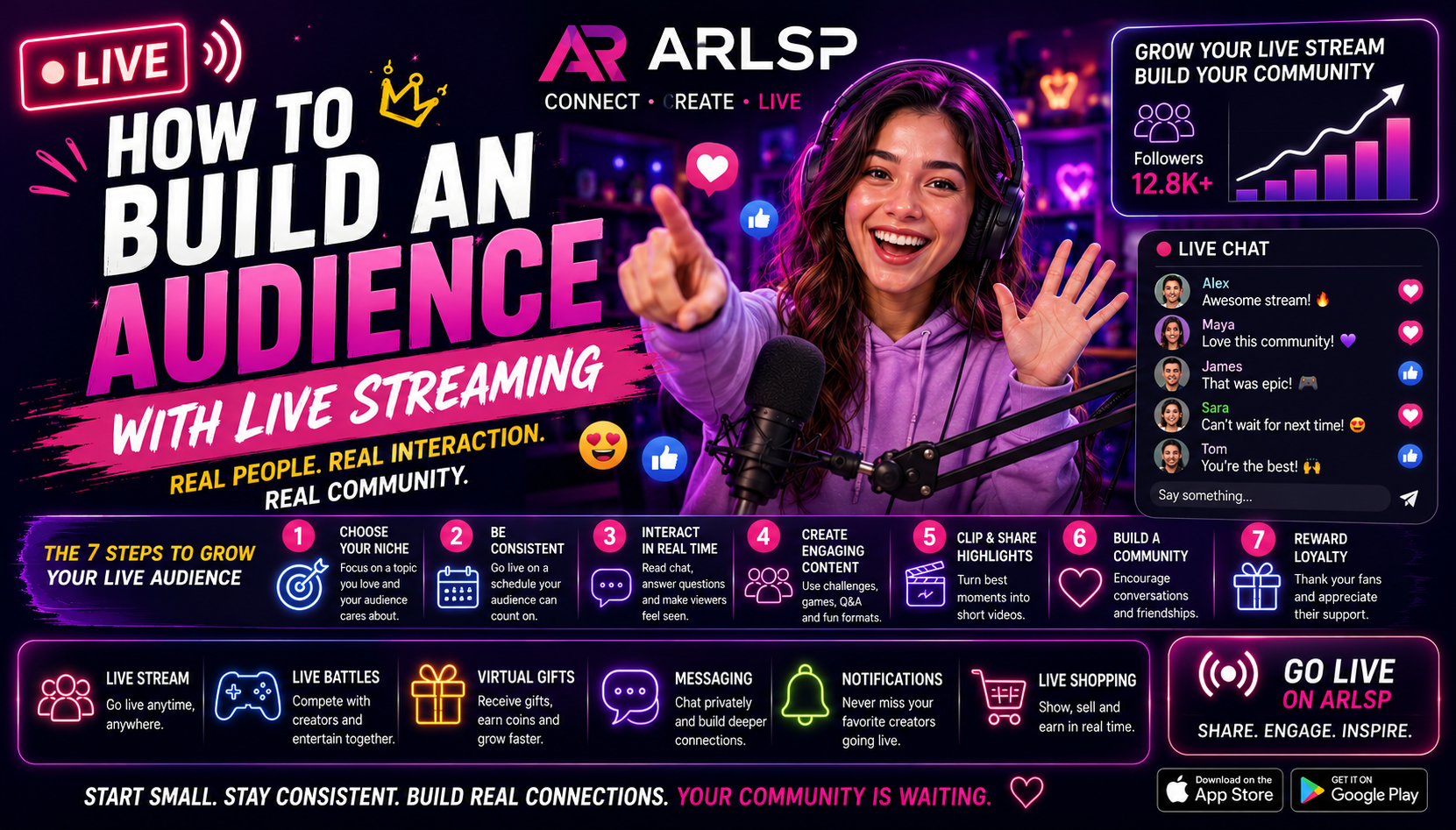
Introduction
Starting a livestream is easy.
Building an audience is not.
Anyone can open a camera, press Go Live, and start broadcasting. The difficult part is giving people a reason to stay, return, interact, and eventually become part of your community.
That is why successful live streaming is not simply about having viewers.
It is about building a relationship with viewers.
A creator who understands this difference can approach live streaming very differently.
Instead of asking:
"How do I get more viewers?"
the better question becomes:
"Why would someone want to come back to my livestream?"
That question changes everything.
Whether you are a gamer, entertainer, traveler, educator, social creator, musician, hobbyist, or simply someone who enjoys talking to people online, the same basic principles can help you build a stronger live audience.
What Does It Mean to Build an Audience?
Audience growth isn't just increasing the viewer count on one livestream.
A healthy creator audience can develop through several stages:
Discover
↓
Watch
↓
Interact
↓
Follow
↓
Return
↓
Become Part of the Community
The goal is to move people through this journey.
A viewer who watches once is valuable.
A viewer who returns every week is much more valuable to the long-term health of a creator community.
Why Live Streaming Is Different From Regular Video
Recorded videos and livestreams can both attract audiences, but they create different experiences.
A recorded video is usually created first and watched later.
A livestream happens while the audience is present.
That means the creator can:
Respond to comments
Answer questions
React to viewers
Change the conversation
Take suggestions
Create spontaneous moments
Build relationships in real time
This makes live streaming particularly powerful for community building.
Step 1: Choose a Clear Content Direction
One of the biggest mistakes new creators make is trying to appeal to everyone.
A viewer should have some idea of what they will experience when they discover you.
Your content could focus on:
Gaming
Gameplay, challenges, competitions, reactions, and gaming discussions.
Entertainment
Comedy, conversations, reactions, challenges, and interactive shows.
Travel
Destinations, local experiences, food, culture, and exploration.
Education
Tutorials, Q&A sessions, demonstrations, and discussions.
Lifestyle
Daily activities, hobbies, interests, and personal conversations.
Social Content
Community discussions, collaborations, interviews, and interactive sessions.
You can eventually expand.
But starting with a recognizable direction makes it easier to build an initial audience.
Step 2: Give People a Reason to Watch
"Going live" isn't a content idea.
It is a format.
The content needs a reason.
Compare:
"I'm live."
with:
"Tonight we're letting the audience choose every challenge."
The second statement creates curiosity.
A good livestream concept should answer:
Why should I watch this?
Examples:
Audience-controlled challenges
Live competitions
Gaming sessions
Travel exploration
Q&A
Creator collaborations
Community discussions
Live reactions
Behind-the-scenes content
Live shopping demonstrations
Step 3: Create a Repeatable Format
You don't need a completely different idea every time.
In fact, recurring formats can help audiences develop habits.
For example:
Monday: Gaming Night
Wednesday: Community Q&A
Friday: Creator Battle
Sunday: Travel & Stories
The specific format doesn't matter as much as consistency.
Eventually, viewers know:
"Friday is when this creator goes live."
That is much stronger than randomly appearing online.
Step 4: Be Consistent
Consistency doesn't mean streaming for ten hours every day.
It means giving your audience a predictable experience.
You might stream:
Three times a week
Twice a week
Every weekend
Specific evenings
Around a recurring event
Choose a schedule you can realistically maintain.
A smaller consistent schedule is usually better than an ambitious schedule you abandon after two weeks.
Step 5: Make the First Few Minutes Count
A viewer can leave quickly if they don't understand what is happening.
When you start, explain:
What are we doing?
What is the goal?
How can viewers participate?
For example:
"Tonight we're doing three challenges, and you decide which one happens next."
Now the audience immediately understands the concept.
Step 6: Talk to Your Viewers
This sounds obvious.
But many new creators focus so heavily on the activity that they forget the audience exists.
If you're gaming, talk.
If you're traveling, explain what you're seeing.
If you're cooking, explain what you're doing.
If you're discussing a topic, ask viewers what they think.
Silence can make a livestream feel empty.
Conversation makes it feel alive.
Step 7: Ask Better Questions
Instead of asking:
"How is everyone?"
try questions connected to your content.
Gaming:
"Which game should we play next?"
Travel:
"Would you visit this place?"
Entertainment:
"Which challenge should we try?"
Education:
"Which part should I explain next?"
These questions are easier for viewers to answer because they have a clear subject.
Step 8: Make Viewers Feel Seen
People remember how a creator makes them feel.
When appropriate:
Read comments
Respond to questions
Welcome returning viewers
Thank people for participating
Acknowledge community milestones
You don't have to respond to every message.
But viewers should feel that interaction is actually possible.
That is one of the biggest advantages of live video.
Step 9: Turn Viewers Into Participants
A passive viewer watches.
A participant interacts.
You can encourage participation through:
Questions
Polls where available
Challenges
Audience choices
Games
Competitions
Predictions
Suggestions
Community discussions
The more meaningful the interaction, the stronger the relationship can become.
Step 10: Create Moments Worth Sharing
Not every part of a livestream will be equally interesting.
That's normal.
Look for moments that create:
Surprise
Humor
Emotion
Competition
Achievement
Useful information
Strong reactions
Those moments can later become short videos or clips.
One Livestream Can Become Multiple Pieces of Content
This is one of the most important strategies for modern creators.
Instead of thinking:
One livestream = One piece of content
think:
One livestream = Content source
For example:
2-Hour Livestream
↓
5 Interesting Moments
↓
3 Short Videos
↓
1 Highlight Video
↓
Several Community Posts
↓
Next Livestream Promotion
This allows creators to get more value from the time they already spent live.
Step 11: Use Short Video for Discovery
Someone may not discover you through your livestream.
They may discover you through a short clip.
That clip gives them a small sample of your personality.
If they enjoy it, they may visit your profile.
Then they may see that you're going live.
The journey becomes:
Short Video
↓
Profile
↓
Livestream
↓
Follow
↓
Community
This is why short-form video and live streaming can complement each other.
Step 12: Build Around Your Personality
You don't need to copy another creator.
In fact, copying another creator can make it harder to establish an identity.
Think about what makes you naturally interesting.
Maybe you are:
Funny
Competitive
Knowledgeable
Relaxed
Energetic
Curious
Good at explaining things
Good at storytelling
Good at connecting with people
Your personality can become part of your content strategy.
Step 13: Don't Chase Every Trend
Trending content can help discovery.
But building an entire creator identity around trends can create an unstable audience.
Someone may follow you because of one viral topic and never return.
A stronger strategy is:
Trend for Discovery
Consistent Content for Retention
Community for Loyalty
Use trends where they make sense.
But don't let them replace your identity.
Step 14: Collaborate With Other Creators
Collaboration can introduce your content to another creator's audience.
Possible formats include:
Interviews
Gaming sessions
Challenges
Live Battles
Q&A
Travel streams
Discussions
Competitions
The best collaborations aren't simply:
"We are both live."
They have a concept.
Give the audience something to watch.
Live Battles as a Community Format
ARLSP's Live Battle feature creates another option for creators who enjoy competition.
Two creators can participate in a live competitive experience while their audiences watch and interact.
This creates multiple engagement points:
Creator A
↕
Creator B
↓
Audience Interaction
For creators, this can become a recurring content format.
For viewers, it creates a reason to stay until the competition develops.
Step 15: Build a Community, Not Just a Viewer Count
This is perhaps the biggest difference between short-term growth and long-term creator growth.
A viewer count tells you how many people are watching.
A community tells you how many people care enough to return.
You want people who:
Recognize your content
Return to your livestreams
Participate in conversations
Recommend you to others
Support your content
Interact with other community members
That is the foundation of a creator brand.
The Audience Growth Funnel
A useful way to understand creator growth is:
Discovery
↓
People encounter your content.
Interest
↓
They become curious about you.
First View
↓
They watch.
Interaction
↓
They comment or participate.
Follow
↓
They choose to stay connected.
Return
↓
They come back.
Community
↓
They become regular participants.
Support
↓
They contribute to the creator ecosystem.
The objective is not simply to maximize the top of the funnel.
You also need to move people downward.
Why Returning Viewers Matter
Imagine two creators.
Creator A
10,000 people watch once.
Creator B
1,000 people watch regularly.
Creator A has impressive reach.
But Creator B may have a stronger community foundation.
Returning viewers can create:
More consistent engagement
More conversation
Better community culture
Stronger creator relationships
More predictable livestream performance
This is why retention deserves as much attention as discovery.
Step 16: Give Your Audience Something to Expect
People return when they know what they are returning for.
That might be:
A weekly challenge
A recurring gaming session
A Friday Live Battle
A Sunday community conversation
A regular travel stream
The format becomes part of your identity.
Step 17: Use Milestones
Milestones can create shared community moments.
For example:
First 100 followers
First major livestream
Community anniversary
Creator achievement
Special event
Collaboration milestone
Celebrate the audience alongside yourself.
Instead of:
"I reached 10,000 followers."
you can frame it as:
"We reached 10,000 together."
That language reinforces community.
Step 18: Experiment
Don't expect to discover your perfect format immediately.
Try different ideas.
For example:
Week 1: Q&A
Week 2: Gaming
Week 3: Challenge
Week 4: Collaboration
Then compare the results.
Look at:
Viewers
Watch time
Comments
Follows
Returning viewers
Community activity
Use the data to identify what your audience actually enjoys.
Step 19: Improve One Thing at a Time
You don't need to rebuild everything after every livestream.
Improve gradually.
Maybe this week you improve:
Audio.
Next week:
Lighting.
Then:
Opening hook.
Then:
Audience interaction.
Then:
Content structure.
Small improvements compound.
Step 20: Make Your Livestream Feel Like an Experience
The strongest creators don't simply broadcast.
They host.
There is a difference.
A broadcaster says:
"I'm here."
A host says:
"Welcome. Here's what we're doing. Come join us."
That second approach creates a stronger sense of participation.
How ARLSP Fits Into This Creator Journey
ARLSP can be positioned as a live-social environment where creators can build audiences through interactive experiences.
Creators can use live streaming to connect with viewers around different interests, including:
Gaming
Entertainment
Travel
Social conversations
Challenges
Community content
Creator collaborations
ARLSP's ecosystem also includes features such as:
Live Battles
Virtual Gifts
Creator Coins
Messaging
Notifications
Creator communities
Live shopping
Audience interaction
This means the creator experience can extend beyond simply broadcasting video.
The objective is to create an environment where creators can go live, interact, build relationships, and develop communities.
Creator Monetization Should Come After Value
Audience growth and monetization are connected, but they shouldn't be confused.
The first objective should be:
Create something people value.
Then:
Build relationships.
Then:
Build community.
Then:
Explore monetization.
ARLSP includes virtual gifting and coin-based interactions that can form part of the creator monetization ecosystem.
But creators should never make every interaction feel like a request for support.
Give people a reason to be there first.
The Creator Growth Loop
A sustainable creator strategy can look like this:
Create Useful or Entertaining Content
↓
Reach New People
↓
Invite Them Into a Livestream
↓
Interact
↓
Build Community
↓
Create Memorable Moments
↓
Repurpose Into Video
↓
Reach New People
↓
Repeat
This creates a continuous loop.
Common Live Streaming Mistakes
Going Live Without a Concept
Simply appearing online isn't always enough.
Streaming for Too Long
Longer doesn't automatically mean better.
Ignoring New Viewers
People joining midway need context.
Never Speaking
Interaction is one of the biggest advantages of live video.
Copying Other Creators
Learn from successful creators without losing your own identity.
Focusing Only on Viewer Count
Retention and interaction matter too.
Giving Up Too Early
Building an audience often requires repeated experimentation.
A Simple 30-Day Live Streaming Plan
Week 1 — Establish Your Format
Choose your category and create two or three livestream concepts.
Week 2 — Test
Run different formats and observe audience behavior.
Week 3 — Double Down
Identify the format producing the strongest engagement.
Week 4 — Build a Routine
Create a recurring schedule and start turning livestream moments into short-form content.
The goal isn't overnight virality.
The goal is creating a repeatable system.
The Most Important Question
Don't ask:
"How do I become viral?"
Ask:
"How do I make someone who discovers me today want to come back next week?"
That is a much more useful question.
Because viral attention can disappear.
A community can remain.
Frequently Asked Questions
How do I get more viewers on my livestream?
Create a clear concept, promote your livestream through short-form content, collaborate with other creators, maintain a consistent schedule, and actively interact with viewers.
How long should I livestream?
There is no universal ideal length. Stream for as long as you can consistently maintain quality, energy, and interaction.
What should I livestream?
Choose a topic that fits your interests and audience, such as gaming, entertainment, travel, education, hobbies, challenges, or social conversations.
How often should I go live?
Choose a realistic schedule you can maintain. Consistency is generally more useful than streaming intensely for a short period and then disappearing.
How can I turn viewers into followers?
Give them a clear reason to return, interact with them, create recurring content, and build a recognizable creator identity.
Can livestreams help build a community?
Yes. Real-time interaction can create stronger relationships between creators and returning viewers.
Can I monetize livestream content?
Depending on the platform, eligibility, and applicable rules, creators may have opportunities involving virtual gifts, sponsorships, commerce, subscriptions, or other creator programs.
What makes ARLSP useful for creators?
ARLSP combines live streaming with social and creator-focused features such as Live Battles, virtual gifts, creator coins, messaging, communities, and audience interaction.
Final Thoughts
Building a live-streaming audience is not about pressing Go Live and hoping people appear.
It is about creating a reason to watch.
Then creating a reason to interact.
Then creating a reason to return.
The strongest creator strategy is therefore not:
Views → Views → Views
It is:
Discovery → Interaction → Follow → Return → Community
Use short videos to attract attention.
Use livestreams to create deeper relationships.
Use recurring formats to build habits.
Use collaborations to expand your reach.
Use memorable moments to create more content.
And most importantly, give your audience a reason to feel that they are part of something.
That is how a livestream can become more than a broadcast.
It can become a community.
And for creators building on platforms such as ARLSP, the opportunity is to combine live video, social interaction, entertainment, creator tools, and community experiences into a single creator journey.
**Don't just build viewers.
Build people who want to come back.**