How to Create a Live Show People Come Back to Every Week
How to Create a Live Show People Actually Come Back to Every Week
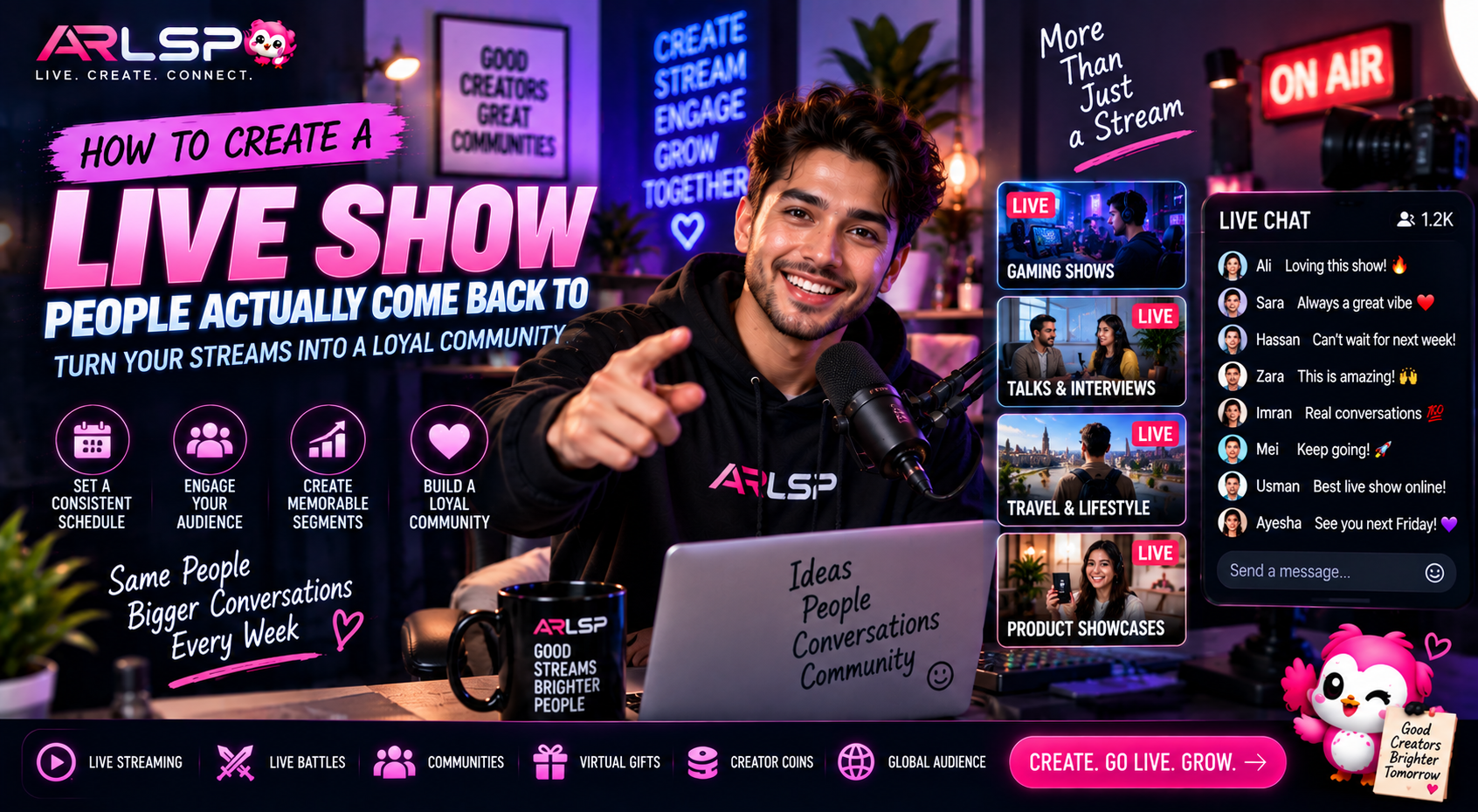
Going Live Is Easy. Building a Show Is Different.
A creator can press Go Live whenever they want.
That does not automatically create a show.
There is a big difference between:
I'm live. Let's see what happens.
and:
Welcome back. Tonight is episode five, and viewers are choosing the final challenge.
The first is a live stream.
The second begins to feel like a live show.
That difference matters because creator growth rarely comes from convincing someone to watch once.
The real opportunity is giving people a reason to return.
A strong recurring live show creates familiarity.
Viewers know:
What kind of content to expect
When it happens
How they can participate
What makes the format different
Why the next session matters
Eventually, the audience does not simply notice that you are live.
They expect you to go live.
That is a much stronger position for a creator.
What Is a Live Show?
A live show is a structured real-time video experience built around a recognizable topic, format or series.
It may include:
Entertainment
Gaming
Interviews
Q&A sessions
Creator challenges
Live Battles
Tutorials
Product demonstrations
Community discussions
Travel or lifestyle experiences
Competitions
The important word is structured.
A live show still feels spontaneous, but it has enough direction that viewers understand what they are watching.
It has a beginning.
It has moments.
It usually has an outcome.
And ideally, it gives people a reason to watch the next episode.
A Live Stream Can Be Random. A Live Show Has an Identity.
Imagine these two creator sessions.
Stream A
I'm bored, so I'm going live.
Stream B
Every Friday, viewers give me three challenges. I have one hour to complete them.
Both are technically live streams.
Only one has an obvious format.
The second gives viewers something they can remember.
That memory is important.
People are much more likely to return to something they can describe.
If a viewer can tell a friend:
There's this creator who lets the audience control three challenges every Friday.
you have created something stronger than another random livestream.
Why Recurring Live Shows Can Help Creators Grow
Every isolated livestream starts almost from zero.
A recurring live show can build on what happened before.
Episode one introduces the idea.
Episode two improves it.
Episode three brings back viewers.
Eventually, regular viewers understand the rules before you explain them.
That creates momentum.
Instead of constantly inventing a completely new live experience, you improve an existing one.
A strong live show can create:
Recognition
↓
Familiarity
↓
Returning Viewers
↓
Audience Traditions
↓
Community
That is much more sustainable than hoping every live session becomes viral.
Start With One Simple Show Idea
Do not begin by creating an overly complicated production.
You need one clear concept.
A good live-show concept can usually be explained in a single sentence.
For example:
Viewers choose three challenges and I have one hour to complete them.
Every Saturday I explore a new place live and the audience chooses where we go.
Two creators compete in a live challenge every Friday.
I answer one difficult creator question every night.
We test budget and premium products live and viewers choose the winner.
If explaining the show takes five minutes, simplify it.
Give the Show a Reason to Exist
A good concept answers:
Why should someone watch this instead of another livestream?
Maybe the value is:
Competition
Education
Entertainment
Access
Discovery
Interaction
Community
Unpredictability
You do not need all of them.
You need a clear reason.
For example, a gaming live show might exist because viewers control the strategy.
A travel live show might exist because the audience chooses the route.
A creator show might exist because difficult questions are answered in real time.
The format should make sense for the audience.
Name Your Recurring Live Show
A simple name can make a format easier to remember.
Examples:
Friday Live Battle
Creator Challenge Night
Build It Live
Viewers Decide
Live Product Test
Weekend Explorer
Ask a Creator
One Hour, Three Challenges
A show name does not need to sound like television.
It simply gives the experience an identity.
Instead of saying:
I'm going live Friday.
you can say:
Creator Challenge Night is back Friday.
That feels like something recurring.
Keep the Name Easy to Understand
Avoid names that make sense only to you.
Someone seeing the title for the first time should have a reasonable idea of what they are getting.
Creative is useful.
Confusing is not.
You can always combine a branded name with a descriptive title.
For example:
Creator Arena: Live Challenge Night
Now you have identity and clarity.
Build a Repeatable Format
Creators often think repetition is bad.
In live entertainment, some repetition is useful.
Viewers like knowing what to expect.
Your show might always include:
Opening
↓
First Segment
↓
Audience Vote
↓
Main Challenge
↓
Community Q&A
↓
Final Result
↓
Next Episode Teaser
The topics change.
The structure stays recognizable.
That saves you planning time and helps the audience follow along.
Create Segments Instead of One Long Conversation
A 60-minute live session can feel very long when nothing changes.
Divide it into sections.
For example:
Opening — 5 Minutes
Explain what is happening today.
Main Topic — 15 Minutes
Begin the core content.
Viewer Decision — 5 Minutes
Let the audience influence the next segment.
Challenge — 15 Minutes
Introduce an outcome viewers can follow.
Community Questions — 10 Minutes
Respond to viewers.
Finale — 10 Minutes
Complete the challenge and preview what happens next.
You do not need to follow exact timings.
The point is creating movement.
The Opening Should Start the Show Immediately
Do not spend the first ten minutes waiting.
Avoid:
We'll get started when more people join.
People are already joining.
Give them something.
A stronger opening might be:
Tonight we have three creator challenges. You choose the order, and I only get one attempt at each.
The viewer immediately understands:
What is happening
How they can participate
What is at stake
That is much stronger than a waiting room.
Create a Familiar Opening
Recurring shows benefit from familiar patterns.
You might always begin with:
Welcome back to Viewer Challenge Friday.
Then quickly explain today's variation.
The audience begins recognizing the show.
Do not make the opening too long.
Familiar does not mean repetitive for five minutes.
Give Each Episode Something New
The format can repeat.
The experience should not be identical.
For example:
Episode 1: viewers choose gaming challenges
Episode 2: another creator joins
Episode 3: losing a challenge adds a penalty
Episode 4: viewers control every decision
Same show.
Different episode.
That balance between familiarity and novelty is important.
Every Live Show Needs a Question the Viewer Wants Answered
Great live content often contains uncertainty.
The viewer wants to know:
Will they succeed?
Who will win?
Which product is better?
What will happen next?
What will the audience choose?
That question creates a reason to continue watching.
A stream without uncertainty can feel flat.
Create Stakes Without Making Everything Dramatic
You do not need huge prizes.
Small stakes work.
For example:
If I lose this round, viewers choose tomorrow's challenge.
or:
Whichever product wins tonight becomes the one we use next week.
or:
If Creator B wins, they choose the next Live Battle rule.
The stakes simply give the outcome meaning.
Let the Audience Influence the Show
Live video has one major advantage over prerecorded content:
the audience is present while you create it.
Use that.
Viewers can decide:
Which topic comes next
Which challenge happens
Which creator joins
Which product gets tested
Which direction you travel
Which gaming strategy you use
Which question you answer first
Participation turns passive viewing into involvement.
Audience Participation Should Be Easy
Do not make viewers write paragraphs just to participate.
Try:
A or B?
Challenge one or challenge two?
Red or black?
Attack or defend?
Yes or no?
Simple actions create momentum.
Once someone comments once, it becomes easier for them to participate again.
Give Viewer Choices Real Consequences
If you ask people to vote, respect the result.
Suppose viewers choose option B.
Then you ignore them and do option A.
Why would they vote next time?
Audience control works because the audience believes its input matters.
If a decision cannot actually influence the show, do not pretend that it can.
Create Recurring Audience Traditions
Strong communities often develop small traditions.
Your show might include:
Question of the Night
Viewer Challenge
Final Vote
Creator of the Week
Community Prediction
Last-Minute Battle
These recurring elements create familiarity.
Returning viewers begin anticipating them.
Give Regular Viewers Something to Recognize
Maybe every show ends with the same question.
Maybe viewers always vote on next week's topic.
Maybe one recurring challenge appears every episode.
Those traditions become part of the show's identity.
People enjoy recognizing patterns.
It makes them feel familiar with the experience.
But Keep the Show Friendly to New Viewers
There is a danger.
Recurring shows can become full of references that new viewers do not understand.
Do not create a private club accidentally.
If you mention an ongoing story, give context.
For example:
If you're new, last week viewers made me attempt this challenge and I failed badly. Tonight we're trying again.
Now everyone understands.
Regular viewers get continuity.
New viewers get context.
Repeat the Premise Throughout the Live Session
Someone joining halfway through did not hear your introduction.
Occasionally say:
Quick update if you're just joining: this is Creator Challenge Night. Viewers gave us three tasks, and we're on the final one.
That single sentence helps new viewers understand why they should stay.
Build Episodes Around Progress
Progress gives a show natural structure.
For example:
Road to Rank X
Building a Creator Studio — Part 4
Trying Every Local Food Market
30-Day Streaming Challenge
Learning a New Skill Live
The audience can follow improvement over time.
Yesterday matters.
Today's episode matters.
Tomorrow has a reason to exist.
Progress-Based Shows Can Create Stronger Return Behavior
If someone watches episode four, they may want to see episode five.
That is useful.
A random stream has no natural follow-up.
A continuing journey does.
This is one reason series can outperform isolated livestream ideas for community building.
Use Cliffhangers Carefully
You do not need to manipulate viewers.
But if something genuinely continues next time, say so.
We didn't finish the setup today. Tomorrow we're testing the final version.
or:
The winner tonight faces another creator next Friday.
That creates legitimate anticipation.
Do not artificially withhold information simply to force another view.
Schedule Helps Turn a Stream Into a Show
A show becomes easier to remember when it happens consistently.
Instead of:
I'll probably go live sometime this week.
try:
Every Friday at 8 PM.
A predictable schedule allows viewers to build habits.
You do not need to stream constantly.
You need a schedule you can actually maintain.
Do Not Choose an Unrealistic Schedule
A creator might announce:
Live every single night!
Then stop after four days.
That is worse than committing to something manageable.
Start with:
once weekly
or
twice weekly
if that is what you can sustain.
You can increase frequency later.
Reliability matters.
Promote the Live Show Before It Starts
Do not rely only on people noticing the live notification.
Build anticipation beforehand.
You can use:
Short videos
Creator profiles
Community posts
Previous live sessions
Relevant social content
Teaser clips
For example:
Friday's Live Battle has one new rule: viewers control the final round.
That gives people something specific to anticipate.
Short Video Is Excellent for Promoting a Live Show
Short-form video can become the discovery layer.
A 20-second clip might say:
Last Friday viewers gave me this challenge. I failed. We're attempting it again tomorrow live.
Now the short video has:
Context
Entertainment
Continuity
A reason to join the live show
The content system becomes:
Short Video
↓
Live Show
↓
Memorable Moment
↓
Short Clip
↓
Next Live Show
That cycle can repeat continuously.
Use Previous Episodes to Promote Future Ones
Your past content is evidence that something happens on your show.
Instead of simply saying:
Join Friday.
show last Friday's best moment.
Then say:
This week the challenge gets harder.
People understand what they are signing up for.
Collaborations Can Make Recurring Shows Stronger
You do not need to host every episode alone.
Invite relevant creators.
For example:
Creator Challenge Night
could feature a different guest each week.
Live Product Test
could bring in experts.
Gaming Battle Friday
could introduce different opponents.
The show remains consistent.
The participants create variety.
Give Guests a Role, Not Just Screen Time
A weak collaboration is:
Here is another creator. Let's talk.
A stronger collaboration is:
Tonight Creator A and Creator B have three challenges. Viewers decide who wins.
The guest becomes part of the format.
That creates clearer entertainment.
Live Battles Fit Naturally Into Recurring Creator Shows
ARLSP includes Live Battles, which can work particularly well inside recurring competitive formats.
For example:
Friday Creator Battle
could become a recognizable weekly series.
One creator faces another.
Viewers participate.
The winner advances.
Next week introduces another matchup.
Now individual Live Battles become connected episodes rather than isolated competitions.
Turn a Live Battle Into a Story
Competition becomes stronger when the audience understands the context.
Explain:
Who the creators are
What today's challenge is
How the result is determined
What the winner gets to do next
What happens in the next episode
A competition without context is simply activity.
Context makes it a story.
Build Shows Around Community, Not Just the Host
A recurring live show becomes much stronger when viewers recognize one another.
Encourage healthy interaction.
You might ask:
What did everyone predict last week?
Or:
Who remembers which option won the previous vote?
The audience becomes part of the continuity.
Make New Viewers Feel Welcome
Never make someone feel like they arrived too late.
Explain ongoing references briefly.
Welcome questions.
Avoid creating the impression that only longtime viewers matter.
Every regular viewer was new once.
Strong Communities Need Healthy Boundaries
A recurring show can create a sense of closeness.
That is valuable.
But creators should maintain appropriate boundaries.
Viewers do not own the creator's time.
Creators do not own the audience's attention.
The show should feel welcoming rather than demanding.
Healthy communities last longer.
Create a Distinct Visual Identity
A recurring show can become more recognizable through consistent visual elements.
That might include:
Similar thumbnail style
Repeated typography
Consistent show name
Recognizable background
A recurring icon
Similar opening graphics
Do not redesign everything every episode.
Familiarity can help viewers recognize the show quickly.
Keep Episode Titles Specific
Your series name can stay the same.
The episode title should explain what is different today.
For example:
Creator Challenge Night: Viewers Control Every Decision
Next week:
Creator Challenge Night: Two Creators, One Final Battle
Next:
Creator Challenge Night: Three Attempts Only
This supports both familiarity and discovery.
Live Events Need More Preparation Than Casual Streams
Some episodes may become bigger live events.
Perhaps:
Multiple creators participate
A special competition happens
A product launches
A major challenge is attempted
A community milestone is celebrated
Treat those sessions differently.
Promote earlier.
Prepare the structure.
Test the setup.
Make the stakes clear.
A special live event should actually feel special.
Not Every Episode Needs to Be a Major Event
If everything is:
THE BIGGEST STREAM EVER!
people eventually stop believing you.
Some sessions can be normal episodes.
Save special-event language for genuinely unusual moments.
That makes those moments more meaningful.
Live Shows Need Pacing
Long live sessions often fail because everything happens at the same intensity.
Think in waves.
Strong opening
↓
Conversation
↓
Challenge
↓
Short reset
↓
Audience decision
↓
Finale
That variation keeps the session from feeling monotonous.
Quiet Moments Are Not Automatically Bad
You do not need constant shouting.
A calmer conversation can give the audience a break.
The problem is not quiet.
The problem is when nothing meaningful is happening.
A thoughtful Q&A can be quiet and still highly engaging.
Create One Strong Moment Per Episode
Before going live, ask:
What is the moment people might remember tomorrow?
It could be:
A final challenge
A product test
A creator competition
A reveal
A viewer decision
A difficult question
An unexpected result
You cannot control whether something goes viral.
But you can create conditions for memorable moments.
Memorable Moments Become Short-Form Content
After the live show ends, find the strongest section.
Turn it into a focused short video.
Add enough context for someone who missed the full session.
For example:
Viewers gave me one impossible challenge during Friday's live show. This is what happened.
That clip becomes discovery content for the next episode.
Build a Content Engine Around One Live Show
A single weekly show can generate:
Before the show
Teaser
Short video
Community question
During the show
Live content
Audience interaction
Creator collaboration
After the show
Highlight clip
Educational short
Funny moment
Quote
Next-episode teaser
Now one recurring live format supports an entire content calendar.
Measure Return Behavior, Not Only Peak Viewers
A huge viewer spike can be exciting.
But for a recurring show, another question matters:
Are people returning?
Look for signals such as:
Familiar viewers
Repeat comments
People referencing previous episodes
Audience predictions
People asking about the next stream
These behaviors suggest the show is developing continuity.
Ask the Audience What They Want More Of
Creators do not need to guess forever.
Ask viewers.
Which segment should stay next week?
Which challenge should we remove?
Who should join next?
Do you prefer the Q&A before or after the competition?
The audience can help improve the format.
You still make the final creative decisions.
But their feedback is useful.
Improve One Part of the Show Each Week
Do not redesign everything after every session.
Choose one improvement.
Week one:
Improve the opening.
Week two:
Make viewer voting easier.
Week three:
Improve pacing.
Week four:
Create a stronger finale.
Small improvements compound.
After several months, the show can become dramatically better without losing its identity.
Do Not Abandon a Format After One Average Episode
Some concepts need time.
Your first episode may feel awkward.
The audience does not know the format yet.
You are still learning.
Give promising ideas enough repetitions to evaluate them properly.
At the same time, do not continue something indefinitely if viewers consistently show no interest.
Use judgment.
Know When to Change the Format
A show may need refreshing when:
You are bored creating it
Viewers stop participating
Every episode feels identical
The premise no longer fits your audience
Better opportunities emerge
You can evolve the format without throwing everything away.
For example:
Viewer Challenge Friday
might evolve into:
Creator vs Viewer Challenge Friday
The brand remains familiar.
The format gains something new.
How ARLSP Can Support Recurring Live Shows
ARLSP includes several confirmed features that can support creators building recurring live formats:
Live streaming
Live Battles
Creator communities
Messaging
Notifications
Trending/discovery features
Virtual gifts
Creator coins
Live shopping
QR profile sharing
The value comes from connecting them thoughtfully.
A creator journey might look like:
Create a Recognizable Live Show
↓
Get Discovered
↓
Encourage Viewer Participation
↓
Use Live Battles or Other Interactive Formats
↓
Build Community
↓
Stay Connected
↓
Bring Viewers Back for the Next Episode
The livestream itself is one piece of the relationship.
Communities Can Extend the Show Between Episodes
If your show happens once a week, what happens during the other six days?
ARLSP's creator-community functionality can support ongoing audience connection.
Creators might continue conversations around:
Next week's topic
Audience suggestions
Previous results
Creator discussions
The next episode can begin before the camera turns on.
Notifications Can Help Returning Viewers Know You Are Live
Once someone genuinely wants to follow your show, knowing when the next session begins matters.
ARLSP includes notification functionality within its creator ecosystem.
This supports the basic rhythm:
discover → enjoy → connect → know when the creator returns
A recurring show benefits from that continuity.
Messaging Can Support Creator Relationships Beyond the Broadcast
Live sessions eventually end.
ARLSP also includes messaging functionality for broader social interaction.
The important principle remains the same:
Use communication to strengthen genuine community relationships, not to spam viewers with constant promotion.
Virtual Gifts Should Support the Show, Not Control It
ARLSP includes virtual gifts and creator coins.
Audience support can become part of live interaction.
But do not design the entire show around asking for gifts.
A viewer should be able to enjoy the complete experience whether they spend anything or not.
Content first.
Community first.
Monetization should fit around genuine value.
Live Shopping Can Become Its Own Recurring Show Format
Creators and sellers can also build series around live commerce.
For example:
Friday Product Test
New Arrival Live
Budget vs Premium
Viewer Chooses the Winner
This is stronger than randomly going live whenever there is something to sell.
The shopping experience gains a recognizable format.
A Simple Live Show Template
Here is a practical structure you can adapt.
1. Opening
State exactly what tonight's show is about.
2. Quick Audience Question
Get people participating early.
3. Main Segment
Deliver the core experience.
4. Audience Decision
Let viewers influence what happens next.
5. Second Segment
Respond to the result.
6. Main Challenge or Event
Create the biggest moment.
7. Community Recap
Talk about what happened.
8. Next Episode Teaser
Explain what happens next time.
Simple formats are easier to repeat.
Before-Show Checklist
Before going live:
Is the episode topic clear?
Does today's episode have something new?
What is the main outcome?
How can viewers participate?
What is the strongest moment?
What should happen in the opening?
Do guests understand their role?
Is the technical setup ready?
What will you tease for the next episode?
If you can answer those questions, the show already has structure.
During-Show Checklist
While live:
Start immediately
Explain the premise
Give context to new viewers
Keep segments moving
Ask easy questions
Respect audience decisions
Create peaks in the experience
Watch for memorable moments
Mention the next episode naturally
After-Show Checklist
Afterward:
Identify the strongest moment
Save potential short clips
Review audience questions
Note where energy dropped
Record ideas for next time
Continue relevant community conversations
Improve one element
Every episode should teach you something.
Common Live Show Mistakes
No Recognizable Format
Every stream feels unrelated.
Too Much Repetition
Nothing new happens between episodes.
Waiting for Viewers
Start the show immediately.
Ignoring New Viewers
Give context throughout the stream.
Fake Audience Decisions
If people vote, let their decision matter.
Overcomplicated Segments
Simple formats are easier to understand.
No Ending
A show should feel like it reached something.
No Next Episode
Give returning viewers something to anticipate.
The Goal Is to Become Part of Someone's Routine
One random live stream may be entertaining.
A recurring live show can become a habit.
That is a much bigger opportunity.
Imagine someone thinking:
It's Friday. That creator's challenge show should be live tonight.
Now you are no longer competing for one accidental click.
You have built expectation.
That expectation comes from:
Consistency
Format
Participation
Quality
Community
and enough novelty to keep the experience interesting.
Stop Going Live Randomly. Start Building Something People Recognize.
There is nothing wrong with spontaneous streams.
Creators should still experiment.
But if you want to build a stronger returning audience, turn some of those live sessions into recognizable experiences.
Give the show a name.
Give it a format.
Give viewers a role.
Create recurring segments.
Build continuity between episodes.
Turn strong moments into short videos.
Improve the experience a little every week.
ARLSP's live streaming, Live Battles, communities, messaging, notifications, discovery and other creator features can support that broader journey.
The goal is not simply:
Go Live.
It is:
Create something people know is worth coming back for.
Frequently Asked Questions
What is a live show?
A live show is a structured real-time video experience built around a recognizable topic, series or format rather than an unplanned livestream.
How is a live show different from a normal live stream?
A live show typically has a recurring format, clear premise, recognizable segments and greater continuity between sessions.
How often should creators host a live show?
The best schedule is one the creator can maintain consistently. For many creators, one or two recurring shows per week can be more sustainable than streaming every day.
How can I get viewers to return to my live streams?
Use recurring formats, consistent scheduling, audience participation, continuing stories and clear previews of what happens in future sessions.
What makes a good live show format?
A good format is easy to explain, repeatable, interactive and flexible enough to create something new in each episode.
Can short videos help promote a live show?
Yes. Creators can use teaser videos, previous highlights and memorable live moments to attract people toward upcoming sessions.
Can Live Battles be part of a recurring live show?
Yes. ARLSP includes Live Battles, which can fit naturally into creator-vs-creator competitions or recurring challenge formats.
Does ARLSP support recurring live creator content?
ARLSP supports live streaming alongside Live Battles, communities, messaging, notifications, discovery, virtual gifts, live shopping and other creator-focused features that can support recurring live formats.