How to Make Short Videos People Actually Watch to the End
How to Make Short Videos People Actually Watch to the End
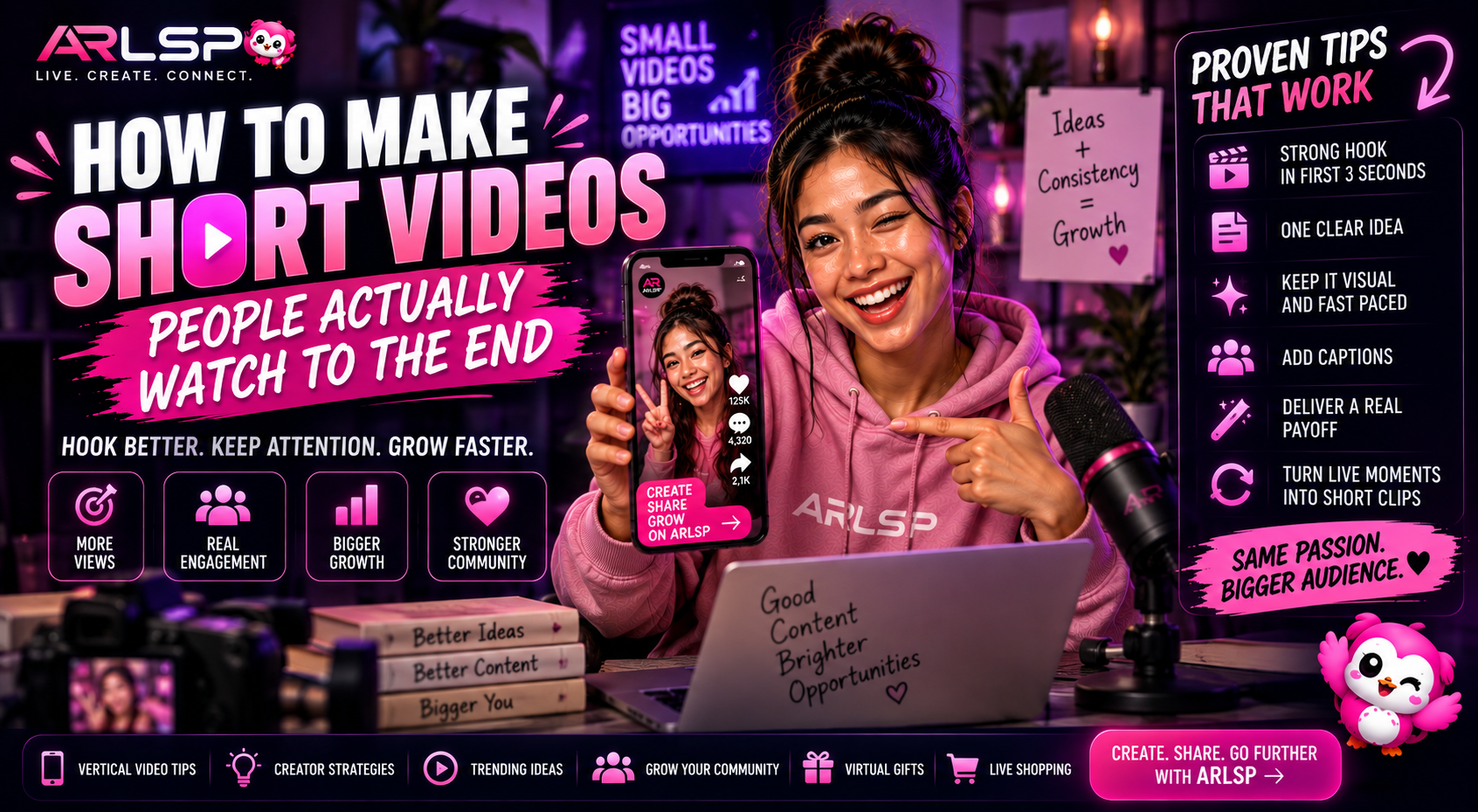
Getting Views Is Only Half the Job
A short video can reach thousands of people and still do very little for a creator.
Someone scrolls.
Your video appears.
They watch for two seconds.
Then they leave.
Technically, you received a view.
But you did not really win their attention.
That is why creators should care about more than simply making a short video.
The bigger goal is creating a video people actually want to finish.
Because when viewers stay longer, understand your idea, react to it and remember who made it, your content has a much better chance of helping you grow.
The strongest short-form videos usually do three things well:
They make people stop.
They give people a reason to stay.
They reward them for reaching the end.
Here is how to build that kind of content.
What Is a Short Video?
A short video is compact video content designed to communicate an idea, story, moment or message quickly.
It is often created for mobile viewing and may appear as:
Vertical video
Social video
Gaming clips
Quick tutorials
Reactions
Travel clips
Product demonstrations
Entertainment
Creator commentary
Behind-the-scenes moments
Short-form content works because it asks for very little commitment.
A viewer does not need 20 minutes.
They may only need 15, 30 or 60 seconds.
But because short videos are so easy to consume, they are also easy to abandon.
That creates the creator's biggest challenge:
attention.
Why People Leave Short Videos So Quickly
Think about how people use their phones.
They are not sitting patiently waiting for your content.
They are scrolling.
Every swipe offers another option.
If the beginning feels slow, confusing or predictable, there is almost no reason to stay.
People often leave because:
The opening takes too long
They do not understand the topic
Nothing interesting happens
The creator repeats themselves
The payoff is obvious
The video feels like an advertisement
The pacing is too slow
The viewer does not know why they should care
The first improvement, therefore, is simple:
remove anything that delays the interesting part.
The First Seconds Decide Everything
Creators often spend most of their effort on the middle of the video.
But many viewers never reach the middle.
Your opening needs to create immediate interest.
Compare these two introductions.
Weak:
Hey everyone, welcome back. Today I wanted to make a quick video about something I've been thinking about.
Stronger:
If people keep leaving your videos after three seconds, this is probably why.
The second version immediately creates:
A problem
Relevance
Curiosity
A reason to continue
That is what a hook should do.
A Good Hook Does Not Need to Be Clickbait
You do not need to exaggerate.
You just need to make the value clear.
Useful hook styles include:
Problem Hook
Your videos may not be boring. Your first three seconds might be.
Curiosity Hook
I changed one thing in this video, and people stayed much longer.
Result Hook
Here is how I would turn this boring 30-second clip into something people actually finish.
Challenge Hook
Can I explain live-stream growth in 20 seconds?
Contrarian Hook
More editing does not always make a better short video.
Audience Hook
If you are a new creator, stop doing this at the beginning of your videos.
The best hook matches what the video actually delivers.
Tell the Viewer What They Are Getting
Confusion destroys retention.
Someone should understand the basic idea quickly.
If the viewer is thinking:
What is this about?
for too long, they may leave.
A good opening can establish the topic in one sentence.
For example:
Here are three ways to make your live streams more interactive.
Now the viewer knows exactly what they are watching.
Clarity does not make content boring.
It makes the content easier to trust.
One Short Video Should Usually Have One Main Idea
Trying to fit five unrelated topics into 30 seconds creates chaos.
A better short-form video focuses on one thing.
For example:
Bad:
Five streaming tips, three monetization ideas, the best equipment, platform selection and audience growth.
Better:
One mistake that makes new livestreamers look unprepared.
One idea makes the content:
Easier to understand
Easier to edit
Easier to title
Easier to remember
Easier to share
You can always create another video for the next idea.
Build Curiosity Without Hiding the Answer Forever
Curiosity is useful.
Frustration is not.
A creator might say:
Wait until the end to discover the secret.
Then spend 45 seconds saying nothing useful.
That may get someone to stay once.
It probably will not build trust.
A stronger approach gives value throughout the video.
For example:
There are three reasons viewers leave early. The third is the one most creators overlook.
Now there is a reason to keep watching, but the video can still deliver value immediately.
Use a Simple Short-Video Structure
One useful structure is:
Hook
↓
Context
↓
Value
↓
Payoff
↓
Next step
For example:
Hook:
People are leaving your livestream clips too quickly.
Context:
Most creators start with introductions nobody needs.
Value:
Start with the strongest moment instead.
Payoff:
The viewer immediately knows why they should care.
Next step:
Try it on your next clip.
Simple structures reduce unnecessary filler.
Start With the Most Interesting Moment
Creators often think chronologically.
The interesting moment happened after 18 seconds, so they leave it there.
That may be a mistake.
If the strongest moment is at second 18, consider showing part of it at second one.
For example:
I thought this Live Battle was over. Then this happened.
Now the viewer wants context.
This technique works particularly well for:
Gaming
Live reactions
Travel
Challenges
Product tests
Creator competitions
Behind-the-scenes content
Show the result.
Then explain how you got there.
Cut Anything the Viewer Does Not Need
A short video has very little room for wasted time.
Remove:
Long greetings
Repeated explanations
Dead air
Unnecessary transitions
Slow setup
Sentences that say the same thing twice
Ask:
If I remove this sentence, does the video still make sense?
If yes, consider removing it.
Short-form content often improves through subtraction.
Pacing Does Not Mean Talking as Fast as Possible
Some creators mistake speed for engagement.
They speak so quickly that the content becomes difficult to follow.
Good pacing means something meaningful keeps happening.
That can be:
A new sentence
A visual change
A demonstration
A reaction
A question
A new example
A change in camera framing
The content should feel active, not exhausting.
Use Visual Changes to Reset Attention
If the screen looks identical for 40 seconds, viewers may lose interest.
Small visual changes can help.
For example:
Change framing
Show the product
Display an example
Insert a screenshot
Show gameplay
Add a relevant caption
Switch from creator to demonstration
Include a reaction shot
Each change gives the brain something new to process.
But do not edit just for the sake of editing.
The visual should support the idea.
Vertical Video Should Be Designed for a Phone
Most short-form content is consumed on mobile devices.
That means creators should think vertically.
Important elements should be easy to see on a small screen.
Keep:
Faces clearly visible
Text readable
Products large enough to understand
Main actions near the center
Important information away from crowded interface areas
Do not design a vertical video like a small television screen.
Design it for the device people actually use.
Captions Can Make Short Videos Easier to Follow
Not everyone watches with full audio.
Captions can help people understand the video when:
They are in public
Their phone is muted
The creator speaks quickly
The accent is unfamiliar
Background noise exists
But avoid turning the screen into a wall of text.
Highlight the important words.
Let the video remain visual.
Give the Viewer Something to Wait For
Strong short-form videos often create a small open loop.
For example:
I tested three livestream titles. One performed much better than the others.
Now the viewer wants to know which one.
Or:
The first two tips are obvious. The third is why most beginner streams feel empty.
The viewer now has a reason to continue.
That is retention by curiosity.
The Payoff Must Be Worth the Wait
If the video promises something interesting, deliver it.
Imagine the hook says:
This simple change doubled my engagement.
Then the answer is:
Just make better content.
That feels disappointing.
The payoff should be:
Specific
Useful
Interesting
Surprising
Entertaining
Emotionally satisfying
Viewer trust matters more than one completed view.
Storytelling Works Even in 20 Seconds
You do not need five minutes to tell a story.
A short story can be:
Problem
↓
Attempt
↓
Unexpected moment
↓
Result
Example:
I went live for the first time and nobody joined. Instead of ending the stream, I kept talking as though 100 people were watching. Ten minutes later, people started joining, and they had something to watch immediately.
That is a complete story.
Short does not mean meaningless.
Use Specific Details
Specificity makes content feel real.
Weak:
I struggled with streaming at first.
Stronger:
My first live stream had zero comments for the first 12 minutes.
The second sentence creates an image.
Specific details are easier to remember.
Emotion Makes Content More Shareable
People often share content because it made them feel something.
That might be:
Surprise
Excitement
Humor
Inspiration
Curiosity
Recognition
Frustration
Hope
A useful question before publishing is:
What should someone feel after watching this?
If the answer is “nothing,” the video may need a stronger angle.
Useful Content Can Perform Without Being Dramatic
Not every short video needs shock or controversy.
Practical information can be extremely compelling.
For example:
Three things to check before you go live from your phone.
or:
How to make your livestream audio sound clearer without buying a new microphone.
The value itself becomes the hook.
Useful content builds trust.
Do Not Chase Every Trending Video Format
Trends can create visibility.
But copying every trend can make your creator identity unclear.
Ask:
Does this trend make sense for my audience?
A gaming creator could adapt a trend to gameplay.
A travel creator could adapt it to destinations.
A seller could adapt it to products.
A livestream creator could adapt it to audience interaction.
The trend provides familiarity.
Your niche provides relevance.
Trending Content Works Better When You Add Your Own Angle
Simply copying a popular video makes you one of many.
Try adding:
Your experience
Your niche
Your opinion
Your result
Your audience
Your challenge
For example:
Generic:
Things I wish I knew sooner.
Creator-specific:
Three things I wish I knew before my first livestream.
Now the trend has a clear audience.
Turn Live Streams Into Short Video Clips
You do not always need to record new short-form content.
Live streaming can produce excellent raw material.
Look for moments such as:
Funny reactions
Strong opinions
Helpful answers
Audience questions
Unexpected outcomes
Live Battle highlights
Product demonstrations
Emotional moments
A 60-minute stream may contain dozens of potential clips.
The key is not uploading the entire section.
Extract the strongest idea.
A Live Clip Still Needs a Hook
Just because something was interesting during the livestream does not mean it will work as a short video automatically.
Live viewers already had context.
Short-video viewers do not.
Before publishing the clip, ask:
Would a stranger understand why this matters?
You may need to add a short opening.
For example:
A viewer asked me the hardest question I've received during a livestream.
Then show the clip.
Now the moment has context.
One Live Stream Can Become an Entire Week of Content
Imagine you host one useful live session.
You could create:
Short Video 1: strongest advice
Short Video 2: funniest moment
Short Video 3: viewer question
Short Video 4: controversial opinion
Short Video 5: teaser for the next live session
This creates a sustainable creator workflow.
Instead of:
What should I post every day?
you ask:
What useful moments did I already create?
Short Video Should Lead Somewhere
Views are useful.
But a strong creator strategy thinks beyond views.
What should someone do next?
Depending on your goal:
Watch another video
Follow you
Visit your profile
Join a live session
Join your community
Explore a product
Share the content
Your next step should feel natural.
Avoid Begging for Engagement
There is a difference between a natural call to action and constant begging.
Instead of:
Like, comment, share, follow, subscribe and send this to five people.
Try:
Which one would you try first?
That creates a real conversation.
Or:
I'm testing the second method live tomorrow.
That gives viewers a reason to return.
Use Questions That People Can Answer Quickly
Complicated questions produce fewer responses.
Compare:
What is your overall perspective on the future of livestream engagement?
with:
Would you rather watch a Live Battle or a Q&A?
The second question requires almost no effort.
Short-form interaction should feel easy.
Create Recognizable Series
Instead of publishing disconnected videos, create recurring formats.
Examples:
Livestream Mistake of the Day
60 Seconds for New Creators
Live Battle Highlights
Creator Question of the Week
One Streaming Tip
Before You Go Live
Series help audiences recognize your content.
They also make planning easier.
Consistency Is Easier When the Format Is Repeatable
Many creators quit because every video feels like starting from zero.
A recurring format solves that.
You already know:
The opening style
The topic category
The visual structure
The length
The audience
Now you only need the next idea.
That reduces creative pressure.
How Long Should a Short Video Be?
There is no universal perfect length.
The correct length is:
as long as necessary to deliver the idea without unnecessary delay.
Some ideas need 10 seconds.
Others need 45.
Others need more.
Do not stretch a 12-second idea into 60 seconds simply because you can.
And do not compress a useful explanation until nobody can understand it.
Retention starts with respecting the viewer's time.
Should Every Video Be Very Short?
No.
A strong video should feel complete.
If the viewer reaches the end and thinks:
That's it?
you may have cut too much.
The goal is not the shortest possible video.
It is the clearest possible video.
What Makes People Rewatch a Short Video?
Rewatches often happen when:
The ending connects to the beginning
Something happens quickly
The information is dense
The viewer missed a detail
The result is surprising
The clip is entertaining
The explanation is worth hearing again
You can sometimes structure the ending so it naturally loops back to the beginning.
But do it because it improves the experience, not as a trick.
Popular Video Content Usually Feels Easy to Understand
Some creators overcomplicate their message because they want to sound expert.
But clarity is powerful.
You should be able to explain the main idea in one sentence.
If you cannot, the video may contain too much.
Simple does not mean shallow.
It means focused.
Short Videos Can Be the Discovery Layer of Your Creator Strategy
A useful way to think about short-form video is:
Discovery content.
Someone sees you for the first time.
Your goal is not necessarily to build a deep relationship in 20 seconds.
Your goal may simply be:
earn the next interaction.
That could mean:
Watch another video.
Then:
Follow.
Then:
Join a live stream.
Then:
Become part of the community.
Growth happens through steps.
From Short Video Viewer to Live Viewer
This is where short-form content becomes especially useful for live creators.
Imagine someone watches a short clip:
Three mistakes beginners make when they go live.
At the end:
I'm fixing all three in a live session tonight.
That CTA makes sense.
The live stream continues the topic.
You are not randomly asking someone to join.
You are offering the next chapter.
How ARLSP Fits Into This Content Journey
ARLSP can support the interactive stage after initial discovery.
Once people become interested in a creator, ARLSP's confirmed creator-focused features include:
Live streaming
Live Battles
Communities
Messaging
Notifications
Virtual gifts
Creator coins
Trending/discovery features
Live shopping
QR profile sharing
That creates a possible creator journey:
Short Video
↓
Discovery
↓
Interest
↓
Go Live
↓
Real-Time Interaction
↓
Community
Instead of treating short-form content and live streaming as separate worlds, creators can use each format for what it does best.
Use Short Video to Build Curiosity Before Going Live
Before a live session, publish a short teaser.
For example:
Tomorrow I'm trying three live-stream formats. Viewers will choose the winner.
Or:
I normally wouldn't try this live, but we're doing it tomorrow.
The short video does not need to explain everything.
Its job is to create interest.
Use Short Video After the Live Stream Too
After the stream:
Find the strongest moment.
Turn it into a short clip.
Then add:
This happened during last night's live.
Now viewers who missed the session can still discover it.
And they may want to join the next one.
This creates a content loop.
The Short-Video Growth Loop
A sustainable system could look like:
Create useful short video
↓
Reach new viewers
↓
Bring interested viewers toward your profile/live content
↓
Interact during live sessions
↓
Create memorable moments
↓
Turn those moments into short clips
↓
Reach new viewers again
Now each format supports the next.
A Practical Short-Video Checklist
Before publishing, ask:
Hook:
Would a stranger understand why they should stop?
Clarity:
Is the topic obvious?
Focus:
Does the video have one main idea?
Pacing:
Is anything unnecessarily slow?
Visuals:
Does something meaningful happen on screen?
Payoff:
Does the ending deliver what the opening promised?
Mobile:
Can people understand it easily on a phone?
CTA:
Is there a logical next step?
If several answers are “no,” improve the video before publishing.
Common Short-Video Mistakes
Long Introductions
You do not need to introduce yourself every time.
Start with the idea.
Too Much Information
One video does not need to explain everything.
Create a series.
Copying Trends Without Relevance
A trend should support your niche, not replace it.
No Payoff
If the hook promises something, deliver it.
Overediting
Constant effects cannot fix weak content.
No Personality
Useful content still needs your perspective.
No Connection to Bigger Creator Goals
Views alone do not automatically build community.
Know what you want the viewer to do next.
Short Video Success Is Not Just About Going Viral
A viral video can be exciting.
But one viral clip does not automatically create a sustainable creator career.
A creator would usually rather have:
consistent discovery
plus
returning viewers
plus
an engaged community
than depend entirely on random viral moments.
Think beyond:
How many views did this get?
Also ask:
Did anyone remember me?
Did anyone follow?
Did anyone return?
Did anyone join the next live session?
Those questions are closer to real creator growth.
Make Every Second Earn Its Place
The best short-form videos respect attention.
They do not waste time getting started.
They do not hide the value.
They do not confuse viewers.
They make a clear promise and deliver it.
If you want people to watch longer:
Start stronger.
Remove unnecessary words.
Focus on one idea.
Create curiosity.
Deliver a satisfying payoff.
Give viewers a reason to continue their relationship with you.
Short video can help people discover you.
Live video can help them know you.
And community can give them a reason to keep coming back.
For creators building that journey, ARLSP provides an interactive environment around live streaming, Live Battles, communities, messaging, virtual gifts, discovery and live shopping.
Do not chase attention for one video.
Build a content system that turns attention into connection.
Frequently Asked Questions
How do you make a short video more engaging?
Start with a clear hook, focus on one main idea, remove unnecessary introductions, use relevant visual changes and give viewers a strong payoff.
What is the best length for a short video?
There is no single best length. A short video should be long enough to deliver the idea clearly without unnecessary filler.
Why do viewers leave short videos quickly?
Common reasons include slow introductions, unclear topics, weak hooks, poor pacing, repetitive information and disappointing payoffs.
What is vertical video?
Vertical video is content designed in portrait orientation for mobile screens. It is commonly used for short-form social video.
How can creators improve short-video retention?
Creators can improve retention by beginning with the strongest part, creating curiosity, keeping the content focused, removing dead time and delivering the promised value quickly.
Can livestreams be turned into short videos?
Yes. Creators can extract useful, funny, surprising or emotional moments from livestreams and turn them into focused short clips.
Can short videos help grow a live-streaming audience?
Yes. Short videos can introduce creators to new viewers and direct interested people toward future live sessions.
How does ARLSP support creators after short-video discovery?
ARLSP supports interactive creator experiences through confirmed features including live streaming, Live Battles, communities, messaging, notifications, virtual gifts, creator coins, discovery and live shopping.