Live Streaming vs Live Broadcast: What's the Difference?
Live Streaming vs Live Broadcast: What Creators Need to Know Before They Go Live
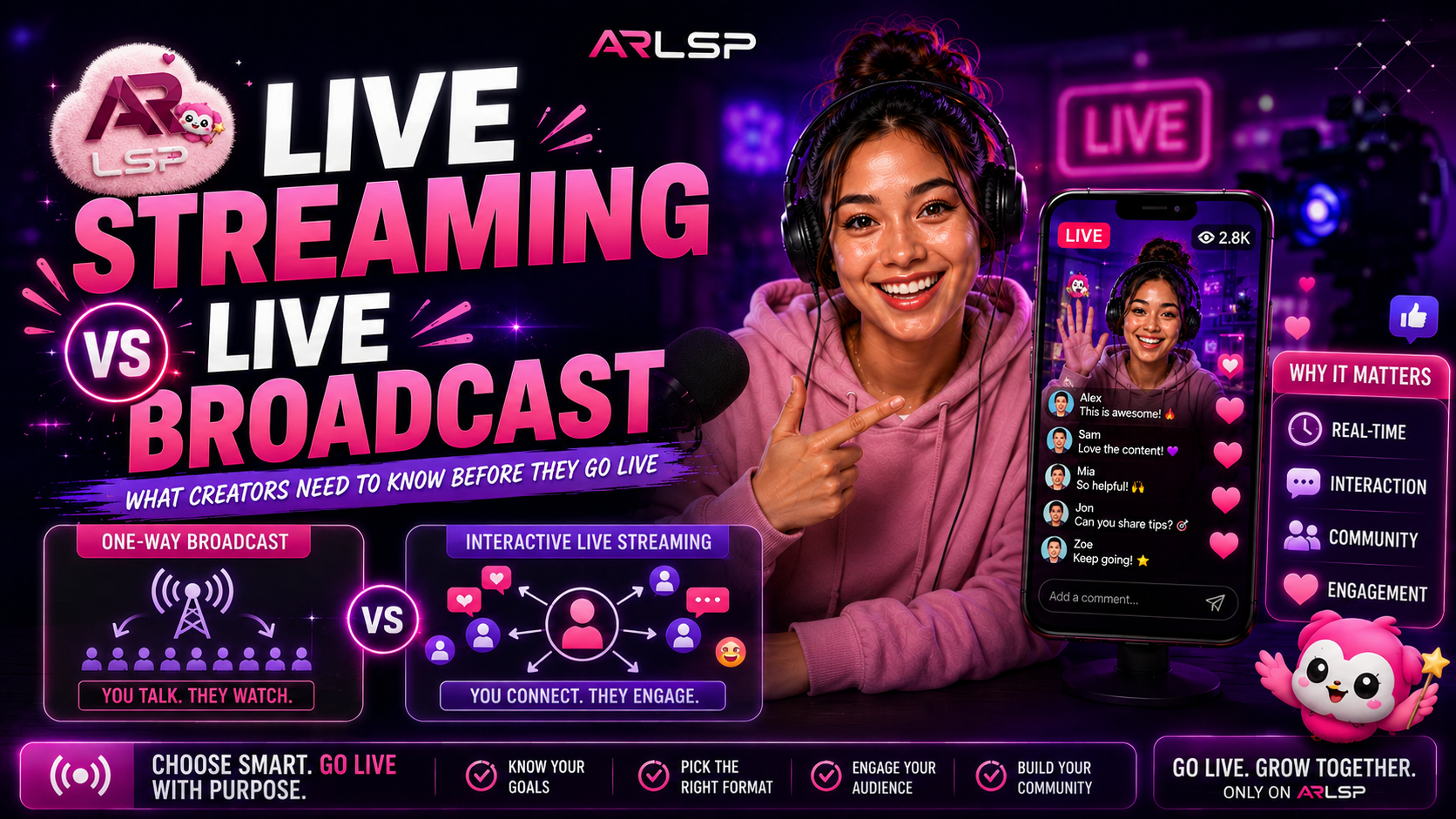
Live video has changed the way people communicate online.
A creator can pick up a phone, tap Go Live, and immediately start talking to viewers from different locations. A gamer can stream gameplay. A seller can demonstrate a product. A traveler can share a destination while actually standing there.
But terms such as live streaming, live broadcast, live video, live feed, and going live are often used as though they mean exactly the same thing.
They don't always.
Understanding the difference matters because the way creators approach a traditional broadcast can be very different from the way they approach an interactive live stream.
A broadcast mainly focuses on delivering content.
Modern live streaming can go much further.
It can create conversations, communities, audience participation and ongoing relationships between creators and viewers.
So what exactly separates a live stream from a live broadcast, and which approach should creators use?
Let's break it down.
What Is Live Streaming?
Live streaming is the real-time transmission of video or audio over the internet while viewers watch the content as it happens.
Instead of recording a video, editing it and publishing it later, the creator sends the content directly to viewers.
Examples include:
A gamer streaming gameplay
A creator answering questions live
A musician performing online
A traveler showing a destination
A seller demonstrating products
An educator teaching a live session
Two creators competing in a live challenge
A community host discussing a topic with followers
The important word is real-time.
The audience is experiencing the content at almost the same moment the creator produces it.
That creates something prerecorded video cannot completely reproduce:
immediacy.
Viewers know something is happening now.
That sense of being present can make live content particularly powerful.
What Is a Live Broadcast?
A live broadcast also delivers content in real time, but the term traditionally comes from television and radio.
Think about:
Live television news
Sports broadcasts
Award ceremonies
Political events
Concert broadcasts
Major announcements
Traditional broadcasting usually follows a:
one-to-many model.
The broadcaster delivers information.
The audience watches.
There may be millions of viewers, but most of them have little direct influence over what happens during the broadcast.
Live streaming introduced a different model.
Instead of simply broadcasting to an audience, creators can increasingly communicate with their audience.
That difference is important.
Live Streaming vs Live Broadcast: The Main Difference
At a technical level, both involve transmitting content in real time.
The biggest practical difference is often the relationship between the person creating the content and the people watching it.
A traditional broadcast looks something like:
Broadcaster → Audience
A modern interactive live stream can look more like:
Creator ↔ Audience ↔ Community
That second model creates many more possibilities.
Viewers may:
Comment
Ask questions
React
Send virtual gifts
Participate in discussions
Join creator communities
Follow creators
Receive notifications
Watch Live Battles
Discover other creators
Participate in live shopping experiences
This is why live streaming has developed into much more than simply putting television on the internet.
It has become a form of social interaction.
Live Streaming vs Broadcasting at a Glance
Live BroadcastLive StreamingTraditionally one-wayOften interactiveUsually professional productionCan start from a smartphoneAudience mainly watchesAudience can participateOften scheduled programmingScheduled or spontaneousTV/radio originsInternet-firstLimited viewer interactionComments, reactions and engagementUsually large media organizationsAccessible to individual creatorsContent-focusedContent + community-focused
The lines can overlap.
A major sporting event might be both a broadcast and an online live stream.
The real difference is increasingly about how the audience participates.
Why Live Streaming Became So Important for Creators
The internet gave individual creators something that was once available primarily to large media organizations:
the ability to broadcast live to an audience.
But creators gained something even more valuable.
They gained feedback.
When someone posts a prerecorded video, most interaction happens after publication.
During a live stream, interaction happens while the content is being created.
A viewer might ask:
Can you show us that again?
Another might suggest:
Try this challenge next.
Someone else might ask:
Where are you streaming from?
The creator can immediately respond.
That changes the nature of the content.
The audience is no longer completely passive.
They can become part of the experience.
What Happens When You Go Live?
Although live platforms differ, the basic process is usually straightforward.
The creator starts a live session using a phone, computer or streaming setup.
The platform distributes the live video to viewers.
People can then discover or join the stream.
Depending on the platform, they may interact through:
Comments
Reactions
Messaging
Gifts
Community features
Creator interactions
Live competitions
Product experiences
The stream continues until the creator ends the session.
Simple technically.
Much more complicated strategically.
Because pressing Go Live doesn't automatically create an audience.
Going Live Is Easy. Keeping People Watching Is Harder.
One of the biggest mistakes new creators make is assuming that live streaming itself creates engagement.
It doesn't.
The technology simply gives you the opportunity.
What matters is what happens after the viewer enters the stream.
Imagine someone discovers your live video.
Within seconds they are unconsciously asking:
What is happening here?
Why should I stay?
Is this interesting?
Can I participate?
Is something going to happen?
If the answer isn't clear, they leave.
Successful live streaming therefore requires more than simply turning on a camera.
Creators need a reason for viewers to stay.
Give Every Live Stream a Clear Purpose
Weak live stream:
I'm live. Ask me anything.
Stronger live stream:
I'm testing five viral creator challenges live — you choose which one I do next.
The second concept gives the audience:
Context
Participation
Curiosity
A reason to stay
A reason to comment
This illustrates an important principle.
A successful live stream normally needs a format.
Live Stream Formats Creators Can Use
Different audiences respond to different types of live content.
Here are several formats creators can experiment with.
Q&A Live Sessions
Invite viewers to ask questions about a clear topic.
For example:
Ask a fitness coach anything about beginner workouts.
That's stronger than simply:
Ask me anything.
Specificity attracts the right audience.
Behind-the-Scenes Streams
Show viewers something they normally would not see.
Examples:
Preparing for a performance
Setting up a gaming stream
Creating a product
Traveling to an event
Preparing content
Running a small business
Behind-the-scenes content can make viewers feel closer to the creator.
Live Tutorials
Teach something while viewers follow along.
Examples:
Cooking
Drawing
Makeup
Software
Language practice
Gaming techniques
Photography
The audience can ask questions while learning.
That creates a major advantage over prerecorded tutorials.
Live Gaming
Gaming naturally fits live streaming because the outcome is unpredictable.
A creator can:
Stream gameplay
Explain strategies
React to unexpected events
Talk with viewers
Accept community challenges
Compete with other creators
The combination of unpredictability and interaction gives viewers a reason to continue watching.
Live Battles and Creator Competitions
Creator-vs-creator formats add another layer to live entertainment.
Instead of one creator presenting content alone, two creators can compete or interact around a challenge.
ARLSP includes Live Battles, allowing creators to introduce competition into their live content.
A battle creates:
Creator A
vs.
Creator B
while viewers follow and participate in the experience.
This can make a normal live session feel more like an event.
Live Shopping and Product Demonstrations
Live video is also useful when audiences want to see products rather than simply read about them.
A seller or creator can demonstrate:
How a product works
Different product variations
Real-world use
Features
Answers to viewer questions
This combines entertainment, information and commerce.
ARLSP includes live shopping and product showcasing/selling capabilities, which makes live commerce one relevant use case within its broader creator ecosystem.
We'll explore live commerce much more deeply in its own content cluster rather than turning this article into a shopping guide.
The Real Power of Live Video Is Interaction
A prerecorded video might receive:
10,000 views.
But those viewers may never interact with one another.
A smaller live audience can sometimes create a much stronger sense of community because people are experiencing something simultaneously.
Imagine 80 viewers watching a creator live.
One person asks a question.
Another viewer responds.
The creator joins the conversation.
Someone recognizes another regular viewer.
A discussion develops.
Now the stream isn't simply content.
It is becoming a social space.
That is one of the biggest opportunities live streaming offers creators.
Live Streaming Can Turn Viewers Into Participants
The difference between an audience and a community often comes down to participation.
Watching:
Creator produces → viewer consumes
Participating:
Creator creates → viewer reacts → creator responds → viewers interact → community develops
Live streaming makes that loop much easier.
Creators who understand this stop treating comments as interruptions.
They treat them as part of the content.
How to Get More Interaction During a Live Stream
Instead of waiting for viewers to participate, actively create opportunities.
Ask Specific Questions
Weak:
What do you think?
Better:
Which setup looks better — A or B?
The second question is easier to answer.
Give the Audience Decisions
Let viewers influence what happens.
For example:
Should I try level one or level two next?
or:
Which product should I demonstrate next?
People become more invested when their choices affect the stream.
Recognize Viewers
Acknowledging comments can make the experience feel personal.
Someone joining a live session doesn't want to feel like an invisible number.
Small recognition can create a much stronger connection.
Create Recurring Segments
Give viewers something they expect every stream.
For example:
Question of the Day
Viewer Challenge
Live Battle Friday
Creator Spotlight
Product Test
Recurring formats can eventually become part of a creator's identity.
Live Stream, Live Video and Live Feed: Are They Different?
These terms frequently overlap.
Live Stream
Usually refers to internet-based real-time content.
Live Video
A broad term describing video being transmitted live.
Live Feed
Often refers to an ongoing real-time source of video or information.
Live Broadcast
Traditionally refers to broadcasting live content to a large audience.
Go Live
The action of starting a live stream or broadcast.
For most creators, the terminology matters less than the strategy.
The real question is:
What experience are you giving someone who joins your stream?
Live Streaming From a Phone vs Professional Streaming
Creators don't necessarily need an expensive studio to start.
Mobile devices have made live streaming accessible to almost anyone.
Mobile Live Streaming
Useful for:
Travel
Lifestyle
Casual conversations
Events
Outdoor content
Behind-the-scenes video
Its biggest advantage is flexibility.
You can potentially go live wherever your content happens.
Desktop or Studio Streaming
Useful for:
Gaming
Interviews
Tutorials
Professional shows
Multi-camera content
Longer sessions
A more advanced setup can offer greater control, but equipment alone does not make a stream interesting.
Content still matters more than the camera.
Live Streaming for Travel Creators
Travel demonstrates why live video can be different from prerecorded content.
A traditional travel video shows:
what happened.
A live travel stream shows:
what is happening.
The audience can experience the moment alongside the creator.
Imagine walking through a market while viewers decide which direction you explore.
Or showing a destination while answering questions in real time.
That creates a completely different relationship with the viewer.
Live Streaming for Businesses
Live streaming isn't limited to influencers.
Businesses can use live video for:
Product demonstrations
New product launches
Q&A sessions
Customer education
Behind-the-scenes content
Community events
Founder discussions
Live selling
The principle remains the same.
Don't simply broadcast information.
Give viewers a reason to participate.
Live Streaming for Educators and Experts
Live video can also work particularly well when the audience has questions.
Examples include:
Language teachers
Coaches
Designers
Developers
Consultants
Tutors
Fitness instructors
A prerecorded lesson answers predicted questions.
A live session can answer the actual questions viewers are asking.
That creates a more responsive learning experience.
What Makes a Good Live Streaming Platform?
Creators evaluating a live platform should think beyond the ability to transmit video.
A useful platform should support the broader creator experience.
Questions worth considering include:
Can creators interact with viewers?
Streaming without interaction is simply broadcasting.
Can audiences discover creators?
Discovery matters if creators want to reach people beyond their existing followers.
Can creators build communities?
The relationship shouldn't necessarily end when the stream ends.
Are there engagement features?
Interactive features can make streams more participatory.
Are there monetization opportunities?
Creators increasingly consider sustainability alongside audience growth.
Does the platform support the creator's content style?
Gaming, shopping, lifestyle and educational creators may need different things.
From Broadcasting to Building a Community
This is where modern live streaming becomes particularly interesting.
Traditional broadcast thinking says:
How many people watched?
Creator-community thinking asks:
How many people came back?
That's a much more important question.
One viral stream can produce attention.
A returning audience creates an asset.
Creators therefore need to think beyond viewer count.
Look for signs such as:
Returning viewers
Regular commenters
Community conversations
Repeat participation
Viewer recognition
People joining future streams
Those behaviors show that something deeper than temporary attention is forming.
How ARLSP Fits Into Interactive Live Streaming
ARLSP is designed around a broader live-social creator ecosystem, rather than treating live video only as a broadcasting tool.
Creators can go live and use relevant platform features such as:
Live streaming
Live Battles
Virtual gifts
Creator coins
Creator communities
Messaging
Notifications
Trending/discovery features
Live shopping
QR profile sharing
The important opportunity isn't simply:
broadcast video.
It is:
Live Content → Interaction → Community → Engagement → Monetization Opportunities
For a creator, that changes the objective of going live.
Instead of thinking:
I need as many viewers as possible today.
Think:
How can today's stream give viewers a reason to return tomorrow?
That shift can completely change a creator's live strategy.
A Simple Live Streaming Strategy for New Creators
If you're preparing to start streaming, use this framework.
Step 1: Choose a Clear Topic
Don't go live about everything.
Choose a reason for the session.
Step 2: Give the Stream a Hook
Explain immediately what viewers will experience.
For example:
Today I'm testing three ways creators can improve their first live stream, and we'll choose the best one together.
Step 3: Encourage Interaction Early
Don't wait 20 minutes before asking viewers something.
Invite participation quickly.
Step 4: Create a Repeatable Format
A successful idea should be reusable.
One live stream is content.
A weekly recurring live show can become a property.
Step 5: Build Beyond the Stream
Encourage viewers to follow, connect and return.
The live stream should become the beginning of the relationship rather than the end.
Common Live Streaming Mistakes
Going Live Without a Topic
People enter and don't understand what is happening.
Result:
They leave.
Waiting for Viewers Before Starting
A creator sits silently saying:
I'll wait until more people join.
New viewers see nothing happening and leave.
Start delivering value immediately.
Talking Without Involving the Audience
A 60-minute monologue may technically be live streaming.
But it isn't necessarily interactive.
Use the live format.
Ask.
React.
Respond.
Participate.
Copying Large Creators
A famous creator may attract viewers simply because of their name.
A new creator needs a stronger reason.
Your format matters more when nobody knows you yet.
Chasing Viewer Count Only
Ten engaged regular viewers can be more valuable for long-term community development than hundreds of people who leave immediately.
Growth should include both:
reach
and
relationship.
Is Live Streaming Better Than Traditional Broadcasting?
Neither is universally better.
They serve different purposes.
Traditional broadcasting is extremely effective when the goal is distributing professionally produced content to very large audiences.
Interactive live streaming becomes particularly powerful when the goal includes:
Participation
Creator relationships
Community
Real-time feedback
Social interaction
Live commerce
Creator monetization
For individual creators, that interactive layer is often the real opportunity.
The Future of Live Content Is More Interactive
The internet has gradually changed the definition of an audience.
People once mainly watched.
Then they commented.
Then they followed.
Now they participate.
Creators can increasingly build experiences where audiences influence what happens in real time.
That's why the future of live content will likely be defined less by:
Who can broadcast?
and more by:
Who can create the strongest live experience?
The technology to go live is becoming common.
The ability to make people care, participate and return is what separates strong creators from everyone else.
Start Thinking Beyond the Broadcast
Going live is no longer simply about putting a camera in front of yourself.
It's an opportunity to create a real-time relationship with an audience.
A strong live streaming strategy can turn:
viewers into participants
participants into followers
followers into regular viewers
and eventually:
regular viewers into a community.
Platforms such as ARLSP provide creators with live streaming alongside interactive features such as communities, Live Battles, messaging, virtual gifts and discovery.
The opportunity is therefore bigger than simply broadcasting.
Go live. Create a reason to participate. Give people a reason to return.
That's where live streaming starts becoming more than video.
It becomes a community.
Frequently Asked Questions
What is live streaming?
Live streaming is the real-time transmission of video or audio over the internet so viewers can experience content while it is happening.
What is the difference between live streaming and live broadcasting?
Traditional live broadcasting is generally a one-to-many communication model, while modern live streaming often includes audience interaction through comments, reactions, communities and other engagement features.
What does go live mean?
To go live means to start broadcasting or streaming real-time video to an online audience.
What is a live streaming platform?
A live streaming platform is an online service that allows creators or organizations to transmit live video to viewers over the internet.
Can beginners start live streaming?
Yes. Many creators begin using a smartphone before investing in more advanced streaming equipment. Content, consistency and audience interaction are usually more important than expensive equipment at the beginning.
How can creators make live streams more engaging?
Creators can ask specific questions, involve viewers in decisions, create recurring formats, respond to comments, run challenges and give audiences a clear reason to participate.
Can creators build communities through live streaming?
Yes. Live streaming allows audiences and creators to interact in real time, making it useful for building relationships that continue beyond individual streams.
Does ARLSP support live streaming?
Yes. ARLSP includes live streaming along with creator-focused features such as Live Battles, communities, virtual gifts, creator coins, messaging, notifications, discovery and live shopping.