Live Streaming vs Short-Form Video
Live Streaming vs Short-Form Video
Introduction
Creators today have more ways to reach an audience than ever before.
A short video can reach thousands of people within hours.
A livestream can bring creators and viewers together in real time.
Social media can introduce a creator to completely new audiences.
And communities can turn occasional viewers into regular followers.
So which format should creators focus on?
Live streaming or short-form video?
The answer is not as simple as choosing one.
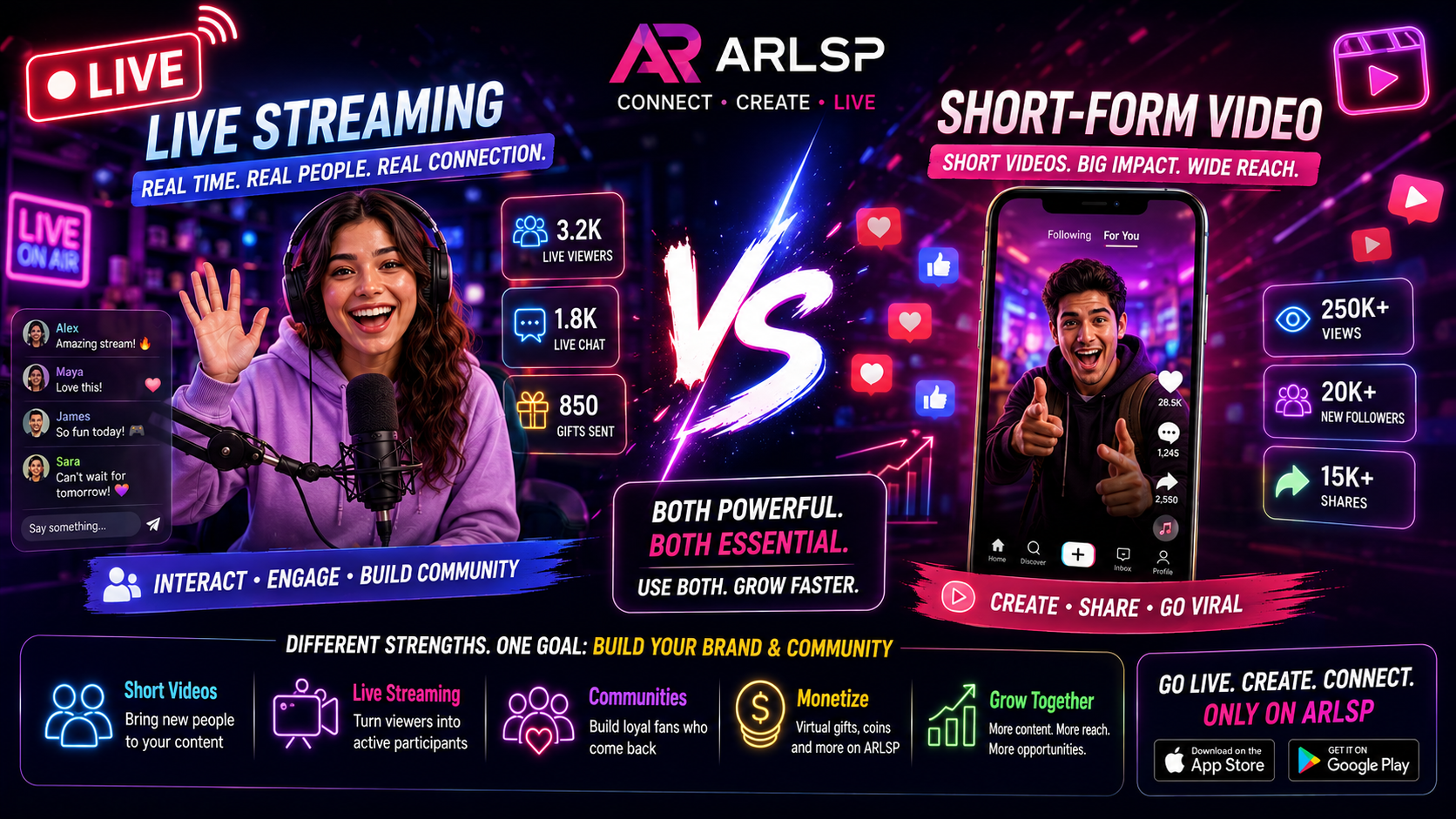
Short-form video is excellent for discovery.
Live streaming is powerful for interaction and community.
One can help people discover you.
The other can give them a reason to stay.
For creators building a serious presence in 2026, the stronger strategy may be to understand how these formats work together rather than treating them as competitors.
What Is Short-Form Video?
Short-form video is content designed to communicate an idea, moment, story, reaction, or entertainment experience in a relatively short format.
Examples include:
Quick tutorials
Funny clips
Gaming highlights
Travel moments
Reactions
Challenges
Trending content
Creator tips
Behind-the-scenes clips
Short entertainment videos
The major strength of short-form video is speed of consumption.
Someone can discover your content without knowing who you are.
They can watch.
They can swipe.
They can share.
They can follow.
That makes short video particularly useful for reaching new audiences.
What Is Live Streaming?
Live streaming is different.
Instead of recording content and publishing it for people to watch later, the creator broadcasts while the audience is present.
Viewers can potentially:
Comment
Ask questions
React
Participate
Make suggestions
Support creators
Join community conversations
The experience is happening in real time.
That changes the relationship between creator and viewer.
A short video might say:
"Watch this."
A livestream can say:
"Come join us."
Live Streaming vs Short-Form Video at a Glance
Short-Form VideoLive StreamingMain strengthDiscoveryInteractionConsumptionFastReal-timeAudience relationshipQuick interactionDeeper interactionContent lifespanCan continue circulatingFocused around live eventCommunity buildingModerateStrong potentialSpontaneityLimitedVery highViewer participationUsually limitedReal-timeBest useReach new peopleBuild relationshipsRepurposingEasyCan create clips afterward
Neither format automatically wins.
They solve different problems.
Why Short-Form Video Is Powerful
Imagine someone has never heard of you.
They are unlikely to search for your two-hour livestream.
But they might encounter a 20-second video while scrolling.
That video gives you an opportunity to capture attention.
If they enjoy it, they may visit your profile.
Then they may discover your longer content or livestream schedule.
This makes short-form video a powerful top-of-funnel content format.
Why Live Streaming Is Powerful
Now imagine the same person joins your livestream.
Instead of watching a 20-second clip, they spend 20 minutes interacting with you.
They ask a question.
You answer.
They comment again.
You respond.
They watch something unexpected happen.
They return the next day.
The relationship has changed.
They are no longer simply consuming your content.
They are participating in it.
The Biggest Difference: Passive vs Interactive Viewing
Short-form video is usually designed around a viewer consuming content.
Live streaming can turn that viewer into a participant.
Consider a gaming creator.
A short video might show:
"My best gaming moment of the week."
A livestream could let viewers:
Watch the gameplay
Suggest strategies
Ask questions
React to decisions
Participate in challenges
Watch competitions
The second experience has a different level of involvement.
Discovery vs Community
This is one of the simplest ways to understand the difference.
Short Video
Discovery
People who don't know you can encounter your content.
Live Streaming
Community
People who already have some interest can spend time with you.
That doesn't mean short videos can't build communities.
They absolutely can.
And livestreams can attract new viewers.
But each format has a natural strength.
The Smartest Strategy: Use Both
Instead of:
Short Video OR Live Streaming
think:
Short Video + Live Streaming
The two formats can feed each other.
For example:
Short Video
↓
New viewer discovers creator
↓
Creator Profile
↓
Sees upcoming livestream
↓
Live Stream
↓
Interacts with creator
↓
Follows
↓
Returns
↓
Community
That is a much stronger creator journey.
Use Short Videos to Promote Your Livestream
Suppose you're going live on Friday.
Don't simply wait for people to notice.
Create short content before the event.
For example:
"Friday we're doing a creator challenge live."
Or:
"Tonight I'm testing whether I can complete this challenge."
Or:
"Join me tonight and decide what happens next."
The short video becomes an invitation.
The livestream becomes the experience.
Turn Livestreams Into Short Videos
The relationship works in the opposite direction too.
A livestream can contain dozens of interesting moments.
You might find:
A funny reaction
An unexpected event
A great gaming moment
An interesting conversation
A creator competition
An audience interaction
A surprising achievement
Those moments can become short videos.
So instead of:
One livestream = one piece of content
think:
One livestream = multiple content opportunities.
The Content Flywheel
A creator can build a simple system:
Create Short Video
↓
Reach New Audience
↓
Invite Viewers to Live Stream
↓
Build Interaction
↓
Create Memorable Moments
↓
Extract Short Clips
↓
Publish More Videos
↓
Reach More People
↓
Repeat
This creates a continuous content cycle.
Live Streaming Creates Real-Time Moments
One reason live content remains attractive is unpredictability.
You can plan a livestream.
But you cannot completely control what happens.
A viewer might ask an unexpected question.
A competition might take an unexpected turn.
A game might produce a surprising result.
A travel experience might suddenly change.
Those moments can become some of the most memorable content a creator produces.
Short Videos Can Be More Controlled
Short-form content usually allows creators to:
Record multiple takes
Edit mistakes
Add captions
Change pacing
Remove unnecessary sections
Add music or graphics
Improve the opening
That control is useful.
Creators can package their strongest moments into a highly focused piece of content.
Live Streaming Shows More Personality
Short videos can show personality.
But livestreams often reveal more of it.
Viewers can see:
How you respond to questions
How you handle unexpected situations
How you communicate
How you react
How you interact with your community
Over time, this can make the creator-viewer relationship feel more personal.
Live Streaming Is Especially Strong for Community
A community doesn't form simply because someone watches a video.
It develops through repeated interaction.
Livestreaming can provide many opportunities for this:
Creator ↔ Viewer
Viewer ↔ Creator
Viewer ↔ Viewer
The audience can begin recognizing familiar names.
People can share conversations.
Inside jokes can develop.
Regular events can become community traditions.
This is where livestreaming can move beyond content and become a social experience.
Different Niches Can Use Both Formats
The combination isn't limited to gaming.
Gaming
Short clips can showcase exciting moments.
Livestreams can provide complete gameplay and audience interaction.
Travel
Short videos can showcase destinations.
Livestreams can let viewers experience the journey in real time.
Entertainment
Short videos can capture funny moments.
Livestreams can create interactive shows.
Education
Short videos can answer quick questions.
Livestreams can provide detailed Q&A sessions.
Social Content
Short videos can introduce opinions or conversations.
Livestreams can turn those topics into discussions.
Gaming Example
A gaming creator could create:
Short Video
"Watch this incredible final move."
Then:
Livestream
"Join me tonight as I try to repeat it."
Then:
Live Competition
"Can another creator beat the challenge?"
Then:
Short Video
"The funniest moment from the competition."
One idea can become an entire content cycle.
Travel Example
A travel creator might publish:
Short Video
"Three things you need to see in this city."
Then:
Livestream
"Come explore the city with me."
During the livestream, viewers suggest where to go.
Later, the creator turns the best moments into additional short videos.
Again:
Short Content → Live Experience → More Short Content
Social Media and Live Streaming Work Together
Social media can act as the discovery layer.
Live streaming can act as the interaction layer.
This creates a useful distinction:
Social Media
"Here I am."
Live Streaming
"Come talk to me."
Community
"Let's stay connected."
Creators who understand these different roles can build a more complete digital presence.
What About Trending Content?
Trends can help short-form video gain attention.
A creator can react to a trend, adapt it to their niche, or add a personal perspective.
But trends shouldn't become the entire strategy.
A creator who only follows trends may attract people who have no long-term interest in the creator.
A better approach is:
Use trends for discovery.
Use original content for identity.
Use livestreaming for relationships.
Fun Content Can Bridge the Gap
Fun content works particularly well across both formats.
For example:
Short Video
"Would you survive this challenge?"
Then:
Livestream
"Let's actually try it."
The short video creates curiosity.
The livestream provides the full experience.
Live Battles Create a Different Type of Content
Competition can make live streaming even more engaging.
ARLSP's Live Battle feature provides a creator-versus-creator format where audiences can watch and interact around the competition.
This introduces another content structure:
Creator A
vs.
Creator B
with:
Audience Interaction
The competition creates a clear storyline.
Who wins?
What happens next?
How does the audience react?
This type of live content can also produce memorable moments that creators can later turn into video content.
ARLSP's Role in the Creator Content Ecosystem
ARLSP can be positioned as more than a place to simply broadcast live video.
Its creator-focused ecosystem combines live streaming with social interaction and monetization-oriented features.
Depending on the creator's content strategy, ARLSP includes features such as:
Live Streaming
Live Battles
Virtual Gifts
Creator Coins
Communities
Messaging
Notifications
Live Shopping
Audience Interaction
This creates opportunities for creators to build content around both entertainment and interaction.
The livestream can be the central experience.
Community features can help maintain the relationship between live sessions.
Why ARLSP Can Be Attractive to Emerging Creators
Large established platforms can provide enormous audiences.
But emerging creators also need environments where they can focus on:
Building relationships
Creating communities
Experimenting with formats
Interacting with viewers
Developing their creator identity
Exploring monetization opportunities
ARLSP's creator-first ecosystem gives emerging creators another environment in which to experiment with interactive live content.
The objective shouldn't be to copy the biggest platforms.
It should be to create a creator experience that gives audiences a reason to participate.
Live Streaming and Monetization
Different platforms use different monetization models.
Depending on eligibility and platform rules, creators may have access to:
Virtual gifts
Subscriptions
Advertising
Sponsorships
Commerce
Premium content
Creator programs
ARLSP includes virtual gifts and coin-based interactions within its ecosystem.
However, monetization should come after audience value.
The order should be:
Create
↓
Engage
↓
Build Trust
↓
Build Community
↓
Monetize
A creator who focuses only on monetization can quickly make the audience experience feel transactional.
Which Is Better for New Creators?
If you are completely new, short-form video can be useful for getting your first exposure.
Why?
Because people can discover you without already knowing your name.
But once people become interested, live streaming can help you deepen that relationship.
So a practical approach is:
Use video to attract.
Use live streaming to connect.
Use community to retain.
Which Format Takes More Preparation?
Short videos often require more editing and post-production.
Livestreams can require less editing but demand stronger real-time communication.
You need to be comfortable:
Speaking
Responding quickly
Handling unexpected situations
Keeping the conversation moving
Entertaining people without editing
Both formats require skill.
They simply require different skills.
Don't Judge Your Livestream by the Same Standard as a Short Video
A short video might receive thousands of views.
A livestream might receive fewer.
That doesn't automatically mean the livestream failed.
Consider what happened during the livestream:
How long did people stay?
Did they participate?
Did people return?
Did the community become more active?
Did followers increase?
Did viewers interact?
The value of live content isn't captured by a single number.
Build a Balanced Content Strategy
A creator could divide content into three layers.
Layer 1 — Discovery
Short videos.
Purpose:
Reach new people.
Layer 2 — Engagement
Livestreams.
Purpose:
Interact with people.
Layer 3 — Retention
Community.
Purpose:
Give people a reason to return.
This creates a much more complete strategy than relying on one format.
A Simple Weekly Strategy
Here's an example:
Monday
Short video.
Tuesday
Short educational or entertaining video.
Wednesday
Community content.
Thursday
Livestream promotion clip.
Friday
Main livestream.
Saturday
Best livestream moment.
Sunday
Audience question or discussion.
The schedule can be adjusted based on the creator's niche and available time.
What Creators Should Measure
Don't only track views.
For short videos, look at:
Views
Watch time
Completion
Shares
Comments
Follows
For livestreams, consider:
Peak viewers
Average viewers
Watch time
Comments
Returning viewers
Followers gained
Community activity
This helps you understand which content actually contributes to growth.
The Future Is Not Live vs Video
The more useful question is:
How can live and recorded video work together?
A creator doesn't need to choose between them.
A short video can introduce you.
A livestream can build the relationship.
Another video can bring more people in.
A community can keep them connected.
That creates a creator ecosystem rather than a collection of unrelated posts.
A Practical Creator Funnel
Here is a simple model:
Short Video
↓
Discovery
↓
Profile
↓
Follow
↓
Live Streaming
↓
Interaction
↓
Community
↓
Returning Viewer
↓
Long-Term Supporter
Each stage has a different purpose.
Final Verdict: Which One Is Better?
There is no universal winner.
If your main goal is:
Reach → Short-form video
If your main goal is:
Real-time interaction → Live streaming
If your goal is:
Community → Live streaming + social content
If your goal is:
Long-term creator growth → Combine both
The most effective strategy isn't necessarily choosing one format.
It is understanding what each format does best.
Final Thoughts
Short-form video can put your content in front of people who have never heard of you.
Live streaming can turn those viewers into participants.
Community can turn participants into returning members.
That creates a powerful journey:
Video → Discovery → Live → Interaction → Community
For creators, the opportunity in 2026 isn't simply to create more content.
It is to create a connected content ecosystem.
Use short videos to capture attention.
Use trends carefully to increase discovery.
Use entertaining content to create curiosity.
Use livestreaming to build relationships.
Use community features to maintain those relationships.
And use platforms such as ARLSP to explore an environment where live video, social interaction, creator communities, Live Battles, virtual gifts, creator coins, and other interactive experiences can work together.
The question isn't:
"Should I choose live streaming or video?"
The better question is:
"How can I use video to bring people to my livestream—and use my livestream to give them a reason to stay?"