Short-Form Video vs Live Video: Which Grows Audiences Faster?
Short-Form Video vs Live Video: Which Is Better for Audience Growth?
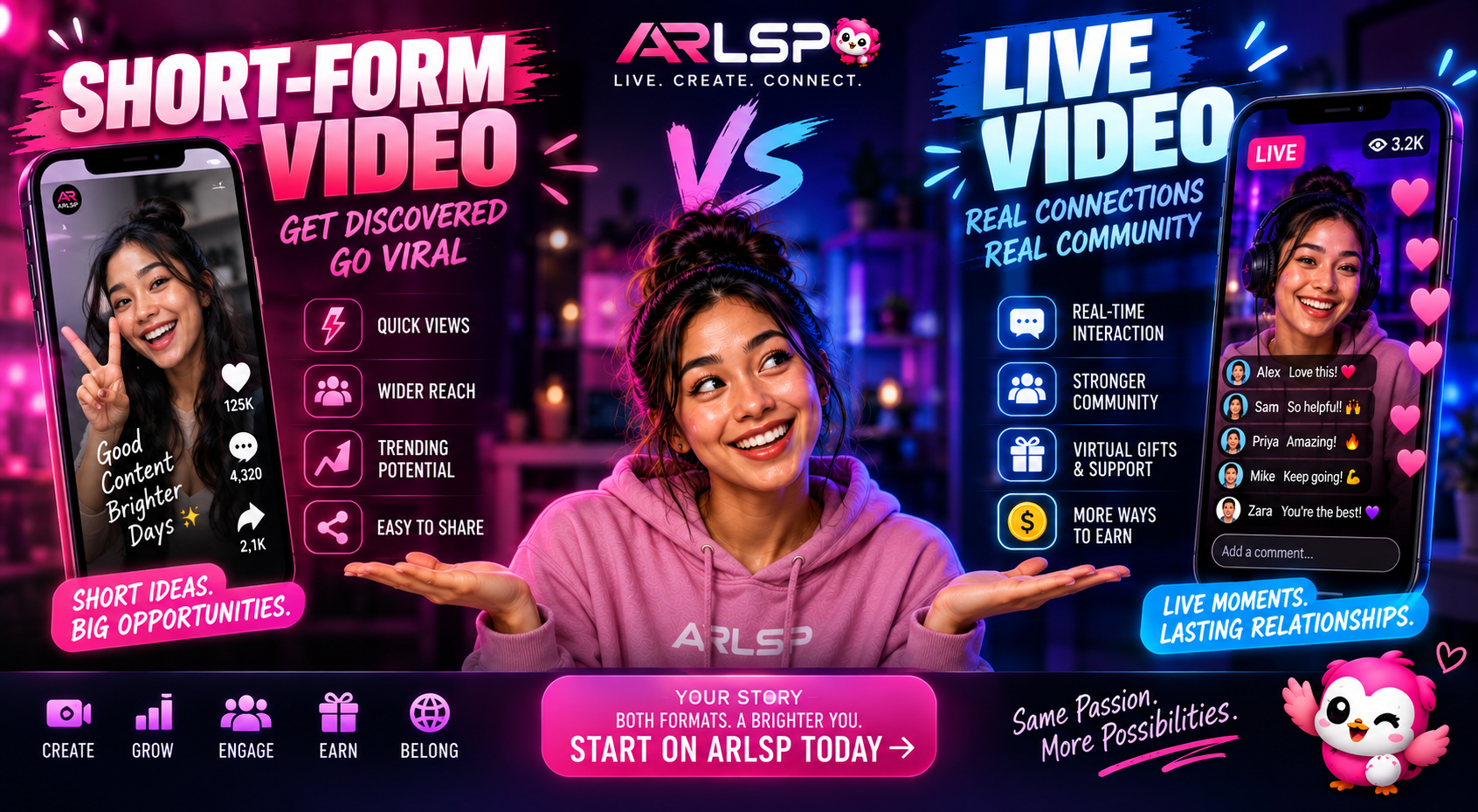
Short-Form Video Gets Attention. Live Video Builds Connection.
Creators today have more ways to reach people than ever before.
You can publish a 20-second vertical video.
You can upload a viral clip.
You can create a social video around a trending idea.
Or you can turn on the camera and talk to your audience in real time.
The problem is deciding where to put your effort.
Should you focus on short-form video because it can reach more people quickly?
Or should you focus on live video because it creates deeper interaction?
The answer is not necessarily one or the other.
For many creators, the strongest strategy is:
Short video for discovery.
Live video for connection.
When those two formats work together, creators can build a much stronger growth system than relying on either one alone.
What Is Short-Form Video?
Short-form video is compact video content designed to communicate an idea, moment or story quickly.
It is usually:
Easy to consume
Mobile-friendly
Highly visual
Fast-paced
Designed for quick discovery
Often vertical
Easy to share
Common examples include:
Quick tutorials
Funny clips
Reactions
Gaming highlights
Travel moments
Product demonstrations
Before-and-after videos
Educational tips
Creator opinions
Behind-the-scenes moments
The strength of short video is simple:
someone can understand it quickly.
That makes it ideal for people who have never seen your content before.
What Is Live Video?
Live video is real-time content where viewers watch while the creator is actually producing the content.
Instead of:
record → edit → upload → watch
the experience becomes:
go live → viewers join → interaction happens immediately
Live video can include:
Gaming
Q&A sessions
Tutorials
Live Battles
Product demonstrations
Travel streams
Creator conversations
Entertainment
Community events
Its biggest strength is not necessarily reach.
Its biggest strength is interaction.
Short-Form Video vs Live Video: The Main Difference
Short video is usually designed to win attention quickly.
Live video is usually better positioned to hold a conversation.
Think about it like this:
Short-form video:
“Look at this.”
Live video:
“Come experience this with me.”
One format gets people through the door.
The other gives them a reason to stay.
Short Video vs Live Video at a Glance
Short-Form VideoLive VideoFast consumptionLonger interactionStrong discovery potentialStrong relationship potentialUsually editedHappens in real timeEasy to replayExperience is happening nowDesigned for scrollingDesigned for participationGood for reaching strangersGood for engaging viewersWorks well as highlightsWorks well as community contentLess pressure while recordingRequires real-time confidence
Neither format automatically wins.
The right choice depends on what you are trying to achieve.
If Your Goal Is Discovery, Short-Form Video Has an Advantage
Imagine someone has never heard of you.
They are much more likely to watch a 15-second clip than commit immediately to a one-hour livestream.
That makes short-form content useful for the top of the creator funnel.
A strong short video can quickly communicate:
Who you are
What you create
Why your content is interesting
What makes you different
This is why creators often use short videos as an introduction.
The viewer does not need to trust you yet.
They only need to be curious for a few seconds.
Short-Form Video Works Well for New Audiences
Someone scrolling through content may have no intention of discovering you.
Your video appears.
The first few seconds catch their attention.
They watch.
Maybe they follow.
Maybe they watch another clip.
This creates a discovery path.
Scroll → Stop → Watch → Visit Profile → Follow
That is one of short-form video's biggest strengths.
It can introduce creators to people who were not actively searching for them.
Why Some Short Videos Go Viral
There is no guaranteed formula for creating a viral video.
But videos that spread tend to give people an immediate reason to keep watching.
Common ingredients include:
Strong curiosity
Surprise
Humor
Emotion
Useful information
Relatable situations
A clear payoff
Strong visual movement
An interesting opinion
A memorable moment
The first few seconds matter enormously.
People decide quickly whether to continue watching.
A Better Way to Think About Viral Video
Many creators make a mistake.
They ask:
How do I make this go viral?
A better question is:
Why would someone stop scrolling for this?
Virality is an outcome.
Attention comes first.
If the opening is weak, the rest of the video may never be seen.
The First Seconds of a Short Video Matter Most
Weak opening:
Hey guys, today I wanted to talk about something.
Stronger opening:
Most new livestreamers make this mistake before their first viewer even joins.
The second opening creates curiosity immediately.
You know:
Who it is for
What the problem is
Why you should continue watching
Short-form video rewards clarity.
Live Video Solves a Different Problem
Short video can introduce someone to you.
But it can be difficult to create a meaningful relationship in 20 seconds.
This is where live streaming becomes powerful.
During a live session, a viewer can:
Ask a question
Receive an answer
Share an opinion
Participate in a challenge
Join a conversation
Return to another stream
Become part of a community
The creator is no longer just content on a screen.
They become someone the audience can interact with.
Live Video Creates Real-Time Feedback
Imagine publishing a short video about gaming.
You might receive comments later.
Now imagine streaming the game live.
Someone asks:
Why did you choose that strategy?
You answer immediately.
Another viewer disagrees.
A discussion starts.
Someone suggests the next challenge.
Now the audience is helping shape the content.
That feedback loop is difficult to recreate with prerecorded video.
Short Video Builds Reach. Live Video Can Build Loyalty.
A creator may get thousands of views on a short clip.
But many viewers may never return.
A livestream might attract a smaller audience but create stronger relationships.
That leads to an important distinction.
Reach asks:
How many people saw me?
Loyalty asks:
How many people came back?
Creators need both.
Why Live Viewers Can Be More Valuable Than Passive Views
A viewer who spends 30 minutes in your live session has had a very different experience from someone who watched a 12-second video.
They may have:
Heard your story
Asked questions
Seen your personality
Interacted with other viewers
Participated in the session
Followed what happened in real time
That creates familiarity.
And familiarity is one of the foundations of community.
Short-Form Video Is Better for Repurposing
One major advantage of short video is flexibility.
A creator can take one idea and turn it into several pieces of content.
For example, a 45-minute livestream could produce:
One funny clip
One educational clip
One reaction
One quote
One controversial moment
One behind-the-scenes video
This creates a powerful workflow.
Live once → create multiple short videos
Instead of creating everything from scratch.
Your Live Stream Can Become Your Short-Video Content Engine
Many creators struggle with this question:
What should I post today?
If you livestream regularly, the answer may already exist inside your previous stream.
Look for moments where:
You answered a great question
Something unexpected happened
Someone made you laugh
You explained something clearly
A challenge became interesting
You reacted strongly
The audience became active
Clip the moment.
Turn it into short-form content.
Now your live stream is producing future discovery content.
Short Video Can Also Promote Your Next Live Stream
The relationship works in both directions.
Short videos can send people toward live content.
For example:
Tomorrow I’m testing this live. You decide which version wins.
Or:
We tried this on yesterday’s stream and the result was completely unexpected.
Or:
Tonight I’m doing the full challenge live.
This creates a natural funnel:
Short Video → Curiosity → Profile → Live Stream → Interaction
The Best Creator Strategy Connects the Formats
Instead of thinking:
short video vs live video
think:
short video + live video
A simple creator system might look like this:
Step 1: Publish a short video
↓
Step 2: Attract new viewers
↓
Step 3: Invite interested viewers to a live session
↓
Step 4: Interact with them in real time
↓
Step 5: Build relationships
↓
Step 6: Turn strong livestream moments into more short videos
↓
Step 7: Repeat
This is a much stronger content loop than treating every post as an isolated piece of content.
Which Is Better for New Creators?
If you are starting from zero, short-form video can be particularly useful for discovery.
It gives people a low-commitment way to understand your content.
But you should not wait until you have thousands of followers before going live.
Live sessions are where you develop important creator skills such as:
Speaking naturally
Handling silence
Responding to viewers
Creating live energy
Managing conversations
Building recurring formats
Start practicing early.
Which Is Better for Audience Engagement?
Live video usually has the advantage.
A short video might ask:
Which one would you choose?
Viewers comment later.
A live stream can ask the same question and react immediately to the answer.
That creates a much stronger feedback loop.
The audience sees that their participation matters.
Which Is Better for Community Building?
Live video has a natural advantage because communities are built through repeated interaction.
A viewer might first discover you through a viral short video.
But community begins when that person:
Returns
Recognizes other viewers
Joins discussions
Participates regularly
Builds familiarity with the creator
Live streaming gives creators more time and space for those relationships to develop.
Which Is Better for Gaming Creators?
Use both.
Short video works well for:
Funny gaming moments
Highlights
Wins
Fails
Tips
Reactions
Live streaming works well for:
Full gameplay
Challenges
Viewer interaction
Creator competitions
Audience suggestions
Live Battles
Short clips attract attention.
Live sessions deliver the full experience.
Which Is Better for Travel Creators?
Again, both formats solve different problems.
Short-form travel video is excellent for:
Beautiful locations
Quick recommendations
Travel tips
Food clips
Unexpected moments
Live travel content can make viewers feel like they are actually there.
A creator can walk through a destination while viewers ask questions and influence what happens next.
Short video shows the highlight.
Live video shows the journey.
Which Is Better for Businesses and Sellers?
Short-form video works extremely well for introducing products.
Examples:
Quick product demos
Before-and-after results
Product benefits
Customer problems
New arrivals
Live video becomes valuable when customers need more information.
A live seller can:
Demonstrate a product
Answer questions
Compare options
Explain features
Show real use
This is where live commerce becomes particularly interesting.
Short Video Gets the Click. Live Shopping Can Continue the Conversation.
Imagine a seller publishes a 20-second video showing a product.
Someone becomes interested.
Instead of asking them to make a decision from that short clip alone, the seller could bring interested viewers into a live product session.
There the audience can ask:
Does it come in another color?
Can you show the size?
How does this feature work?
That real-time communication can remove questions that short videos cannot always answer.
How ARLSP Fits Into the Short Video → Live Video Journey
ARLSP's strongest role in this strategy is at the interactive live stage.
Creators can use short-form social content to attract attention across their wider content ecosystem, then build deeper engagement through ARLSP's confirmed live-focused features, including:
Live streaming
Live Battles
Communities
Virtual gifts
Creator coins
Messaging
Notifications
Trending/discovery features
Live shopping
QR profile sharing
The goal is not simply:
get a view.
The stronger journey is:
Get discovered → Go live → Interact → Build community → Create reasons to return
Short content can open the door.
Live interaction can deepen the relationship.
Turn One Live Session Into Five Short Videos
Here is a practical workflow.
Imagine you livestream for 45 minutes.
During the stream:
Clip 1
A surprising moment happens.
Turn it into:
“I did not expect this to happen live.”
Clip 2
A viewer asks a useful question.
Turn the answer into:
“The biggest mistake new streamers make.”
Clip 3
You give a strong opinion.
Turn it into:
“Why I think most creators approach livestreaming backwards.”
Clip 4
Something funny happens.
Post the reaction.
Clip 5
Promote the next session.
We’re continuing this live tomorrow.
One live stream.
Five discovery opportunities.
A Simple Weekly Content System for Creators
You do not need to create ten completely different ideas every week.
Try this:
Monday: Short educational video
Tuesday: Live session
Wednesday: Clip from Tuesday's stream
Thursday: Short trend/reaction video
Friday: Live challenge or community session
Saturday: Best moment from Friday
Sunday: Teaser for next week's live content
Now your content works together.
Do Not Make Every Short Video Promotional
If every video says:
Join my live.
people will stop caring.
Give value first.
Make the short video worth watching even if the viewer never joins the live session.
Then use the live stream as the logical next step.
Example:
Short video:
Three things that instantly make a livestream look unprofessional.
CTA:
I’m fixing all three live tonight and showing the setup in real time.
The CTA continues the content rather than interrupting it.
Do Not Make Every Live Stream Random Either
The reverse problem happens too.
Creators build great short-form content, then go live with no structure.
Someone discovers them through an interesting video.
They join the live session.
The creator is sitting silently saying:
What should we talk about?
The viewer leaves.
Your live content should fulfill the expectation your short videos created.
Match Your Short Video to Your Live Content
If your short videos focus on gaming, your live sessions should probably include gaming.
If your short content teaches beauty techniques, your live content could include tutorials, demonstrations or Q&A sessions.
If your short videos cover travel, bring viewers into live travel experiences.
Consistency helps viewers understand your creator identity.
Use Short-Form Content to Test Live Ideas
Not sure whether a topic deserves a full live session?
Test it first.
Publish a short video about it.
Watch the response.
If viewers ask questions or show strong interest, turn the subject into a live session.
This gives you a simple idea-validation system.
Short video = test
Live video = deeper experience
Trending Video Does Not Mean Copying Everyone
Creators often see a trend and immediately copy it.
That can produce content that feels interchangeable.
A better strategy is to connect the trend to your niche.
Ask:
How would my audience experience this differently?
A gaming creator, travel creator, seller and educator can all use the same broader trend differently.
The trend gives you attention.
Your perspective gives you identity.
Vertical Video Works Because It Matches Mobile Behavior
Most short-form content is designed around mobile consumption.
That means creators should think about:
Clear framing
Readable text
Fast opening
Large visual subject
Simple composition
Immediate movement
The viewer should understand the content without working for it.
Good mobile video respects limited attention.
Short Does Not Mean Low Quality
Short-form content is not simply a longer video cut down randomly.
The strongest short videos usually feel complete.
They have:
Hook
↓
Idea
↓
Payoff
A 20-second video can still tell a story.
Live Does Not Mean Unplanned
Live streaming should feel spontaneous.
That does not mean completely unprepared.
A strong creator may know:
The opening
The main topic
Audience questions
The challenge
The closing CTA
They simply leave room for the audience to influence the journey.
What Metrics Should Creators Care About?
Do not judge every format using the same metric.
For short-form video, useful questions include:
Did people stop scrolling?
Did they finish the video?
Did they share it?
Did they follow?
Did they visit the profile?
For live video, think about:
Did viewers stay?
Did they comment?
Did they return?
Did they participate?
Did the community become more active?
A short video and a live session have different jobs.
Measure them accordingly.
The Biggest Mistake Is Choosing Only One Format
A creator says:
I only make short videos.
They may get reach but struggle to deepen relationships.
Another says:
I only livestream.
They may build strong relationships with existing viewers but struggle with discovery.
Connecting the two creates a much healthier system.
Short-form video brings people in.
Live video gives them something deeper.
A Smarter Creator Growth Funnel
Here is the model worth remembering:
Short Video
↓
Discovery
↓
Profile Visit
↓
Follow
↓
Live Stream
↓
Interaction
↓
Community
↓
Returning Viewer
That is more powerful than chasing isolated viral views.
Because creator growth is not only about getting seen.
It is about giving people a reason to come back.
So, Which Is Better: Short-Form Video or Live Video?
If your goal is fast discovery, short-form video usually has the advantage.
If your goal is real-time engagement and community, live video usually offers more opportunities.
If your goal is long-term creator growth, use both.
Short video can introduce your content to new people.
Live streaming can turn some of those people into active participants.
And strong live moments can become the short videos that attract your next viewers.
The formats do not need to compete.
They can feed each other.
Build a Content Loop, Not Just a Content Calendar
Creators often think in individual posts.
Monday's video.
Tuesday's stream.
Wednesday's clip.
A better approach is to connect everything.
One idea becomes:
Short Video → Live Session → Viewer Interaction → Clip → New Short Video → Next Live Session
Now your content compounds.
Instead of constantly asking:
What should I create next?
you are building from what already worked.
For creators using ARLSP, live streaming, Live Battles, communities, messaging, discovery, virtual gifts and live shopping can become the interactive part of that broader creator journey.
Use short content to get discovered.
Use live content to become memorable.
That is where audience growth starts turning into community growth.
Frequently Asked Questions
What is short-form video?
Short-form video is compact video content designed for quick consumption, often on mobile devices and usually focused on one clear idea, moment or message.
Is short-form video better than live streaming?
It depends on the goal. Short-form video is particularly useful for discovery, while live streaming is better suited to real-time interaction and community building.
Can short videos help grow a livestream audience?
Yes. Creators can use short videos to introduce their content, promote upcoming live sessions and repurpose highlights from previous streams.
What is vertical video?
Vertical video is video designed primarily for portrait-oriented mobile screens. It is commonly used for short-form social content.
How can I turn a live stream into short videos?
Identify useful, funny, surprising or emotional moments from the livestream and edit them into focused clips with their own hooks and clear payoff.
Should new creators focus on short video or live video?
New creators can use short video for discovery while practicing live streaming early to build confidence, interaction skills and community relationships.
Can businesses use both short videos and live streaming?
Yes. Businesses can use short videos to attract attention to products and use live video for demonstrations, questions, customer education and live selling.
How does ARLSP fit into this strategy?
ARLSP supports the interactive live side of the creator journey through confirmed features including live streaming, Live Battles, communities, messaging, notifications, virtual gifts, creator coins, discovery and live shopping.