Social Video Is Changing How People Connect: The Rise of Interactive Live Streaming
Social Video Is Changing How People Connect: The Rise of Interactive Live Streaming
Introduction
Social media began with simple ideas.
Share a thought.
Post a photo.
Send a message.
Connect with friends.
Then video changed everything.
People began spending more time watching, creating, sharing, and discussing video content. Short videos became a major form of entertainment, while creators turned their personalities and interests into entire digital communities.
Now another shift is taking place.
Social video is becoming increasingly interactive.
Instead of simply watching a video that someone uploaded earlier, audiences can join a creator while the content is happening.
They can comment.
They can react.
They can ask questions.
They can participate.
They can influence conversations.
And sometimes, they can become part of the content itself.
That is where social video and live streaming meet.
What Is Social Video?
Social video refers to video content created, shared, discovered, and discussed within social environments.
It can include:
Short-form videos
Live streams
Creator videos
Community videos
Video conversations
Video challenges
Gaming content
Travel content
Entertainment
Educational videos
Product demonstrations
Interactive broadcasts
The important part isn't simply that the content is video.
It is the social layer around the video.
People aren't only watching.
They are communicating around what they watch.
From Watching Video to Participating in Video
Traditional video works like this:
Creator → Video → Viewer
Social video adds another layer:
Creator → Video ↔ Audience
Live streaming takes that even further:
Creator ↔ Live Audience
The creator can see audience reactions while broadcasting.
The audience can respond while watching.
That creates a feedback loop.
The content influences the audience.
The audience influences the conversation.
And the conversation can influence the content.
Why Live Video Feels More Social
Imagine watching a recorded video.
You can watch it.
You can like it.
You can comment.
But the creator may never see your comment while they're making the video.
Now imagine joining a livestream.
You ask:
"Where are you going next?"
The creator sees it.
They respond.
You ask another question.
They answer.
Other viewers join the conversation.
Suddenly you're not simply watching content.
You're participating in an experience.
That is the core difference between ordinary video consumption and interactive live video.
Social Video Is Bigger Than Social Media Posts
A social video strategy doesn't have to mean uploading videos every day.
It can involve an entire content ecosystem:
Short Video
↓
Creator Profile
↓
Live Stream
↓
Audience Interaction
↓
Community
↓
Returning Viewers
The short video can attract attention.
The livestream can create deeper interaction.
The community can encourage people to return.
This creates a much stronger relationship between creator and audience.
Why Creators Are Moving Toward Interactive Content
Creating video isn't only about reaching people anymore.
Creators increasingly want to build relationships.
A creator may want to know:
Who is watching?
What do viewers like?
What questions do they have?
What content should come next?
Which topics generate the strongest reactions?
Which viewers keep returning?
Live streaming provides immediate feedback.
Instead of waiting for analytics after publishing, creators can see audience reactions during the experience itself.
The Audience Becomes Part of the Content
One of the most powerful aspects of social live video is audience participation.
A creator can ask:
"Which game should we play?"
The audience answers.
A creator can ask:
"Which destination should we explore next?"
The audience votes.
A creator can ask:
"Should we try this challenge?"
The audience reacts.
Now the content isn't completely controlled by the creator.
The audience has influence.
That creates a feeling of ownership.
Comments Are More Than Comments
In a livestream, comments can become part of the entertainment.
A funny comment can change the direction of a conversation.
A question can create an entirely new topic.
A viewer's suggestion can lead to a challenge.
Another viewer can respond.
The creator can react.
The result is a constantly evolving conversation.
This makes live chat one of the most important social layers of live video.
Social Video Creates Micro-Communities
Not everyone wants to join a massive social network.
People often want smaller communities built around specific interests.
For example:
Gaming communities
Travel communities
Music communities
Fitness communities
Education communities
Comedy communities
Creator fan communities
Hobby communities
Entertainment communities
A creator can become the center of one of these communities.
The livestream becomes the gathering point.
The Creator Economy and Social Video
The creator economy has changed the traditional relationship between audiences and media.
A person with a smartphone can potentially:
Create → Publish → Build Audience → Interact → Monetize
They don't necessarily need a television studio.
They don't necessarily need a traditional media company.
They can build a digital audience around their personality, knowledge, entertainment style, or interests.
Live streaming adds another dimension to this creator economy.
The creator isn't simply producing content.
They are hosting an experience.
Why Personality Matters
Social video is personal.
Two creators can discuss the same subject and attract completely different audiences.
Why?
Because viewers aren't always following the subject.
They may be following the person.
A creator's:
Personality
Humor
Communication style
Opinions
Energy
Knowledge
Authenticity
can become part of the reason viewers return.
This is why creator-led platforms can be different from traditional media.
The Importance of Authenticity
Live streaming is difficult to fake.
There is less opportunity to edit every sentence.
There is less opportunity to remove every awkward moment.
Things happen naturally.
That can make livestreams feel more authentic.
A creator might make a mistake.
Laugh.
Correct themselves.
Respond to a viewer.
Change direction.
Those imperfections can actually make the experience more human.
Social Video and Entertainment
Social video isn't limited to serious conversations.
Entertainment is one of its strongest uses.
Creators can host:
Comedy sessions
Challenges
Games
Live battles
Reactions
Music sessions
Q&A sessions
Social conversations
Interactive events
The audience can become part of the entertainment rather than simply consuming it.
Social Video and Gaming
Gaming provides an excellent example of interactive social video.
A creator plays.
The audience watches.
The audience comments.
The creator responds.
Viewers suggest strategies.
Creators compete.
Communities form.
This produces:
Gaming + Video + Social Interaction + Live Streaming
The game is the subject.
The social interaction is the experience.
Social Video and Travel
Travel is another natural fit.
A creator can livestream:
City exploration
Food experiences
Walking tours
Cultural events
Tourist destinations
Local markets
Adventures
Viewers can ask questions while the creator is physically at the location.
That creates a feeling of shared discovery.
The audience isn't physically there.
But they can participate in the experience.
Social Video and Live Shopping
Video has also changed online shopping.
Instead of looking at a static product image, customers can watch someone demonstrate a product.
Live shopping adds interaction.
A creator can:
Demonstrate a product
Answer questions
Show different features
Respond to comments
Explain how something works
Interact with viewers
The shopping experience becomes more conversational.
This creates:
Video → Interaction → Trust → Commerce
For creator-focused platforms, this can become another potential part of the ecosystem.
ARLSP and the Social Video Opportunity
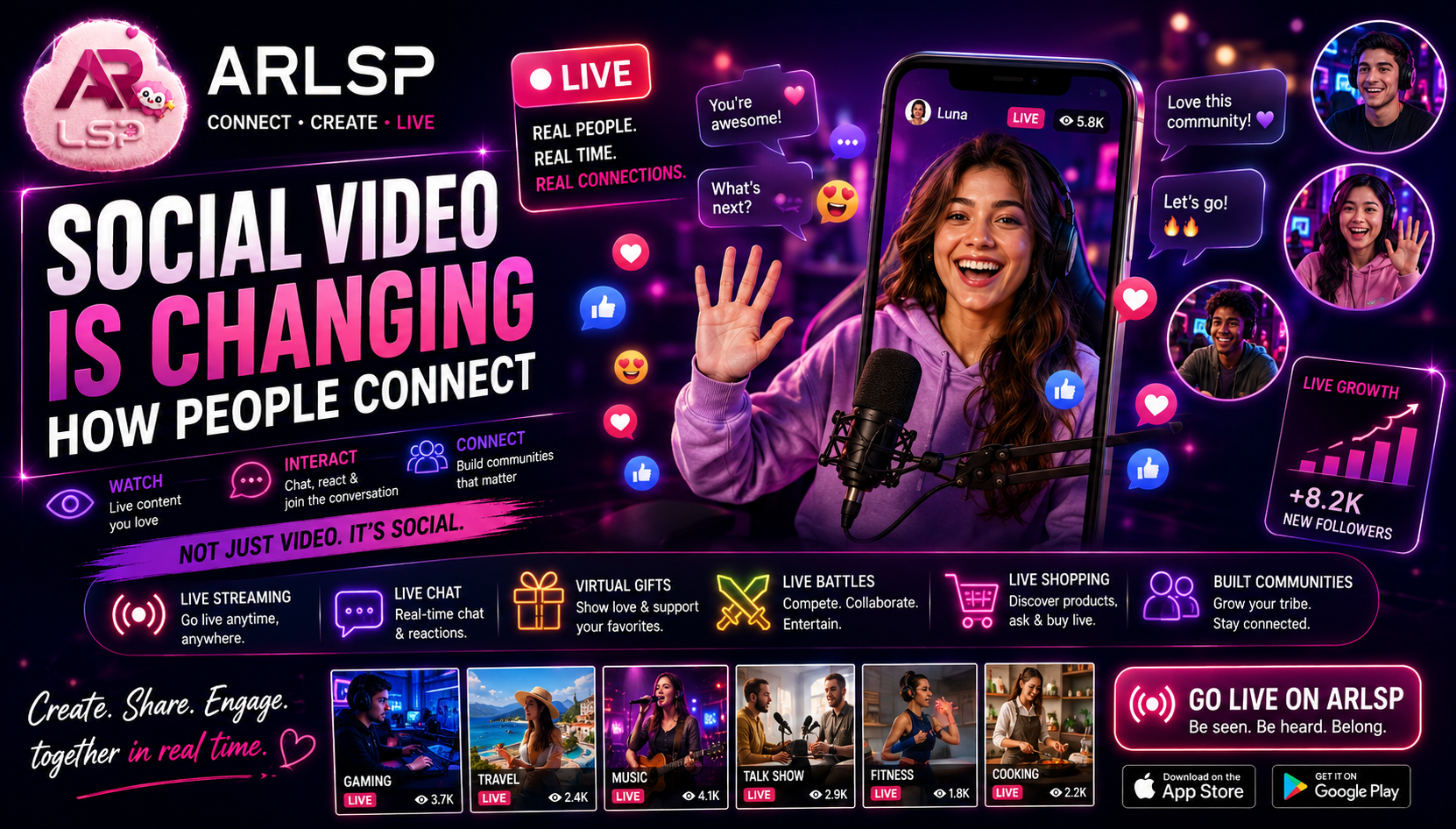
ARLSP sits naturally at the intersection of several of these trends.
It is not simply about broadcasting video.
Its broader ecosystem can combine:
Live streaming
Creator communities
Social interaction
Virtual gifts
Creator coins
Live Battles
Messaging
Notifications
Live shopping
Audience engagement
That creates an environment where video can become social rather than simply something people watch.
A creator can go live.
Viewers can join.
People can interact.
Communities can form.
Creators can explore different ways of engaging their audiences.
ARLSP Is Not Limited to One Content Category
One advantage of a broad live-social platform is that creators don't necessarily have to remain inside one category.
A creator might start with gaming.
Then create entertainment content.
Then travel.
Then host a community conversation.
The audience follows the creator across interests.
This creates a more flexible creator identity.
For example:
Gaming Creator
→
Gaming Livestream
→
Community
→
Entertainment Stream
→
Travel Stream
The creator becomes the common connection.
Live Battles Add a Social Competition Layer
Competition naturally creates engagement.
ARLSP's Live Battle feature allows creators to compete in a live environment while audiences participate.
That changes the experience from:
Creator → Audience
to:
Creator A ↔ Creator B
with:
Audience → Interaction
around the competition.
This can create exciting moments without requiring the audience to be playing the game themselves.
Virtual Gifts Add Another Interaction Layer
Virtual gifting can give viewers another way to support creators.
Instead of only watching or commenting, viewers can use platform-supported virtual gifts as part of the interaction.
For creators, this can become part of the broader creator monetization model.
For viewers, it can become another form of participation.
The important point is that monetization becomes connected to the social experience.
Building a Social Video Community
A creator shouldn't think only about:
"How many people watched?"
A better set of questions can be:
How many people returned?
How many interacted?
How many followed?
How many joined the community?
Which content created the strongest conversations?
Which viewers became regular participants?
These metrics tell a deeper story.
A creator with fewer viewers but a highly engaged community may have a stronger foundation than someone receiving large numbers of passive views.
The Social Video Funnel
A useful creator funnel can look like:
Discovery
↓
Short Video / Trending Content
↓
Profile Visit
↓
First Livestream
↓
Interaction
↓
Follow
↓
Community
↓
Returning Viewer
↓
Active Participant
↓
Creator Support
This is one reason short-form video and livestreaming work well together.
Short content can create discovery.
Live content can create relationships.
Why Short Videos and Livestreams Should Work Together
A creator doesn't have to choose between short videos and live streaming.
They can use both.
Short Videos
Purpose:
Reach
Livestreams
Purpose:
Engagement
Community
Purpose:
Retention
So the broader system becomes:
Reach → Engagement → Retention
This is much more powerful than treating every video as an isolated piece of content.
Turning Live Streams Into Social Content
A livestream can generate many smaller pieces of content.
For example:
Livestream
↓
Funny Moment
↓
Short Video
↓
Social Post
↓
New Viewer
↓
Next Livestream
This creates a continuous content loop.
Creators don't have to start from zero every time they want to publish.
The Social Video Flywheel
A strong creator ecosystem can look like:
Create
↓
Go Live
↓
Interact
↓
Build Community
↓
Create Clips
↓
Reach New People
↓
Bring Them Into the Live Stream
↓
Build Stronger Community
↓
Repeat
The more effectively this loop works, the less dependent a creator becomes on individual viral posts.
What Makes Social Video Successful?
There are several important ingredients.
Relevance
People need a reason to care.
Personality
People connect with people.
Interaction
Audiences want participation.
Consistency
Communities grow through repeated experiences.
Authenticity
People can recognize overly artificial content.
Discovery
Great content needs a path to new viewers.
Community
Long-term audiences need somewhere to belong.
Common Mistakes Creators Make
Posting Without a Purpose
Every piece of content should have a reason.
Ignoring the Audience
Social content should feel social.
Focusing Only on Views
Views don't always represent audience quality.
Never Going Live
Recorded content can reach people, but live video creates deeper interaction.
Going Live Without Structure
Spontaneous doesn't have to mean directionless.
Over-Promoting
People join for value and entertainment first.
How New Creators Can Start With Social Video
A creator doesn't need a huge audience.
Start with one subject.
For example:
Gaming
or
Travel
or
Comedy
or
Education
Then create a simple system.
Step 1
Create short videos.
Step 2
Invite viewers to a livestream.
Step 3
Interact during the livestream.
Step 4
Build relationships with returning viewers.
Step 5
Turn the best moments into more videos.
Step 6
Repeat consistently.
This creates a content system rather than random posting.
A Simple Weekly Social Video Strategy
Monday
Short educational or entertaining video.
Tuesday
Community interaction.
Wednesday
Live stream.
Thursday
Clip from livestream.
Friday
Short-form trend or reaction.
Saturday
Longer livestream or collaboration.
Sunday
Community discussion or recap.
The exact schedule can change.
The principle is:
Discovery + Live Interaction + Community + Repurposing.
The Future of Social Video
The next stage of social media isn't necessarily about creating more content.
It's about creating more interactive content.
The evolution looks something like:
Text
↓
Images
↓
Video
↓
Short Video
↓
Live Video
↓
Interactive Live Video
↓
Creator Communities
The more interactive the experience becomes, the more important the relationship between creator and audience becomes.
Why This Matters for ARLSP
ARLSP's opportunity is not simply to compete for another place in someone's video feed.
The broader opportunity is to create a destination for interactive creator experiences.
A viewer can discover a creator.
Join a livestream.
Interact with the community.
Watch a Live Battle.
Send virtual gifts.
Explore other creators.
Participate in conversations.
Discover different types of content.
That is a different proposition from simply watching another video.
The objective is to turn:
Video Consumption
into:
Video Participation.
Frequently Asked Questions
What is social video?
Social video is video content designed to be discovered, shared, discussed, and interacted with within social environments.
What is social live streaming?
Social live streaming combines real-time video broadcasting with audience interaction, conversations, reactions, and community participation.
Why is live video more interactive?
Because creators and audiences can communicate while the content is happening.
Can social video include gaming and travel?
Yes. Gaming, travel, entertainment, education, music, lifestyle, and many other categories can become social video content.
Can creators make money from social video?
Depending on the platform and eligibility, creators may have opportunities involving virtual gifts, sponsorships, live shopping, affiliate activity, subscriptions, or other monetization models.
How can creators grow a social video audience?
Creators can combine short-form discovery content, consistent livestreams, audience interaction, collaborations, community building, and content repurposing.
What makes ARLSP different?
ARLSP combines live streaming with social interaction and creator-focused features such as Live Battles, virtual gifts, creator communities, messaging, and other interactive experiences.
Final Thoughts from Arlsp.com
Social media started by helping people connect through posts.
Video made those connections more visual.
Live streaming made them real-time.
Now interactive social video is bringing those elements together.
The creator is no longer simply publishing something for an audience to consume.
They can invite the audience into the experience.
They can talk with them.
Respond to them.
Compete with them.
Build communities with them.
And create experiences that continue beyond a single video.
That is the opportunity behind social video.
For creators, it means building deeper relationships.
For audiences, it means becoming participants rather than passive viewers.
And for platforms such as ARLSP, it creates an opportunity to bring video, live streaming, social interaction, entertainment, creators, and communities together in one ecosystem.
The future of social video may not simply be about what people watch.
It may increasingly be about who they experience it with.